The Shameful Power of Lies

I refuse to believe that the truth no longer matters. I refuse to believe that the truth is simply what I choose to believe. I’m loath to admit it, but a clear-eyed look at world politics today and examples from the past suggests I’m wrong. Too many lies have been casually accepted as truth and too many lies have sparked monumentally consequential change.

A young George Washington never cut down a cherry tree or confessed with the line we all know: “I cannot tell a lie.” Biographer Mason Locke Weems made no mention of the tale in the first five editions of The Life of George Washington but the incident suddenly appeared in the sixth. Weems made it up. Similarly, there was no gift-horse, filled with soldiers, with which the Greeks duped the Trojans. Nero did not play the violin as Rome burned. When leaving the room, Galileo did not mumble, “But it does move.” Newton’s work on gravitation was not inspired by a falling apple. Benjamin Franklin never flew a kite in a lightning storm. I could go on.

Lies such as these have been repeated as fact by so many and for so long that they’ve become accepted as true. Joseph Goebbels would understand. As Hitler’s propaganda minister, he said a lie becomes truth when forcefully presented and repeated. Donald Trump certainly understands.

Politico.com studied Mr. Trump’s 2016 campaign speeches and determined that, on average, he lied once every five minutes and sometimes twice in a single, rambling, non-sequitur littered sentence. He lied about having seen thousands of Muslims in New Jersey celebrating the 9-11 attack. He lied about MSNBC distorting his views by editing his statement on abortion. He repeatedly lied about America’s crime rate being higher than ever, about GDP growth being zero for the previous two quarters, and about the United States having the world’s highest corporate taxes. All the lies were shown to be lies but it didn’t seem to matter. Mr. Trump won the presidency. He continues to lie. He recently said there are 96 million unemployed Americans but that counts retired folks and kids in school.

Do the lies that inform so much of what we think we know about our past and Mr. Trump’s successfully lying his way to the White House prove that we don’t care about the truth? We should. Because sometimes lies bring about changes that are enormously consequential. Consider two examples.

President Truman said he approved the dropping of atomic bombs on Japan to save the lives of American soldiers who were preparing to invade the island. With each subsequent interview, Truman’s estimate of the number of men saved went up. He couldn’t quantify it because his justification was a lie. Truman had been advised by the scientists who created the bomb that its use would be immoral. A number of generals and military advisors, including future president General Dwight D. Eisenhower, said it was unnecessary. Japan was on the verge of collapse. All its major cities had been incinerated. The Soviet Union had declared war and was moving on Japan. Japanese leaders were preparing to surrender and Truman knew it.

But the bomb was not really about Japan. Truman agreed with Secretary of State John Foster  Dulles and other advisors that the bomb had to be dropped to brandish its power, especially to the Soviet Union, which they had decided to turn from ally to enemy. They had to demonstrate that America would dominate the post-war world. And so the bombs fell. Months before, Japanese leaders had offered to stop fighting with the condition that Emperor Hirohito stay in place but the Americans refused with their insistence on unconditional surrender. With the atomic bombs suitably displayed, Truman accepted the surrender terms that had been unacceptable before. Hirohito remained. The war ended. But Truman’s lie unnecessarily murdered 150,000 people in Hiroshima and 75,000 in Nagasaki with hundreds of thousands suffering life-altering wounds and horrifying birth defects.

While Truman’s lie involved the end of a war, other lies have started them. The Iraq War was based on the lie that Saddam Hussein had weapons of mass destruction. He didn’t. In 1964, Congress gave President Lyndon Johnson unrestricted power to wage war in Vietnam after an attack on the American destroyer USS Maddox. But the attack didn’t really happen. The lies are disturbing but sadly, tragically, not rare.

At 9:40 in the evening, on February 15, 1898, a tremendous explosion sent a fire ball into sky above Havana’s harbour. The American battleship Maine, which had been anchored there as an expression of American power, had exploded. The ship was destroyed. Its burning, shredded hulk sank, and 266 Americans lost their lives.

Cubans had been rebelling against their Spanish colonial masters in a low-level guerilla war. Thousands of Cuban refugees had been working from new homes in Florida and New York to entice America to intervene on their behalf. After all, they argued, the Monroe Doctrine said that the United States considered the western hemisphere its back yard and would take action to keep countries stable and Europe out.

Powerful newspaper owners had joined their fight. The New York Journal’s William Randolph Hearst and the New York World’s Joseph Pulitzer were in a circulation war and both saw a Cuban war as their ticket to victory. They both had reporters in Cuba before the explosion writing articles that urged President William McKinley to take military action. Two days after the Maine explosion, Hurst’s Journal ran the headline: “Destruction of the warship Maine was the work of the enemy.” The next day, an article quoted unnamed naval men as believing that a Spanish mine had caused the explosion. Hurst offered $50,000 to anyone who turned in those responsible for the mine. Readership soared.

Thousands of Americans wrote to their president demanding a war of revenge with Spain. Militia groups formed and volunteered to leave immediately. Men yelled “Remember the Maine and to Hell with Spain!” as they swamped recruitment offices. Congressmen joined the jingoist parade, declaring that American honour had to be respected. A March 28 Naval Court of Inquiry moved with lightning speed to conclude that the Maine had indeed been downed by a mine. President McKinley was suspicious of the evidence but the mounting political pressure was enormous. He acquiesced. In April, the United States declared war on Spain.

The war lasted only ten weeks. The most famous battle was the taking of San Juan Hill by the Rough Riders, a rag tag group of cowboys, college students, and ex-convicts organized by Assistant Secretary of the Navy Theodore Roosevelt, who had quit his post to join the fight. The war was won when the American navy destroyed Spain’s Atlantic fleet in the Philippine’s Manila Bay. About 2,000 Americans died in the war, all but 385 of disease. About 60,000 Spanish and Cuban soldiers and civilians died. America’s victory led to the Paris Treaty which gave Cuba its independence and ceded the Philippines, Guam, and Puerto Rico to the United States.

The war’s second phase began when Filipino nationalists insisted on independence rather than trading one colonial master for another. When rebuffed, they shouldered rifles. The fighting lasted three years and took the lives another 4,200 Americans and over 20,000 Filipino combatants. The war also saw about 200,000 civilians die from war-related famine, violence, and disease.

The Maine attack and wars that followed entered American civic understanding alongside Washington’s hatchet and Franklin’s kite. They were true because they were believed to be true. But the truth is stubborn.

In its rush to not really investigate but simply confirm the mining of the Maine, the US Naval Court of Inquiry had refused to hear from a number of experts. Included among them was Navy ordnance professional Philip R. Alger. He told the Washington Star that the explosion’s power and ship’s wreckage suggested that the blast had originated with a fire in the Maine’s engine room that ignited its magazine, the room where ammunition and gun powder was stored. In fact, another naval inquiry had reported only a month before that designers of ships such as the Maine had put magazines too close to coal-fired engine rooms. This was alarming because coal bunker fires were a regular problem on naval ships at the time and it had been found that those carrying bituminous coal, like the Maine, were far more likely to suffer spontaneous engine room fires than those carrying anthracite coal. Those salivating for war knew all this but ignored it as they silenced Alger.

In 1974, Admiral Hyman G. Rickover initiated an inquiry into the Maine’s sinking. American, Spanish, and Cuban records were scoured and experts on ship explosions were interviewed. The study concluded that “without a doubt” the Maine had been sunk by a spontaneous combustion fire in her engine room that ignited the magazine. The Spanish had nothing to do with it. Wars had been fought in Cuba and the Philippines, thousands had died, the Spanish empire had shrunk, the American empire grew, and Roosevelt’s political career took flight, all because of a lie. It was a lie the American media helped create and then exploit and that the American people were too willing to believe.

Today, in the revered Arlington National Cemetery, just across the Potomac from Washington, lay the remains of over 14,000 American veterans. On a hilltop near the Tomb of the Unknown Soldier, towers a gleaming white mast. It’s the Maine’s mast. In 1915 it was salvaged and erected atop a large concrete base resembling a ship’s turret. The mast throws a shadow over the respected dead laying nearby while serving as a monument to the power of lies.

power-of-lies-memorial

Maine Memorial (Photo Arlington National Cemetery)

Lies led to the dropping of the world’s worst weapons, were cynically employed to elect a president and used to start unnecessary wars. Lies ended lives and changed the world. It is said that we live in a post-truth era. No. No! We can’t afford that luxury, that embarrassment, that threat. Ignorance is not bliss, it’s dangerous. Ask those resting in American military cemeteries laid there by lies or the ghosts haunting Cuba, the Philippines, Japan, Iraq, and Vietnam. Ask Joseph Goebbels.

The media has an awesome responsibility as the citizens’ eyes, ears, and conscience. It must question and say no to power and not be its poodle. Rewriting press releases is not journalism. The media cannot, as Hearst did, and as Fox and others do, report lies or fashion lies of their own for ratings, clicks, and sales while making us dumber and less safe. We must join the media in robbing lies of their power by calling them what they are and calling out those who either don’t speak the truth, don’t seem to care, or don’t know the difference. We deserve the truth. We can handle the truth. We must demand it.

If you enjoyed this column, please share it with others and consider leaving a comment.

Is Every Child Your Child? A Tale of Courage and Determination

Is every child my child? Does ideology end at the bedside of a sick child? I ponder those questions every day when I watch the bravest person I know – my granddaughter. Consider this:

A healthy, happy little boy was suddenly insatiably thirsty. He began urinating a lot and often and feeling increasingly tired. His skin became thin and dry. No matter how much he ate, he continued to lose weight. A few months later he was weak, gray, and skeletal. His eyesight weakened and then his retinas detached rendering him blind. Within nine months, the now bedridden child gasped for air. Less than a year after falling sick, he slipped into a coma and, mercifully, died.

The sad part to this tragic tale is that it was not rare. Ancient Egyptians, Greeks, Chinese, and Indians saw children and adults die in this horrible, mysterious fashion. A first-century Greek researcher, Arataeus of Cappadocia, described the disease as “the melting down of flesh and limbs into urine.” He used the Greek word for “passing through” or “siphon” to name it: diabetes.

For hundreds of years, researchers were stymied. It was suggested that diabetics eat things that the body would have to fight to turn to urine such as almonds and broken bits of coral. It didn’t work. Seventeenth-century Scottish researchers developed a diet treatment in which patients ate nothing but blood puddings, fat, and rancid meat. It didn’t work. In the 1800s, doctors bled diabetics; every day for a week or so, a vein would be opened and pints of supposedly bad blood was drained. It didn’t work. In the early 1900s, diabetic children were hospitalized and fed only 450 calories a day. They were starved to death. German scientists found that eating carbohydrates was linked to symptoms and so they locked up diabetic children and force fed them oatmeal. Nothing worked.

An import step came when German researchers used autopsy studies to link diabetes to the pancreas. The pancreas is a small seahorse-shaped gland that lies between the stomach and spine. You can locate it by pressing your right thumb and little finger together, keeping your other fingers straight and together, and then placing your thumb at the centre of your stomach, even with your lowest rib. Your three extended fingers now approximate the location and size of your pancreas.

German researcher Paul Langerhans advanced learning by postulating that the pancreas produces two types of cells. One is secreted into the small intestine and aids with digestion. He called them external cells. The other is secreted into the bloodstream to regulate glucose levels. He dubbed them internal (later the islets of Langerhans).  It was postulated that without the internal clusters of cells, sugars could not be metabolized from food and so suger entered the blood stream and gathered in increasingly high levels as the body could no longer clean and flush it out. Then the awful symptoms began.

It was a breakthrough but for decades afterward, researchers tried but failed to find a way to utilize the new understanding by artificially doing what a dead pancreas could not – extracting cells from a healthy a pancreas and injecting them into a diabetic patient. People continued to die.

blood-sugar-research-and-hope

Photo: Queen’s University

Frederick Banting grew up on a small Ontario farm. He undertook medical training at the University of Toronto. After service as part of Canada’s First World War Army Medical Corps, and becoming both wounded and decorated, he became a surgeon in Toronto. He later opened a small practice in London, Ontario. The 29-year-old was barely eking out a living.

In the middle of a sleepless night, he was reading a medical journal about diabetes research when he experienced a eureka moment. It appeared clear to him that when extracting secretions from the pancreas, researchers were missing the possibility that external secretions were damaging the internal secretions. The two had to be separated, he thought, and then a serum could be developed using only the internal secretions.

The next weekend, he arrived without an appointment at the office of the University of Toronto’s professor of physiology, J. J. R. Macleod, who was famous for his work on the metabolism of carbohydrates. McLeod listened patiently but was unimpressed by the young man with little knowledge of current diabetes research, without a Ph.D., and with no clinical research experience. After several more visits, Banting was about to give up when he saw the professor lean back and close his eyes. But then, McLeod leaned forward, smiled, and said the idea just might work.

In April 1921, Banting arrived at McLeod’s small lab. He met fourth-year student Charles Best who would assist. They used dogs. Banting removed the pancreas of some to induce diabetes. He removed part of the panaceas from others and then, with blood vessels still in place, sewed the severed portion just below the skin of the abdomen. He then tied off, ligated, the grafted portion and waited for the external cells to die. Internal cell clusters were then extracted, purified and processed using water at first and, as they learned more, alcohol. They then injected the extraction into depancreatized dogs. Some showed slightly positive reactions but most didn’t. Many died. The determined Banting and Best slaved away in the smelly, sweltering lab, painstakingly honing the process of removing impurities from the extracts.

In July, after a number of revisions and failed experiments, they injected a depancreatized white terrier with duct-ligated extract. Blood sugar levels dropped from dangerous highs to near normal levels. With their extract in its body, the dog was metabolizing sugar as if its pancreas was still there. Unable to estimate the amount of extract necessary, the dog died. They learned. They injected another dog that had fallen into a diabetic coma with new extract and marveled as the dog awoke, wobbled to its feet, and then walked about the room. Banting and Best were ecstatic. They called their extract Isletin.

A month later, shortly after MacLeod’s return from an extended absence overseas, Banting stormed into the professor’s office with a list of demands including a salary, more assistance, and changes to the lab. A young man was hired to tend to the dogs, biochemistry professor James Bertram Collip joined the research team, a bigger lab was found, back pay for Banting and Best was paid, and a university lecturing job was found for Banting who at that point was just a few dollars from destitution.

Research moved more quickly when Banting began using the pancreas of unborn calves that he procured from local abattoirs. The diabetic dogs began responding better and living longer. Finally, it was time

His name was Leonard Thompson. He was 14 years old. He was from a poor family and so was a public ward patient at the Toronto General Hospital. His diabetes had been diagnosed nearly two years before. He was emaciated and near death. He weighed only 65 pounds. His skin was gray, he could no longer walk, and had trouble focussing and even staying conscious. Banting explained the extract trial to Thompson’s father who quickly consented.

On January 11, 1922, two doses of isletin extract were injected into young Thompson’s backside. Thompson was too ill to even flinch. The sugar in his blood and urine dropped by 25%. It was good but not great. The disappointing results were deemed the result of impurities in the extract and so they went back to work with Collip whipping up batches like a chef trying new recipes.

Two weeks later they walked back across the street to Toronto General Hospital’s H Ward. Leonard’s condition had worsened. He was now fading in and out of a coma. The boy was given two injections that afternoon and one the next morning. It worked. Miraculously, he sat up. He smiled. The fog that had haunted his eyes for so long suddenly cleared. He asked for food. Leonard was Lazareth.

Banting opposed patenting what they were now calling insulin. He insisted that medical advances belonged to all and were for the good of mankind. A patent was eventually applied for in the names of Best and Collip and with the direction that it would be assigned to the University of Toronto. It was written so anyone could use their process to manufacture insulin but that no one else could patent the process. It thereby deprived anyone from stopping anyone else from manufacturing insulin. American legalities later led to Banting’s name being added to the patent.

True to Banting’s principles, the Indiana-based Eli Lilly and Company was afforded an exclusive deal to manufacture insulin in the United States but for the first year it had to be distributed free of charge. Toronto’s Connaught Laboratories manufactured and distributed free insulin in Canada. It was also agreed that the university would happily send the formula to any researcher in the world for free, in return for a promise that insulin would not be produced for sale.

By the end of 1923, diabetes patients in Canada, the United States, and parts of Europe were receiving insulin injections. Each represented an inspiring and heartrending story of recovery as they stepped back from death’s door. The 1923 Nobel Prize for Physiology or Medicine was awarded to Banting and McLeod. McLeod shared his prize money with Collip and Banting shared his with Best.

Among the millions of lives that have been saved by the work of Banting and his Toronto colleagues, and those upon whose shoulders they stood, is my granddaughter. She’s eight years old. For three years now she has pricked her thumb to draw then test blood six to ten times a day. It hurts every time. Trust me, I’ve done it, and it hurts. She now injects herself with insulin six or more times a day. She watches what she eats and her Mom counts every carbohydrate consumed to adjust insulin dosages. It’s an awful disease but it doesn’t define her. Before the work of Banting, Best, and the others, though, it would have killed her.

We know now that type two diabetes is mostly contracted by adults and mostly due to lifestyle choices. But type one attacks children. No one knows why. For some reason, a virus that gives some kids a cold kills the pancreas of others. Today, over 420 million people around the world and about 10% of Canadians have diabetes. Most have type two. About 26,000 Canadian children have type one.

And so we are back to our initial question. God bless the determined researchers who are working in labs every day, uncelebrated, and often underfunded and underpaid. And God bless those who support the idea that our circle of community involves devoting charitable giving and a sliver of our tax money for research. We are helping people we’ll never meet. We are making all children ours. We are saying where ideological arguments should die so that fewer children will; at the bedside of a sick child.

Someday the cure for type one diabetes will be found. Banting and Best will be remembered. And on that day, I will stand with my granddaughter, and we will cheer.

If you enjoyed this column, please share it with others, consider leaving a comment, and checking out my other columns at http://www.johnboyko.com

Embers: Warnings Offered by Our Anti-Semitic Past

On a cool April 16, 1933, ball players warmed up at Toronto’s Willowdale Park. Like nearly everything else in the city, the teams were ethnically segregated and so a Jewish team faced an Anglo-Saxon opponent. A Nazi flag was unfurled and anti-Semitic abuse was screamed. The chanting young men left, pausing only to paint a swastika on a park building. Two nights later the Jewish team was back and so were the angry young men. As the flag returned and taunts began, a scuffle ensued. Cars filled with supporters of both sides screamed to the scene. Pipes and bats were swung. Bones and teeth were smashed. Blood flowed as an hours-long riot spilled into the streets.

Newspapers suggested that the Jewish community was to blame for what they dubbed the Christie Pitts Riot. Editorials insisted it was an aberration and that anti-Semitism did not exist. City council promised to address Toronto’s many Swastika Clubs. But nothing was done. To deny a cancer is to allow its growth or a lanced tumour to return.

canadas-anti-semitism-and-warnings-for-today

Canadian anti-Semitism is a long, sad tale. It began with Esther Brandeau. She had disguised herself as a man to secure passage on a ship but her identity was revealed in 1738 upon her arrival in Quebec. The deception was fine but her Jewishness was not. According to the French and Quebec law, she was banished. The British Conquest changed the laws but not mindsets. A Jewish man named Ezekiel Hart was elected to represent Trois-Rivières in Lower Canada’s legislative assembly. He was ejected with a resolution stating, “Anyone professing the Jewish religion cannot take a seat nor sit nor vote in the House.”

Canada’s prime minister, Sir John A. Macdonald, perhaps believing he was being liberal in his attitude rather than perpetuating a stereotype, said, “A sprinkling of Jews in the North-West would be good. They would at once go in for peddling and politiciking, and he is of as much use in the new country as cheap jacks and chapman.” Goldwin Smith, the influential public intellectual who was among the founders of Canadian liberalism, wrote a number of anti-Semitic articles advocating the deportation of Jews. He wrote, “Few greater calamities perhaps have ever befallen mankind than the transportation of the negro and the dispersion of the Jew.” Clifford Douglas advocated a Jewish-free Canada in Social Credit, the book that led to the creation of the Social Credit Party that formed Alberta’s government. Henri Bourassa, the father of Quebec nationalism, stated, “The Jews are the most undesirable class of people a country can have…they are vampires on a community instead of being contributors to the general welfare of the people.” While he later renounced racism, Quebec’s powerful Abbé Lionel Adolphe Groulx never did. The widely-read periodicals he edited and sermons he influenced were virulently anti-Semitic and bathed a generation of Quebec Catholics in a racist cauldron.

With the sanctioning of Canada’s elites, it is hardly surprising that anti-Semitism weaved itself into society’s fabric. Many universities restricted Jewish enrollment or banned Jewish entry into certain programs. A Quebec program called achat chez nous promoted the boycotting of Jewish businesses. Golf and other private clubs banned Jewish membership. Signs proclaiming “No Jews Allowed” were seen at many beaches, hotels, parks, and restaurants across Canada.

In July 1939, 917 German Jews aboard St. Louis sought refuge in Canada after being denied sanctuary elsewhere. In cabinet and House debates, it was explained that if turned away they would end up back at Hitler’s mercy. They were turned away. Deputy Minister of Immigration Frederick Blair was asked how many Jewish people Canada should accept. He replied, “None is too many.” The ship left. Over two hundred people that we could have saved perished in the gas chambers. Hitler’s Holocaust was the shrinking of the sentence: You cannot live among us as Jews. You cannot live among us. You cannot live. We were participants in the shrinking sentence and withering humanity.

Canadians should feel proud of promoting not just tolerance but the acceptance and celebration of differences. But we need vigilance. Those who fan hatred’s embers are among us now, speaking of immigration restrictions and Canadian values tests. They are speaking in code at the moment but as Mr. Trump has demonstrated, it is a short step from code to clarity and far too easy to spark racist embers to flames.

Let us beware of the future by being aware of the past. Let it serve as warning and invitation to reject those who promote a return to a dark version of ourselves that deserves to remain in the past and never, ever return.

If you found this column of value, please share it with others. I tell a fuller story of Canadian anti-Semitism in Last Step to Freedom: The Evolution of Canadian Racism, available online through Chapters-Indigo and Amazon. https://www.chapters.indigo.ca/en-ca/books/last-steps-to-freedom-the/9781896239408-item.html?ikwid=john+boyko&ikwsec=Books&ikwidx=5

An Election Really Rigged – Part One

We Canadians are a smug lot. For the last while, we’ve pressed our noses to the window on our southern border and been shocked and chagrined by the gong show masquerading as a presidential election. We’ve been stunned by, among other things, all the talk of rigged elections and secret shenanigans. Let’s get over ourselves. Let’s consider a Canadian election that was truly rigged. First, let’s see how the Americans helped topple the Canadian government.

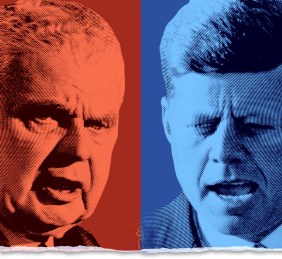
President John F. Kennedy hated Canadian Prime Minister John Diefenbaker. Their political difference would have put them at odds even if they had gotten along famously. The final straw in the feisty fight was Kennedy’s rage over Diefenbaker’s failure to offer enthusiastic and unreserved support during the October 1962 Cuban Missile Crisis. Kennedy needed the Canadian government changed. He usually got what he wanted.

Raffi final

Photo:Toronto Star

Strike One: Two and a half months after the Cuban crisis ended and the world returned to the gritted-teeth peace, NATO’s Supreme Allied Commander General Norstad ended his career with a tour of alliance capitals. On January 3, 1963, he arrived in Ottawa. Resplendent in his medal-bedecked uniform, Norstad made a brief statement and then, in response to reporters’ questions, suggested that Canada’s prime minister was a liar. He had been lying, the general said, about a number of things including the need for Canadian troops in Europe to have American nuclear weapons.

Many newspapers and people had already turned on Diefenbaker but Norstad’s stunning declaration turned more. A few days after igniting the firestorm, Kennedy welcomed Norstad to the White House, pinned a Distinguished Service Medal on his chest, and praised him for displaying “great skill” and “sensitivity” in his diplomacy and especially for having, “…in a unique way held the confidence of our allies in Europe and, of course, our partner to the north, Canada.”

Strike Two: Amid withering attacks from all sides, Diefenbaker rose in the House of Commons to explain and defend his government’s nuclear policy. He concluded that his government’s policies would always reflect Canadian interests and not those of “people from outside the country” who cared only for their own national interests.

The speech was a grand performance but confused more than clarified. It intensified questions about Diefenbaker’s leadership in the media and among his cabinet and caucus. The Americans then poured oil on the gathering flames. The American ambassador sped a message to the State Department in which he took specific exception to nearly every point Diefenbaker had made. The letter was reworked by National Security Advisor McGeorge Bundy and then Secretary of State Dean Rusk took it to the president. Kennedy agreed to the letter’s release saying, “We can’t let these fellows get away with this.”

Late in the afternoon of January 30, the State Department press release was given to Canadian reporters in Washington. It was astonishing. Point by point, it explained how Diefenbaker had misrepresented a range of issues and facts. Only three weeks after General Norstad had told the Canadian people that Diefenbaker was being disingenuous regarding nuclear weapons, Kennedy’s State Department, even more bluntly, had called their prime minister a liar.

In the House of Commons Diefenbaker thundered: “[Canada] will not be pushed around or accept external domination or interference in the making of its decisions. Canada is determined to remain a firm ally, but that does not mean she should be a satellite.” The fury of indignation led by media on both sides of the border forced Secretary of State Rusk to respond. Far from apologizing, he said that after hearing Diefenbaker’s speech the Kennedy administration was justified in laying out the facts. News of Rusk’s statement appeared on the front page of the New York Times and was reprinted in papers across Canada. Yet another high-ranking American, the third in three weeks, had called the Canadian prime minister a liar.

Kennedy called his special advisor George Ball twice that night to say that he understood the effects of his government’s action in Canada but that Diefenbaker deserved it. Ball confirmed that as a result of their interventions the Diefenbaker government could fall. Kennedy doubled down saying, “We should feed some…up there that Diefenbaker’s in trouble. We knew that he has always been running against us so that it’s very important.”

 Strike Three:  The growing tension brought all that had been tearing the Diefenbaker cabinet asunder to the fore. In an unprecedented shouting match meeting at the prime minister’s residence, the cabinet split and the defense minister resigned. Shortly afterward, Rusk appeared before the Senate Subcommittee on Canadian Affairs that had been called to investigate the State Department’s intervention into Canadian domestic political. Revealing that he obviously had an Ottawa mole, Rusk said that six or seven Canadian cabinet ministers were splitting from the prime minister. He then bluntly reiterated everything the State Department memo had said. For those keeping score, it was the fourth time a senior Kennedy administration official had publicly called Diefenbaker a liar.

Ottawa fell into chaos. There were bizarre late night meetings, hushed hallway conversations, private deal making, and public back stabbings. On the evening of Tuesday, February 5, for only the second time in Canadian history, a government was defeated on a vote on non-confidence. Diefenbaker visited the Governor General and the election was set for April 8.

The news sparked laughter and celebration at the White House. The American ambassador telegrammed the State Department to gloat about America’s role in having brought down Diefenbaker: “In effect, we have now forced the issue and the outcome depends on [the] basic common sense of Canadian electorate… we see grounds for optimism that over the long run this exercise will prove to have been highly beneficial and will substantially advance our interests.” Kennedy said nothing publicly about his administration’s role in the Canadian government’s fall. However, McGeorge Bundy later admitted to President Johnson, “I might add that I myself have been sensitive to the need for being extra polite to the Canadians ever since George Ball and I knocked over the Diefenbaker Government by one incautious press release.”

Let us not be naive. Politics is tough. Politicians will do things to advance their careers, political appointees will do things to support their bosses, and political leaders will do things to advance their agendas. Occasionally that leads one government to overthrow another with a violent revolution or coup. Sometimes, such as in Canada in 1963, it leads to a nudge through shaping perceptions and changing course.

Kennedy’s efforts in helping to overthrow the Canadian government would not have been worth it, of course, unless Lester Pearson and his Liberals won the ensuing election. The president would not leave that to chance. But that is for part two.

I have been away from my Monday blog for a while to complete my next book but I’m back. Part two of this story will appear next week with more in the weeks that follow. For more on Kennedy and Canada you could check out Cold Fire: Kennedy’s Northern Front which is available online and at bookstores throughout Canada and the United States.


Don’t Be Smug: Canada’s Racist Legacy

The recent gunshots in Dallas and echoing on many other American streets have reignited debates about state power and racism. It’s a 350-year-old argument with no sign of resolution. Canadians can learn a good deal from America’s twisting itself through its pain and search for solutions and redemption but should not feel smug. No one is clean. The history of systemic Canadian racism is too complex, long, and sad to consider here but let’s look briefly at one example to illustrate a point. Let’s look at Africville.

The bulldozers came in the morning. For days they roared like monsters demolishing houses and streets and even the church. They tore down what remained of Canada’s moral authority to say anything about race other than, “We were wrong.”

Africville was created in 1842 with land grants to African American families escaping slavery and discrimination with little more than the dream of better lives. The original sixteen single-acre lots overlooked the Bedford Basin and were separated from Halifax, Nova Scotia by a thick woods and impassable road. The community was called Campbell Road. As other Black families left the racism of Halifax and elsewhere seeking solace among friends it was dubbed ‘Africville’. The name stuck.

Links between Halifax and Africville grew over the years as kids were bussed to school and most of their parents worked in the city. Throughout the 1940s and 1950s, a number of famous people visited, including retired boxing champion Joe Louis and Duke Ellington, who married an Africville woman named Mildred Dixon. Folks were thrilled with the celebrities but understood that their hospitality was essential because while Louis and Ellington were feted in Halifax during the day they were unable to find lodging in the segregated city at night.

In that way, Halifax was no different than most other Canadian cities and towns. The Queen may have been Canada’s head of state but Jim Crow was boss. African Canadians grew used to restaurants where they could not eat, churches in which they could not pray, houses they could not buy, business licenses for which they could not apply, and schools their children could not attend.

Africvillephoto: Halifax.com

By the 1950s, Halifax had grown to nearly encircle Africville. City council embarked on a determined campaign to rid itself of the Black community that had become part of their city. Despite the fact that Africville’s people were Halifax citizens and paid municipal taxes, the road to and through the community was unpaved and in the winter it seldom saw a plow. There were no streetlights. There were no sewers. Families drew water from a central well that the city had dug as a “temporary measure” in 1852.

Police seldom patrolled and ignored most calls. In 1947, seven houses had been destroyed by fire because, although the fire department had been alerted, like usual, it had not responded. Insurance companies refused to sell home and property policies, so banks issued neither mortgages or home improvement loans.

Africville churchphoto: Halifax.com

Everything distasteful and dirty went to Africville. With no consultation with Africville’s citizens, and in defiance of petitions and presentations, Halifax council located in or adjacent to the community a pungent slaughterhouse, an oil refinery, and tar factory, a deafeningly loud stone crushing plant, and a hospital for infectious diseases. A railway company was allowed to build a line through the community and landowners were only partially compensated for expropriated land. The city dump was relocated 350 yards from west end Africville homes and then a smoke-belching incinerator was constructed nearby.

The disgraceful treatment of the community and the racism faced by those working in Halifax took its toll. Africville got tough. The “Mainline” portion of town was home to middle-class people who worked hard and did their best. The “Big Town” area, however, knew every crime and vice imaginable. The only white people who saw Africville came to Big Town for dirty old times after Halifax bars closed.

University of Toronto’s Gordon Stephenson wrote a report reflecting 1950s urban renewal practices. He recommended relocating Africville’s people and razing their homes. A 1962 Halifax Development Department report stated that the majority of Africville’s people did not want to leave; they just wanted the services that other Halifax citizens – White Halifax citizens – had enjoyed for decades. The report concluded, however, that the people should be ignored and the professor obeyed.

Concerned Africville citizens met at the heart of their community, the Seaview Church. Over a hundred people vowed to save their homes. Peter Edwards made an impassioned plea to city council on October 24, 1962. He spoke of Africville’s history and spirit. He spoke of the racist policies and treatment endured over the years and in the current process. “If they were a majority group,” he said, “you would have heard their impressions first.”

City council responded by hiring University of Toronto’s Albert Rose to again study the situation. No one was fooled. Rose had written Regent Park: A Study for Slum Clearance. They knew what he would say. In no time at all he said it. Africville was doomed.

Residents received an average of $500 for their homes. It was later discovered that additional assistance had been available but only 30% of the people were told about it and then only 15% of applicants were approved. People who had been self-sufficient homeowners were forced into a subsidized housing project and then forced to move again when told that even before they had been crammed into the ramshackle apartments, the complex had been scheduled for demolition.

By 1969, Africville was gone. The city had said it needed the land for industrial expansion but it never happened. It said it needed the land to construct a bridge but ended up using a sliver of the property.

In 1985, a monument was erected to the people of Africville in what had become the Seaview Memorial Park. The names of the original families were engraved in a stone. Family reunions began finding their way home with grandchildren being told the old stories. A former resident recalls, “Out home, we didn’t have a lot of money but we had each other. After the relocation, we didn’t have a lot of money – but we didn’t have each other.”

Africville lives. It lives as a symbol of the more than three hundred years of systemic racism that African Canadians endured and against which they struggled. In 2010, the Halifax City Council apologized to the people of Africville for all they did and did not do for the community. It apologized for Africville’s destruction.

A hectare of land was set aside and money allocated to rebuild the Seaview United Baptist Church. It will serve as a historical interpretive centre in a park renamed Africville. There, stories will be told of a time when racism coursed through Canadian veins and of a hope that someday, racism will be relegated to the dustbin of history. Someday.

If you enjoyed this column, please share it with others even buying my book entitled Last Steps to Freedom: The Evolution of Canadian Racism, that addresses the h. (Find it at Amazon or here at Chapters online: http://www.chapters.indigo.ca/en-ca/home/contributor/author/john-boyko/

A Nation of Festivals Making Us Better

We are a nation of festivals. There are film festivals, poetry festivals, rib festivals, art festivals, and every conceivable genre of music festivals. They are fascinating in like a conch blowing silently but convincingly through the ether they gather those of similar interests to form a temporary community. Festivals offer revelry in the acknowledgement that our particular passion is shared. My favourite are literary festivals. They intrigue me because they shouldn’t work.

Canadians read. Canadians read more books per capita than nearly anyone. A lot of folks enjoy books on tablets but most are sticking with the physical kind, the kind you can hold, smell, feel the joy of cracking for the first time, hold in bed without hurting your eyes, drop without breaking, and then shelve as a friend to share your home. Ok, I’m biased.

Canadians write. A generalization that is generally true is that all novels ask the question, “Who am I?” and all non-fiction asks “Who are we?” That Canada is blessed with so many talented writers asking both questions and so many readers reading all that stuff it is little wonder that we always seem to be in a state of existential angst and renewal. That’s a good thing. A reactive society is one of division and anger but a reflective society enjoys more consideration and compassion. Is this Trump versus Trudeau? Maybe that we read so much leads to our fighting so little.

The thing is, though, and the source of my fascination with writing festivals is that both writing and reading are solitary pursuits. Margaret Atwood once observed that you know you are a writer when you are typing away in your office in July about a winter scene and look up and out the window and wonder where the snow went. As an author, I know that feeling. Writing my history books often transports me back to the era that I am investigating and I quite honestly sometimes have trouble getting all the way back. I’m alone in my research. I’m alone in my writing.

But then, whatever I have written is released to the world. It is like I watch a young bird leave the nest. I wish it well. I always know some will like it. I always know some will attack it. I always hope the world will not just ignore it. It is up to the readers. Readers, of course, then buy what writers have spent so many hours silent and alone creating and devote more hours silent and alone to absorbing. Watch someone reading. They are not really there. They’ve been transported. Books are conduits of ideas from one solitary person to another.

The notion of two solitary experiences coming together for a community group hug is the source of my fascination with writing festivals. Writers blinkingly emerge from their writing dens with their pallid skin and reeking of coffee and wine and are suddenly before large groups and asked to talk about what they wrote, how they wrote it, and why they wrote it. For many, it’s like asking a fish to describe water. Readers emerge from their solitary reading spots to quiz the authors and each other about books and ideas. The isolation ends.

A Nation of Festivals

(Photo: Lakefield Literary Festival)

Festivals, like book clubs, lay out ideas to be examined as a community exercise. They remind us that books are like paintings and songs and any other art. Their meaning is only partially controlled by the artist. The rest is up to the experience and mood of the beholder. At festivals, the readers and writers both learn more about the books and ideas in question and about themselves. I am always intrigued when asked questions about my book that I never considered.

I have attended many but my favourite is the Lakefield Literary Festival. I am biased, of course, because I live in the Village of Lakefield. It is the Ontario community in what city people call “cottage country” consisting of only 2,400 people. Lakefield was once home to sisters Catherine Parr Trail and Susanna Moodie who were among Canada’s first writers and much later to Margaret Laurence who was among Canada’s best.

The Lakefield Literary Festival began in 1995 as a one-off banquet to celebrate Margaret Laurence but it became an annual event. It is now among Canada’s premier literary festivals, this year to take place over the weekend of July 15. It draws writers and readers from across the country to enjoy the campus of Lakefield College School and ideas and books and each other.

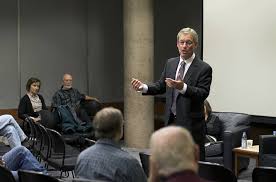
I will be at the Lakefield Literary Festival in a couple of weeks both speaking and teaching a writing class. I’ll be at Saskatoon’s Word on the Street Festival in September. I know I will enjoy both. I know I will enjoy meeting people who share a passion for writing, reading, books, and ideas. All those writers and readers at these and all the other literary festivals will emerge from their isolation. They’ll contribute to our national conversation by reflecting upon who we are as people and as a broader community. Perhaps all that isolated writing and reading and then all those festival conversations will play a role in making Canada a better place for us all.

If you enjoyed this column, please send it along to others. I hope to meet you in Lakefield in July or Saskatoon in September.

The Gordie Howe I Remember

Hockey filled my eight-year-old mind with wonder and possibility. Pictures of NHL players filled my bedroom walls. They posed as gladiators, armed and with the power of savage youth just behind their eyes. While there were many among them, one had a shrine – my hero – Gordie Howe.

Every winter my Dad flooded our backyard. It was the best rink the world, my little world anyway. It boasted boards and nets and benches and even lights for skating past bedtime. The neighbourhood kids gathered every afternoon after school and all weekend to become the players on our walls. I was always Gordie Howe. I had a number 9 Red Wings jersey, red pants and red socks. It was Roch Carrier’s The Hockey Sweater; a generation later and a province over.

me as Gordie Howe

(the author on his rink)

Gordie Howe was MVP 6 times and on the All Star team an astounding 22 times. He was a top 5-goal scorer for 20 consecutive seasons and amassed 801 goals. He was his own enforcer. A Gordie Howe hat trick remains a game with a goal, assist, and a fight. Off the ice, however, he was a gentle, shy, ambassador for the game and epitome of how one should wear celebrity. He often took sticks and pucks to hospitals where he visited children to sign autographs and pose for pictures. He never told the media. He did not do it because it would look good; he did it because it was good.

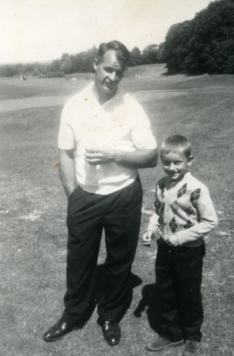
One day my Dad took me to an NHL charity golf tournament. We wandered a little until, oh my goodness there he was, and then, well, after that I really don’t remember. Mr. Howe rubbed my head and asked, “Do you play hockey?” I apparently looked up but could say nothing. Not a word. Mr. Howe asked, “What position do you play son?” I swallowed hard and I guess my lips moved but again not a word. I grinned for a picture with the clenched-fist excitement of an eight-year-old who, for him, had just met the equivalent of God, the Son, and Holy Ghost.

Gordie Howe has died. He’s gone. But for those of my generation he will always be young and strong: a giant of a player and honourable man. And a part of me will always be that skinny kid skating alone on a frigid night and begging Mom for just a little while longer; just a few more minutes to imagine himself bigger and better; just a few more minutes to be Gordie Howe.

Gordie Howe and I

(the author and Gordie Howe)

This article appeared in the Globe and Mail on June 14, 2016. RIP Mr. Howe.


A Speaker’s Rules on Speaking

I’m all about words. With the proper motivation, I’ll write them, speak them, and even sing them. I have long respected the transcendent power of the spoken word and studied public speaking to become better at it. As an author, book promotions have taken me across the country and I’m always humbled by an audience’s attendance and attention and moved by invitations to return. This is what my study and experience have taught me:

  1. The Backside Dictum: As with plays, concerts, and movies, the second you become aware of your ass, the best end has passed. Speakers must respect their audiences. Rather than doing myriad other things, people have opted to devote a sliver of their lives to you and must never regret the decision. Nearly all audiences are captive but must never feel like it. It is the feeling in their end that in the end will have them wish for the end and, consequently, that they should never have come.

Hint: Before approaching the podium, take pen in hand. On your left palm write BB and on the other write the time that your talk should end. BB stands for the primary principle of public speaking: Be brief and Be seated. If you discretely observe your palms throughout your talk you’ll be fine. After all, at the bar afterward (remember I mentioned proper motivation) you want to overhear, “I could have listened all night” and not, “it went on too long.”

A Speaker's Hints on Speaking

  1. The Three Rule: Western society rests on three. Every TV show, movie, or play you have ever seen is based on three. There is the introduction of setting and characters, then the conundrum, and then the resolution. Abner Doubleday understood when he, sort of, invented baseball – three strikes and you’re out and three outs and your team’s out. The three rule applies to public speaking for just like people can only remember seven numbers (that’s why phone numbers are structured like that) they can only remember three arguments. Every good speaker makes three points, not two, and certainly not four or more.

Hint: Whatever you are talking about, boil it down to three points. Each has evidence but never cite more than three. Be blunt. Say clearly that there are three points and number them as you speak. Tell them what you will tell them, tell them, and then tell them what you told them – that’s the three hint within the three rule. Of course you know more about whatever you’re on about but always remember that you want them to remember and they will never remember more than three points.

  1. The Show: The best way to demonstrate that you have something to say worth remembering is to remember it yourself. Never read. Reading is for politicians or others whose words are written by others. They are not really speakers at all; they are readers. Recall that the last half of Martin Luther King’s I Have a Dream Speech – the whole part about the dream – was off script. Robert Kennedy’s moving speech to an African-American audience in which he reported King’s assassination, one of the best speeches in American history, was extemporaneous. Recall every TED talk.

Hint: Memorize your opening lines. Memorize a few sound bites and, of course, your three points. After that simply explain what you know so well. If you think this stuff is interesting then the chances are they will too. Always ask for a lapel mic for without ties to a script you can move around the stage or among the audience. Without reading you can make better eye contact and your moving will force them to shift in their seats a little and that goes back to the backside dictum. Smile. Always be reading the room and silently editing. Make digressions like TV commercials, little breaks before the next part begins. Remember that those who don’t understand the marriage of speaking and entertainment understand neither. Finally, never say um or ah. Any such guttural sound indicates you have forgotten where to simply be silent for a moment suggests thought.

There is more but I remember the three rule. People crave the spoken word. It’s part of who we are. The spoken word pokes memories of bedtime books and the safe murmur of adult voices as we nod asleep. Its power rests gently in the poetry of persuasion. A good speaker honours childhood memories and adult intellectual curiosity. A good speaker understands that it’s the words and ideas that matter and so becomes like a good singer who never gets in the way of the song.

I’m off doing more speeches this week and will try to remember my own rules. Hopefully our paths will cross and you can tell me how I made out. Meanwhile, if you enjoyed this column, please consider sending it to others and checking my other work at http://www.johnboyko.com

Most Important Rock Groups Ever

Rock is art. Rock songs toy with time. Decades after first hearing it, a song will find its way to your radio and instantly transport you to a place and people. They are three-minute symphonies. They are novels with plot, theme, and character. Because rock songs matter, the groups that create them matter and so let us ponder our most important groups.

Most Important Rock Groups EverPhoto: www.picsfair.com

  1. Crickets and the Beatles

Sex spawned Rock ‘n’ Roll. Even the name was an African-American slang for sex. The early songs were blatantly sexual. Consider Good Rockin’ Tonight, Great Balls of Fire, and anything by Little Richard including his transvestite tale in Long Tall Sally. The Crickets and then the Beatles turned rock from sex to fun. The Crickets sang Oh Boy at the thought of merely seeing a girl and the Beatles just wanted to hold her hand.

More important was that they killed the old music industry. For decades, songwriters punched the clock each morning in small offices on Nashville’s Music Row and New York’s Brill building. They wrote the songs that A & R men pitched. The Crickets and Beatles proclaimed that from that point on, groups would write their own material.

  1. The Byrds and the Band

The Byrds married the rhythms and harmonies of the Beatles with the lyrical maturity of Bob Dylan. Many of their early songs were Dylan covers. Kids were surprised to learn that with Turn! Turn! Turn! they were dancing to the Bible’s Ecclesiastes 3:1-8. They certainly knew that Eight Miles High was about drugs.

Like the Byrds, the Band taught listeners that rock songs could move beyond girl-boy angst. They focussed on deeper matters. With The Weight, they wrote of the American Civil War’s pain and the century-long yearning for redemption. With Cripple Creek and many others, they sang of the joy in anti-establishment and anti-consumerist attitudes and behaviours.

  1. The Monkees and the Eagles

That’s right, the Monkees. Of course they were a made up band but they’re on this list because of Mike Nesmith. To quell his protests, he was allowed to produce two of his compositions for the first Monkees album. Papa Jean’s Blues and Sweet Young Thing were rock but also country. Unlike today’s country, which Tom Petty has said is bad pop with a fiddle, Nesmith’s songs were outlaw country before Waylon and Willie coined the phrase. Each Monkees album contained Nesmith country-rock songs and lots of kids were hearing the new genre because, in 1967, the Monkees outsold the Beatles and the Rolling Stones.

Before winning his casting call, Nesmith had been an MC at an L. A. club where he sang and introduced local talent. Among them was Linda Ronstadt and the Stone Poneys. Their first hit was a Nesmith country-rock song: Different Drum. After touring with Ronstadt, her band left and renamed itself the Eagles. They took country-rock to new levels. Marvel at their harmonies and stellar musicianship as you hear country and rock fusing seamlessly in Already Gone, Take It Easy, and Heartache Tonight. A string of hits and sold-out concerts taught folks that the line between rock and country is as illusory as that between the beer and wine of Saturday night and Sunday morning.

  1. The Beatles and the Beach Boys

After enjoying a string of hits, Beach Boys muse Brian Wilson surrendered the road for the studio. Although deaf in one ear from a beating his father inflicted in childhood, he meticulously coached LA’s Wrecking Crew through layers of overdubs until the music on the tape matched the vision in his head. The quirky arrangements and odd instruments, such as the theremin, were like no one had ever imagined. The result was God Only Knows, Good Vibrations, Wouldn’t It Be Nice and the album Pet Sounds.

I know the Beatles are on this list twice. So what, they earned it. When Paul McCartney heard Pet Sounds he drove to Lennon’s house and they accepted the challenge. The Beatles and their genius producer George Martin locked themselves in Abbey Road for months until their masterpiece was complete – Sgt. Pepper’s Lonely Hearts Club Band. There wasn’t a single single. That was the point.

FM radio was invented to allow rock music to graduate from commercial AM formats where songs were almost incidental to ads and DJ patter, to a place where albums could be played in their entirety. The Beach Boys and Beatles and their two albums raised rock music from disposable to art.

  1. Rolling Stones and Led Zepplin

Rock ‘n’ Roll was born in the delta blues of the American south and electric blues of Chicago. A teenaged Keith Richard was at a train station when he noticed a skinny kid with an armful of American blues records. Intrigued, he introduced himself to Mick Jagger. The group they created was named after a blues song and dedicated to bringing American blues to British and then back to American kids. When in America, they insisted on meeting not movie stars but Muddy Waters, Howling Wolf and their blues idols. Listen to Honky Tonk Woman or any number of others and try not to hear the blues.

Led Zepplin was more outrageous in their clothes, behaviour, attitude, and concerts than any group before and their music more ragged, innovative, and loud. All of that distracted from the fact that they were playing little more than operatic variations of the blues. Listen to Muddy Water’s Hoochie Coochie Man then consider the direct line to Whole Lot of Love. As Elvis had, the Rolling Stones and Led Zepplin reminded listeners of rock’s black roots.

  1. The Heartbreakers and the Clash

Rock survived the early ‘60s folk music scare but was nearly defeated by ‘70s disco. It was music untouched by human hands that appealed to neither head nor heart but rather the spinal chord. Some groups manned the cultural barricades and burned the white flag. Tom Petty and the Heartbreakers played music that reminded listeners of the best of the ‘60s but brought a power either not imagined or too long forgotten. Refugee, American Girl and many others pulsed with catchy hooks but just beneath the surface lurked desperate rage.

The Clash employed classic ‘60s models in musicians and song structures. Their songs bespoke the simple beauty wrought from three chords and the truth. They were based on the notion, as Heartbreaker guitarist Mike Campbell once said: “Don’t bore us, get to the chorus.” Their lyrics decried the phoniness of celebrity culture and the pain of Thatcherism. The Heartbreakers and the Clash saved rock music from disco’s circling of the cultural sink and reminded people of rock’s potency and potential.

  1. Pearl Jam and Nirvana

Every decade asks rock music to save itself from the industry of which it’s a part. Grunge did the deed in the ‘90s. Pearl Jam’s music harkened back to classic rock writing structures but it was rougher and more adventurous. Their lyrics were decidedly dark in addressing suicide, sexual abuse, and depression. They sacrificed untold millions to fight Ticketmaster and its greedy, gouging fees. It played stadiums and forced advertising banners to be covered and even tape to be placed over the beer logos on concession workers’ shirts.

Due to the suicide of its leader and lead singer, Nirvana recorded only three albums but that was enough to contribute to the move toward songs that jumped from one rhythm to another, from quiet, gentle sections to screaming raves, and yet stuck to the verse-chorus-bridge structure. Their unplugged concert proved that while bad songs can make fun records, only quality songs stand with credibility when stripped to acoustic instrumentation. Talent always trumps show.

Picasso once took a child’s sparkler and dashed a swirl that instantly vanished. A photographer caught it. There, slashing the darkness, was art. Most rock music is equally fleeting. Some groups, though, are like Picasso. Their concerts are the artist’s sparklers creating moments immediately gone. Recordings, though, are canvasses. They speak to artistic intention, society’s gaps, and a listener’s yearnings. Songs by any of the groups on the list are exactly the same as the day they were recorded but our world has changed, we have changed, and so the songs have changed with our evolving perception of their meaning. That we can visit as old friends is the beauty of art, of all art, but perhaps especially music.

Please consider sharing this with others on Facebook or elsewhere and leaving a comment as to groups I missed and which should not have made this list. You might also be a brute for punishment and check my previous columns where, perhaps as foolishly as above, I tackled:

6 Singers Who Matter Most https://johnboykodotcom.wordpress.com/2016/01/04/popular-important-6-singers-that-matter-most/

Most Important Bands of All Time https://johnboykodotcom.wordpress.com/2016/01/18/most-important-bands-of-all-time/

Top Concerts of the Last 5 Decades https://johnboykodotcom.wordpress.com/tag/concert/

Lessons From the Five and the Resignation

There were five of them. They were experienced professionals who were good at their jobs and respected by their peers. But then, what had been going so well for so long went suddenly wrong. In the end, their lives were derailed and their boss resigned. But it was not really the end. The five and the resigned offer lessons for us all.

  1. The Burglary

It was two in the morning when a Watergate Hotel security guard heard noises on the 6th floor. Plain-clothed police officers soon arrested the five for attempting to rob and bug the Democratic Party’s National Headquarters. It was soon discovered that all five had connections to the CIA and one was the security chief for the Committee to Re-elect the President.

And there, on June 17, 1972, it began. As the scandal unravelled it became clear that the burglary was a blip in a pattern. And the pattern was the point.

Nixon’s press secretary once blurted that the president would not be brought down by a “third-rate burglary.” He would not. Nixon later wrote that his presidency had been ruined by a botched burglary. It was not. Along with his supporters and apologists, Nixon never understood, or perhaps admitted, that the burglary was but a symptom of the problem, an example, and not the problem itself.

  1. The Refusal:

All presidents’ staff know the mantra: “We serve at the pleasure of the president.” It’s true but only to a point. Nixon directed his senior staff to do things they later admitted to knowing at the time were wrong. However, Nixon ordered Attorney General Richardson to fire Special Prosecutor Archibald Cox. Richardson said it was wrong, refused to do it and resigned. Nixon then ordered Deputy Attorney General Ruckleshaus to fire Cox. He too said it was wrong, refused, and resigned.

Richardson and Ruckleshaus remembered that they served at the pleasure of the president but, more importantly, that they were responsible to their conscience and that their greater service was to the country and all for which it stood.

  1. The Determined

The burglary earned a tiny mention, buried deep in local papers. A couple of intrepid reporters, Bob Woodward and Carl Bernstein, however, would not let the story die. No matter how often or vehemently the people around Nixon and Nixon himself deflected, defended, and explained, the growing few who believed something was fundamentally wrong refused to surrender to fear or intimidation or to let it go.

The tenacious group asked increasingly pointed questions, refused to be shushed, and noted demonstrable untruths in official statements. Eventually, determination trumped stonewalling.

  1. The Job

Nixon never understood that he was the temporary occupant of the office and not the office itself. He forgot or never got that his primary job was not to be a crusader for policy initiatives but a guardian of the constitution and its fundamental values. Among his biggest mistakes was seeing those reminding him of his job’s fundamental function as enemies to be fought or interests to be managed.

  1. The Power

When the pattern of questionable behaviour was slowly revealed, Congress began to investigate and the Supreme Court began to rule. Nixon appeased but resented both. He employed the same obfuscations and delaying tactics used to fight critics and reporters. He never understood that the president is not the country’s sole authority and that power is quite rightly shared with others who are equally responsible for protecting its interests.

  1. The Truth

On May 22, 1973, Nixon released a long statement that contained a litany of lies. One thing, though, rang true: “A climate of sensationalism has developed in which even second- or third-hand hearsay charges are headlined as fact and repeated as fact.” He would not allow himself to see that when the truth is shaded, masked or denied, people will make up their own. And there is always a Toto Moment when the curtain is drawn.

  1. The Resignation

Nixon appeared on television on August 8, 1974, and became the first man to resign the presidency. He had a chance to begin America’s healing. He did not take it. Instead, from the first sentence to the last, the speech was sprinkled with the word “I”. Just like all that took him down, it was all about him. He said he was resigning due to the absence of, “a strong enough political base in Congress.” He never acknowledged his responsibility for having destroyed that political base or, for that matter, for anything else.

Nixon’s inability to see beyond himself, to truly understand the presidency, acknowledge mistakes, or to offer an apology, rendered the resignation yet another a moment of profound sadness.

  1. The Helicopter

The day after his resignation, Nixon climbed the steps to the president’s helicopter. He turned, smiled, waved, and, for some reason, ironically, formed his fingers into symbols of peace. He was off to his opulent California home where he wrote books and was accorded the prestige, money, and support of any ex-president. He was pardoned for his crimes.

Meanwhile, the five were imprisoned. Many of Nixon’s staff would join them. Others suffered ruined careers. After causing such havoc, shattering institutional trust, initiating a culture of suspicion, and destroying so many lives, the helicopter’s symbol was indelible – he just flew away.

Lessons fro the Five and the Resignation(cbsnews.com)

  1. The Resilience

Fill a bucket with water. Drive your fist in, swirl it around and then yank it out. Watch how quickly the water calms. That was Nixon. The day after he resigned, fields were ploughed, classes were taught, kids climbed trees, pilots flew, fishers fished, and lovers loved. There were victims, gloomy apologists, and lost souls who had tied their wagons to the failed president but most folks just carried on.

America and all that word entails and inspires was there long before Nixon arrived and remained long after he left. The water settled. The people were warier and tougher to lead. But the place, along with and, in fact, because of the ideas, laws, and values that pumped its heart, moved on.

The whole sad affair is rife with lessons. Most important among them is that downfalls are less often about an event than a behavioural pattern. Power is divided for a reason. There are always opportunities for honourable action. A dribble of discontent can become a tsunami. Truth always wins. Failure is never an orphan and seldom absent good intentions, unintended consequences, or innocent victims. Leadership is about little else than character. Leaders lead only with the assent of the led.

And, perhaps most important of all, redemption and renewal arrive on the wings of deeply held values and that which is true to its values and visions of its founders will always endure – always.

If you enjoyed this column please link it to others. Find more at http://www.johnboyko.com and my books at bookstores, Amazon, or https://www.chapters.indigo.ca/en-ca/books/search/?keywords=john+boyko

The $1,000 Cottage

Water delivery can be arranged for all the material needed for the 560 square foot Chemong “Readi-Cut” cottage. The Chemong offers, “…the answer to your Family Fun, a cottage that will give you many years of relaxing pleasure as well as the pride in showing the folks the job you’ve done yourself.” It’s only $1,069 or, with nothing down, $37 a month.

Time travel is fun. It’s what first attracted me to the study of history. I scour old newspapers when researching my books but time and mission are constant pressures so, usually with eye-straining microfilm, I jump to what I need then leap out. Yesterday, however, an old friend gave me an unexpected gift: a pristine copy of the Tuesday June 11, 1957 Peterborough Examiner. Its stories and ads are fun and revelatory.

The big bold headline reads: PC’S 110, LIBERALS 103. The black and white picture is of John Diefenbaker; the Progressive Conservative leader whose party had just captured what would become a minority government. The trick with the old paper was to enjoy it while knowing not the warp and woof of the day but the context and future.

Diefenbaker’s election presaged an era of contradictions. The cancelling of the Avro Arrow would hurt thousands but Canada’s new Bill of Rights would protect millions. The nationalist Diefenbaker would seek to make Canada more sovereign but a new American president, John F. Kennedy, would try to make her more obedient. Aboriginal people would be granted the right to vote but their children would still be kidnapped for residential schools.

Like now, most Canadians shrugged and accepted the changing political landscape while focussing upon more immediate concerns, distractions, and dreams. Not just cottages but suburban home ownership was an important element of those dreams. Bank and life insurance company ads offer 5.5% mortgages. Another ad presents the chance to move into Peterborough’s “Finest New Home Development” – Westmount Gardens – with a Delux Split Level home that boasted 3 bedrooms, cathedral ceilings, a fireplace, 2 bathrooms, and a 2-car garage, all for $20,900.

Another ad offers a sixteen-foot cedar strip boat, Evinrude motor, and trailer. And for men, Westminster dress shirts are only $4.95. The interesting part of all these consumer dreams, and others the paper offers is that the products were all made in Canada and sold not in national or international chains but by locally owned businesses and companies. Canadians were having Canadian dreams.

The $1000 Cottage

(Love the chrome, tailfins, and pushbutton transmission)

In sports, Terry Sawchuck is happy with his trade from Boston back to the Detroit Red Wings. The team welcomes the all-star goalie back after having won the Stanley Cup eight out of the last nine seasons. The reporter notes that Sawchuk had suffered from mononucleosis and nervous tension while in Boston. No one could guess that his health and demons would see him dead in only 13 years. In the article’s last paragraph, Red Wing general manager Jack Adams offers up for trade the team’s all-star veteran, and league’s highest scoring left-winger, Ted Lindsay. Few knew the trade was punishment for Lindsay’s trying to start a player’s union.

Local sports are generously reported with league play in golf, softball, bowling, lawn bowling, and lacrosse. The number and popularity of the leagues reveal the extent to which people were getting out of their homes to join with others. Nobody bowls alone.

The weekend and weekday leagues also showed that, in 1957, work was not just something you did but somewhere you went. Work had a beginning and end time. Clocks were punched. Overtimes were calculated and rewarded. Technology did not allow work to follow you home. As a result, there was time for sports and fun with neighbours and friends.

Hollywood offers the world to Peterborough’s working class, hockey culture. The Drive-In has Janet Leigh and Jack Lemon in My Sister Eileen and Gregory Peck in The Purple Rain. Two movies! Plus everyone knew a cartoon or two would begin as you were settling in your car with popcorn and pop and adjusting the steel speaker to your window. Downtown theatres presented three more movies, the latest from Robert Taylor, William Holden, and Bob Hope. If that were not enough, the Memorial Centre, the town’s big arena, was presenting, in person, The Lone Ranger and his horse Silver and “the world’s most beloved dog “Lassie.” The boats, houses, and shirts may have been all-Canadian but culture came with an American accent.

The Examiner’s editor was Robertson Davies. Yes, that Robertson Davies who would later write exceptional novels that would help spur a new and overdue interest in Canadian literature. It was perhaps his writer’s eye that led to the paper’s excellence. In every story of substance the vocabulary is challenging, the tone serious, the arguments cogent, and the sentences complex. The paper clearly invites readers to rise to a higher standard rather than pandering to a lower one.

Like the city and society the paper served and reflected, it is very much for and about men. Nearly all the ads are for men including two job postings for “salesmen.” The letters to the editor are all written by men. Nearly all the sports are about men except for a report on a businesswomen’s golf league that is entitled “Business Girls.” Similarly, there are photographs of three local women who graduated from the Kingston General Hospital School of Nursing. The photo’s caption begins, without irony, “Three Peterborough Girls…”

The paper is surprisingly big. The gift’s gift was bigger. It allowed a time travel adventure. It was also a reminder to ignore the muck of life and observe the horizon, to seek context amid distracting details, and, most of all, to enjoy the wonders and blessings of the moment for no one knows what tomorrow will bring. My hour with the paper reminded me that to worry about the past invites depression and to fret about the future brings anxiety so I should more gratefully and completely accept the gift of now – the present of the present.

If you enjoyed this article, please share it with others and consider checking my others at http://www.johnboyko.com or maybe even my books, like Cold Fire: Kennedy’s Northern Front, available at Chapters and Amazon and bookstores everywhere.

10 War Words We Use Today

We are people of peace who use words of war. We can’t help it. They have entered the vernacular so completely that we don’t even realize we are doing it. Consider the following ten and listen for them as you go through your day.

  1. Deadline

American Civil War battles sometimes resulted in the gathering of hundreds or even thousands of prisoners. It was seldom possible to quickly transfer them to camps or arrange prisoner swaps so they had to walk along with victorious army. At night or during rest stops, guards would draw a line in the dirt around prisoners and warn them that if they stepped over that line they would be shot. It was the deadline.

  1. Chatting

Soldiers in First World War trenches found, among other hardships, that their hair and uniforms were infested with lice. They would sit across from each other and use fingernails or cigarettes to remove the lice and their eggs – chats – from their mate’s hair and clothing. While doing the deed they would talk and soon, soldiers referred to anytime they made small talk as chatting.

I Was There: The Great War Interviews

(Photo: http://www.dailymail.co.uk)

  1. Heard It Through the Grapevine

Samuel Morse invented the telegraph. It was a code that could click messages through wires at a speed that was a 19th century marvel. At the outbreak of the American Civil War in 1861, both sides strung wires from city to city and to the front lines. The wires reminded folks of hanging grapevines and so when asked where one had heard a particular bit of news it became common to respond, “I heard it through the grapevine.”

  1. Sniper

In the late 19th century, British soldiers seeking to amuse themselves with proof of marksmanship took birds as their targets. The most difficult to hit was the small and quick moving Snipe. Those able to accomplish the feat became known as snipers. The name stuck when in the First World War Germans began using telescope-sighted rifles to shoot individuals in enemy trenches. Soon, all armies used, and called them variants of, snipers.

  1. Bikini

In the first year of the Cold War, in 1946, the American military needed a remote spot to test atomic bombs. A group of Pacific Islands was deemed perfect and so 167 native people were moved from their homes. The women were wearing skimpy clothing that exposed their midriffs as they were removed from Bikini Island. The bikini bathing suite went on sale shortly afterwards.

  1. Lock, Stock, and Barrel

A 19th century Civil War musket had three parts: a lock, a stock, and a metal barrel. Each part was useless without the other one but deadly when working well together. Thus, when a person put everything into an action he was said to be doing it “lock, stock and barrel.”

  1. Beer

There is evidence that all ancient cultures made and enjoyed beer. However, it was not until Roman soldiers began moving north and drinking a home-made brew in what would later become Germany that the name was invented. They called the hearty ales and lagers by the Latin word for drink – biber. When Romans conquered the southern part of England they found English folks drinking the same grog and they Anglicized it to beer.

  1. Cardigan

During the Crimean War, an English military leader named James Thomas Burdenell carefully drilled his men so that they were unbeatable in battle. Their prowess led to their being called the Light Brigade. In their famous charge, he courageously led them from the front. That day, like many in which the morning dawned chilly, he wore a gift from his wife over his uniform, a knitted, buttoned sweater. Burdenell, his men, and his sweater became famous. He was the 7th Earl of Cardigan.

  1. Champion

Medieval knights trained in contests held on a large field which, in Latin, was called a campus. The contest winners were deemed the campion. For reasons unknown, English spellers simply added a letter to make it champion.

  1. D-Day

The expression came from a First World War way of explaining operations without revealing the time or day of an impending attack. The practice remained common in the Second World War. The first field order mentioning the Second World War amphibious landing at Normandy, consequently, stated that the allies would attack at “H-Hour on D-Day.” The D, rather redundantly, stands for Day. So D-Day, used now for many of our deadlines, recall that is another war word, really means Day-Day.

If you enjoyed this column, please consider sharing it with others.

Charisma in the Capital: Trudeau or Kennedy?

A charismatic, handsome, photogenic leader gobsmacked a capital, turned the media into cheerleaders, and left the people agog. We saw it last week and we’ve seen it before with its lessons as clear as a radiant smile.

Trudeau in Washington

Trudeau, with Obama, in Washington (Photo: blogs.wsj.com) 

On a slate gray afternoon, in May 1961, Air Force One touched down at Ottawa’s Uplands airport. Two thousand guests rose from their bleacher seats inside the massive hangar as 500 children hooted and waved little American and Canadian flags. Applause erupted as the plane’s big white door yawned open to reveal President John F. Kennedy and his wife Jacqueline.

Tanned from a recent Florida vacation, they smiled, waved, and descended the stairs. They moved slowly, shook hands with the governor general, Prime Minister John Diefenbaker, and their wives, and then strolled along the red carpet into the building. Coronation trumpets blared a royal welcome. The Honour Guard was inspected, an RCMP band played the American national anthem, and outside, a twenty-one-gun salute pierced the breeze.

In his welcoming speech, Diefenbaker said some nice things then self-deprecatingly apologized before offering a few words of what he called “fractured French.” Kennedy responded by saying of Canadian-American relations: “Together we have worked in peace, together we have worked in war and now in this long twilight era that is neither peace nor war we must stand together even more firmly than before.” All was going well but then, as he had at the White House press conference before Diefenbaker’s February trip to Washington, Kennedy mispronounced the prime minister’s name—“Deefunbawker.” Diefenbaker winced.

Jacqueline Kennedy was fluently bilingual. She had helped her husband memorize a few lines in passable French. Rather than simply say what he had practised, however, Kennedy admitted that he did not speak the language and then said, “I am somewhat encouraged to say a few words in French, having heard your Prime Minister.” The crowd laughed. The thin-skinned Diefenbaker again felt insulted.

As the Kennedys walked toward the waiting motorcade, the clouds parted as if on cue and bathed them in sunshine. Throngs of cheering people waved from the sidewalks as Kennedy approached the city. The cars were forced to slow several times as admirers surged forward with many holding children on their shoulders. Fifty thousand normally staid and steady people of Ottawa welcomed Kennedy to their city like teenage girls might greet Elvis.

The reception was not unexpected. Kennedy’s popularity was soaring as high Canada as it was in the United States. Kennedy knew policy and actions mattered but believed that his personal popularity was an important key to advancing his agenda. He understood his celebrity and took pains to enhance it with films of him playing touch football and photographs of his photogenic family. Every week viewers watched a riveting display of his prodigious memory, impressive intelligence, clear understanding of complex issues, and razor sharp wit in a live, televised news conference. He told speechwriter Ted Sorensen, “We couldn’t survive without TV.”

The next morning, after enjoying a state dinner at the governor general’s mansion the night before, Kennedy was cheered by a large crowd gathered at the Canadian War Memorial. The brief ceremony began with the American national anthem. Kennedy inspected a one-hundred-man Honour Guard, laid a wreath, and then stood for “O Canada” and “God Save the Queen.” With people waving and cheering, he and Diefenbaker walked slowly across Wellington Street toward the Parliament Buildings’ Gothic splendour.

Kennedy in Ottawa..

Kennedy, with Diefenbaker, in Ottawa (Photo: ici.radio-canada.ca)

With a massive crowd impatiently waiting on the Parliament Hill lawn for another glimpse of Kennedy, the president and prime minister repaired inside where they experienced nothing but frustration. Kennedy had arrived with a shopping list of requests for policy changes but Diefenbaker declared each contrary to Canadian interests and, over and over again, said no. They agreed on nothing except their dislike for each other. The people, however, saw none of the private machinations, only the public smiles.

President Kennedy was, and remains, a phenomenon. Born to wealth and privilege and with terrible health, he could have done anything or nothing at all. Instead, he became a war hero, a Pulitzer Prize-winning author, and then a Congressman, Senator, and President. The blinding light of Kennedy’s celebrity shone so brightly that its 100-watt brilliance overwhelmed Canadians and shaped their perception of their country and its leaders.

Like Macdonald, Lincoln, and Churchill, Kennedy is a standard against which Canadian leaders are measured. When Pierre Trudeau rode to power in 1968, he was complemented for the degree to which his intellectual cool and charisma reminded Canadians of Kennedy. A Trudeau biographer observed: “The mood was conditioned by nearly a decade of jealousy. Canadians had enviously watched the presidency of John Kennedy, and continued to wish for a leader like him.”

Now, Canada seems to have another Kennedy. Last week in Washington, Prime Minister Justin Trudeau acted the heir of Kennedy’s charisma and celebrity. When Kennedy arrived in Ottawa and Trudeau visited Washington they had both been in office for about four and a half months. However, Kennedy went on to add gravitas and a legacy of accomplishment to his celebrity. We’ll see if Trudeau can do the same. We’ll also see whether the next president will be to Trudeau as Diefenbaker was to Kennedy; a personal thorn, ideological nemesis, and challenge to every political skill he can muster.

If you enjoyed this column, please share it with others. The full story of JFK’s relations with Canada is told in Cold Fire: Kennedy’s Northern Front, available at sensible book stores everywhere and online here:

https://www.chapters.indigo.ca/en-ca/books/search/?keywords=john+boyko


Icarus, the Cleavage, & the Interviews

A man should never look at a woman’s breasts. Never. A man should never, ever look down a woman’s cleavage and under no circumstances for fifteen straight minutes. Never. Ever. No how. But I did. The red-faced moment occurred during one of the many interviews I have done as the author of six books supporting the rocky marriage between art and commerce.

A print journalist once began an interview for Into the Hurricane: Attacking Socialism and the CCF with the question, “What does CCF stand for?” The back jacket explained that the Cooperative Commonwealth Federation was the Canadian democratic socialist party and precursor to the NDP. I tried not to betray surprise with my realization that far from judging a book by its cover, she had read neither.

I understand that interviewers are busy folks often armed with nothing but a list of questions prepared by others. Some are so shackled to their list that I could respond, “Gee, my pants caught fire!” and hear nothing but, “I see, now my next question…” I accept those interviews as a challenge to stir interest and I sense success with the first follow up question that hints at a wandering from script.

An American print journalist once told me she had read Blood and Daring, which was about Canada’s role in the American Civil War. That, I thought, standing in my office, cradling my phone, fighting my ADD and trying to stay focussed, was a good start. She then said, “I’ve never heard of this Sir John A. Macdonald, but he seems like kind of a big deal. Perhaps for my American readers you could you sum him up in one sentence?”

With apologies to my high school English teachers, this was my one sentence stab: “Macdonald is like your Thomas Jefferson because he provided much of the philosophical underpinnings of our democracy; he is like America’s James Madison because he was the main architect and author of our constitution; he is also like your George Washington because he was our first chief executive and fully cognisant of the fact that everything he said and did would be precedent to his successors – so, Canada’s Sir John A. Macdonald is like America’s Jefferson, Madison, and Washington rolled into one man.” Damn, I was proud of myself. The article based on the interview was a well-written piece but the run-on Macdonald explanation was absent. Rats.

In-studio radio interviews are fun because many studios are cramped and chaotic. The interviewer is often hidden behind microphones and equipment or glass, making eye contact impossible. Assistants and producers are often scurrying about. During one interview the news and weather person was scribbling madly away beside me, tapping an I-Phone, and leaving and returning. It was a challenge to focus. Other studios offer Zen-like calm. Like Forrest Gump’s chocolates, you never know what you’re going to get.

Icarus, the Cleavage & the Interviews

(Photo: http://www.mxlmics.com)

Live radio over the phone is often interesting. I recently attended a good friend’s retirement party in Chatham, Ontario and expected to be back at his house in time for the 8:00 pm interview with a gentleman broadcasting from Montreal to affiliates across Canada. The party ran longer than I had expected. So, at 8:00 I was shivering in my dark, cold car, beside a parking lot dumpster, answering questions about John F. Kennedy and John Diefenbaker, while hoping beyond hope that a police officer or ne’er-do-well would not rap on my frosted window.

Live radio hates dead air. You must talk without time for thought. The funniest live radio question came at the end of a long interview about my biography of R. B. Bennett. The gentleman said, “Now you have read a lot about Canadian prime ministers so tell me, which one would have made the best NHL hockey player and why?” Later, my wife Sue, who is much smarter than me, said that Lester Pearson was a great hockey player or maybe I should have said Jean Chrétien because of the Shawinigan handshake. The best I could muster was, “Sir John A. because in the Gordie Howe tradition he was the best of his era and not above throwing an elbow.”

Television is fun. I once did a live interview for the East Coast CBC from a studio in Toronto. I was made up, wired up, placed on a swivel chair but told not to move, and then instructed to look at the screen six feet before me. I heard the producer count down and the interviewer’s voice through my ear-piece but the screen remained dark. I had expected to see him as he and viewers were seeing me. I know I was thrown for the first question or two wondering if there was a malfunction. I carried on and tried, as always, not to say anything too stupid.

One of the best in the business is TVO’s Steve Paikin. He has interviewed me three times and in each instance he has carefully read the book and prepared questions but then the interview becomes a conversation. For those interested, here is my most recent interview with Steve Paikin so you can see how very good he is.

http://tvo.org/video/programs/the-agenda-with-steve-paikin/kennedys-northern-front

TVO Feb 17

Steve Paikin and me on February 17

And then there was the cleavage. It was an interview for my Bennett biography. For some reason, it was decided that the taped radio interview would be done outside. The interviewer was an attractive woman about eight inches shorter than me clad in a red, low-cut top. I had begun to respond to her first question when the sound person stopped us and said that because of the height difference she would lower the wind-socked microphone and I would need to look down and keep looking down throughout the interview. “OK,” I whispered, realizing straight away that I was being asked to break the cardinal rule and look where a man should never look. Never. A cleavage is like the sun, I’ve been warned, more than a glance can hurt you. Yet, for fifteen long minutes, I was Icarus.

Interviews are all fun and nearly all interviewers are well read, intelligent, articulate, interested and interesting. Like the folks I get to meet at speeches and festivals, I feel honoured to share ideas with them. I never forget that I am lucky to have written and published books and, through them, to have met so many great people and seen the places I’ve seen and done the things I’ve done. Even when the interviews get a little funny, crazy, or embarrassing, I never take for granted how truly blessed I am.

If you enjoyed this column, please share it with others on Facebook or your social media of choice. You can check out the books I was talking about at your local bookstore or here http://www.amazon.ca/John-Boyko-Books/s?ie=UTF8&page=1&rh=n%3A916520%2Cp_27%3AJohn%20Boyko

Five Reasons Why JFK Still Matters

On a bright and frigid afternoon fifty-five years ago, John F. Kennedy became America’s 35th president. It was an exciting day. The unabating flood of articles, books, and movies suggest that his life and leadership continues to enthral. Let’s consider why he still matters by pondering questions he still poses.

5 Reasons Why JFK Still Matters

(Photo: mauialmanac.com)

Leadership and Wealth: The one percent who own and influence so much is under attack. In Canada’s recent election, Justin Trudeau’s opponents argued that his inherited wealth precluded him from understanding and helping working- and middle-class Canadians. Hillary Clinton is taking similar hits.

Kennedy grew up in mansions and was chauffeured to school in his father’s Rolls Royce. He could have done anything or nothing at all. Instead, he worked tirelessly to improve the lot of those toiling in shops, fields, and factories. He implemented a middle class tax cut, a higher minimum wage, and proposed universal health care. Does money kill compassion?

Government Power: Kennedy was more practical than liberal and more pragmatic than conservative. He decried ideological blindness that seeks victory without compromise while trying to tip the balance of power between government and business too far in one direction. He believed government was a positive societal force, essential for the collective good.

Because government cannot and should not do everything, should it do nothing? Does a government’s inability to completely solve a problem invite rejection of first steps?

Celebrity: Kennedy did not invent the celebrity politician but he was the first to exploit looks, charisma, and a photogenic family in the TV age. The 1960 campaign swung when he beat the more experienced but less-media savvy Richard Nixon in TV debates. Kennedy confessed that he would not be an effective president or possibly even have become president without television.

A journalist once wrote of Canada’s 1968 “Trudeaumania” election: “Canadians had enviously watched the presidency of John Kennedy, and continued to wish for a leader like him.” Last year, Canadians watched Trudeau’s son ride a wave of Kennedyesque celebrity while Nixon-like opponents attacked his appearance and gaps in his policies and resume, all the while forgetting Kennedy’s lesson. And now Trudeau commands, Donald Trump confounds and Kevin O’Leary considers. Must our leaders now also be celebrities?

Public Privacy: Kennedy’s legacy was later tarnished by revelations of reckless sexual liaisons. He also hid serious health problems and daily drug injections that managed symptoms. The press was complicit in the secrecy and silence.

The post-Watergate media changed the relationship between public and private. Social media shattered it. Canada’s last election saw candidates humiliated and others withdraw due to social media gaffes and attacks. Many good people now avoid public service, fearing slander and privacy’s surrender. Can a flawed person be a valid candidate or good leader? Are there limits to our right to know?

Aspiration: Many recall lines from Kennedy’s stirring inaugural address: “Ask not what your country can do for you…” or “The torch has been passed to a new generation…” In June 1963, he called for world peace based on our shared humanity. The next day he went on TV and reframed Civil Rights as a moral imperative.

We are well served by neither demagoguery nor technocratic managers masquerading as leaders. Instead, with so much and so many dividing us, Kennedy reminds us that real leaders really lead and that we need words that inspire, dreams that unite, and the positing of challenging questions and grand goals. What’s wrong with shooting for the moon?

Kennedy still matters because, in the final analysis, his enduring gift was not programs or policies but his inspirational leadership. We should consider the questions he still poses and answers he suggests. We owe it to ourselves and our children to consider his audacious exhortation that idealism is not naïve, hope is not foolish, hardship is incentive, and community can extend beyond one’s family, class, race, or even country.

This column originally appeared as an op ed in the Montreal Gazette on January 20, 2016, the 55th anniversary of JFK’s inauguration. If you enjoyed it, please consider sharing it with others.