Inventing Home

Where are you from? Where do you live? They are the two most popular questions to ask travellers, party guests, and game show contestants. The answer allows a stereotyped categorization. It can spur a conversation or, perhaps, the decision to not bother starting one. It’s odd though, because while often seen as the same question they are two totally different inquiries. Ask yourself the two questions. Do you get two answers?

I am from Hamilton. It is known as Canada’s steel town although with the slow death of the industrial revolution the nickname means less all the time. Home to Huron, then French, and then British settlers, it is named for Robert Hamilton, a War of 1812 veteran, who built his estate at the west end of Lake Ontario. The place grew quickly as railways passed through on their way from the American border to Toronto. The pig iron plant arrived first. Then came the Steel Company of Canada (Stelco) and then, the smaller Dominion Foundry and Steel Company (Dofasco).

Dofasco Dofasco

My great grandfather was among Dofasco’s first employees. He got my grandfather into the foundry and he worked there for over 40 years. He never said a bad word about Dofasco. He always spoke of the bosses as Mr. This and Mr. That. My father worked there too. He tells stories of playing in the Dofasco baseball league and bowling league and hockey league. I recall as a child going to the Dofasco Christmas party. It was a massive affair where an entire building was emptied and then opened for the thousands of employee families. There were treats and games and Santa Claus and a wrapped present for every kid.

Stelco is gone now. Dofasco is all but gone too. Their shadows remain but they were bought and sold a couple of times and are now just cogs in transnational corporations with no ties to Canada let alone the city. Corporations may be constitutionally people but they neither have a home nor care much about those who do. With the steel plants went the others. Hamilton is not the same.

Go to any city. Go downtown near the river or the harbour at the lake. You know the places I mean in whatever city has entered your mind. The big old buildings are nearly all empty. Or they have been turned into fancy boutiques, offices, or condominiums. The places to shop and eat are elsewhere and everywhere the same as everywhere else. You can picture that street too can’t you? Walmart, Costco, McDonalds, and the Tims have taken care of it. Online shopping took care of what remained.

So that is where I am from – a ghost. I still have family there, I’m a proud McMaster University alum, and a great deal remains that I find invigorating and beautiful. But it’s a city re-inventing itself as surely as when Robert Hamilton created it in the first place. It will succeed. There are too many good people for it to fail. No one is sure how just yet, but a consensus will grow. It will enable enough people to recognize that a city, like a well-lived life, is not about money and stuff.

A community rests on shared values and the places where people from up and down and across town meet to enjoy the same things at the same time. Hamilton, and for that matter every city that is going through the same period of existential angst, will come out the other side when enough people say enough to driving out of town to have fun and to driving past boarded up shops once owned by folks they knew to stores the size of football fields to save fifty cents on toilet paper. The city will begin to move when people move by getting out of their cars and walking. When people start to walk they will need some place close to walk to and some version of Walmart won’t put a store there, or a book shop, or a pub – but a neighbour might, in an actual neighbourhood. In walking, neighbours will start talking and the rest will take care of itself. It won’t be easy, but then Robert Hamilton didn’t have it easy either.

Where I live is different. I live in a village of 2500 people called Lakefield. Lakefield was created on Ojibwa land just a few years later than Hamilton. It became known not for stinky steel but silent canoes. It was home to several canoe manufacturers including Walter Walker who made canoes and paddles for ordinary folks and royalty with the same dedication to excellence. It has always been an artistic place. Catherine Parr Traill and Susanna Moodie lived and wrote in Lakefield as did Margaret Laurence. The Leahy band lives nearby as does Rompin’ Ronnie Hawkins. First-rate painters, children’s book authors and illustrators, and sculptors call Lakefield home as do highly respected architects and film makers. The Lakefield Literary Festival and world-renowned Lakefield College School are here.

A river runs through the centre of my Village and it is only right that it does. It is a metaphor that speaks of perpetual movement and things that never change. Margaret Laurence wrote The Diviners here and, if you recall, the novel begins by speaking of a river that runs both ways. It does you know. It really does.

Canoe-and-Paddle-e1413940425220

Last week a new pub opened in Lakefield called the Canoe and Paddle. It is fashioned to reflect the look and feel of a pub one might wander into on an English afternoon or Halifax night. It is owned and run by folks from the village. Last Thursday my little rock band played the pub’s first night of music. It was music for neighbours by neighbours. Last night I walked across the bridge to stand with a pint and enjoy a Celtic band play one lively reel after another. The place was packed. As I looked around the room I realized that I knew nearly every face. Everyone glowed with the happiness of a Saturday night among friends, with neighbours, and in a community that understands the meaning of the word. The pub will do well. The Canoe and Paddle has reminded us that we understand what doing well means.

Hamilton is where I am from. Lakefield is where I live. It’s good to be home.

If you enjoyed this, please share it through social media with others and consider following my blog where I post every Monday morning at johnboyko.com.
John Lennon Was Right

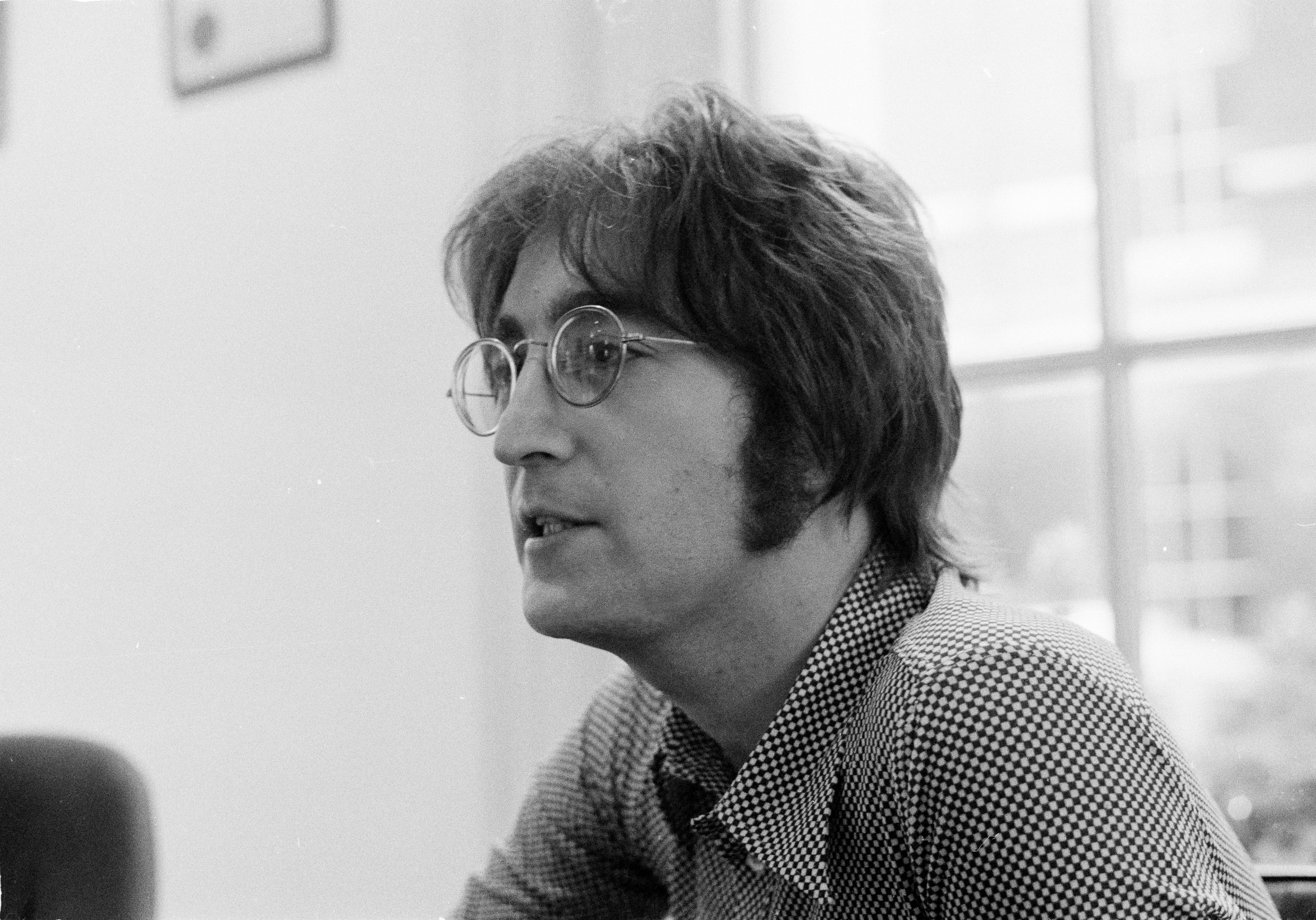
Reduce the Bible to its essence. Consider the messages of Martin Luther King, Bobby Kennedy, the Dali Lama, and Mahatma Ghandi. What is the plea of a baby’s cry or a wounded soldier’s moan? What explains both the sad old man feeding pigeons on a Sunday morning and the smiley young pup at the bar the night before? John Lennon knew – all we need is love.

For a long time I thought I understood. It began on the first day of my last year of high school. I took my assigned seat in Biology class. Decked out in my purple corduroy bell bottoms and high collared green silk shirt and with my curly brown hair falling to my shoulders, I slid into my desk with the practiced sneer of teenage sullenness. Then it happened. To my left sat the most beautiful girl I had ever seen. I was gobsmacked. The poor teacher rattled on but I heard nothing. I just had to speak with her. I finally asked to borrow her ruler. There it was. Neatly printed on the back was her name. Nirvana! I drew a few quick lines and returned it, swooning at the thought that my hand had brushed hers.

The tall blond girl and I have been married now for decades. As teenagers we thought we knew everything. We quickly learned that we knew nothing. And now what we know for sure is that everyone makes it up as they go along and do the best they can. After all these years, no one can make me laugh as she does. No one can put me right like she does. She has saved me, made me, remade me, and inspired me to become the best I can be. Without her I would now be dead, in jail, or sleeping under a bridge.

John Lennon John Lennon

Our child arrived when we were little more than children ourselves. Due to the necessity of finding work, we were living hours from home and family. We relied on logic, instinct, each other, and the long-distance wisdom of moms and grand-moms to figure it all out. We did the best we could and we did OK. As the years of teenage angst rendered our lives more interesting we kept pledging that we would not let her moods dictate ours – we never managed it. As all young people do, she circled the dark side of the moon where communications are temporarily lost and then returned as we knew she would to the safe orbit of family and home. We were only ever as happy as her. We are still only as happy as her. We could not be more proud of her.

This morning, like always, our granddaughter arrived at our door. She bounced in with the sunshine of a six year old; always in the moment, default position stuck on happy, and with the assumption that all is well and always will be. We and her parents are not helicopters hovering to mandate her every move or snowplows eliminating every obstacle. We’re more like bowling alley bumper pads. We ensure that she tacks her way forward in her own way and at her own speed with scraped knees and magic band aids while never knowing the gutter.

I watch her climb trees and play hockey. We’ve dressed up as princesses. We bounce on the trampoline and enjoy picnics in our secret spot. We walk downtown for the best hot dog in the world. We throw stones in the river and hang upside down at the playground. We read and walk and laugh and talk and scheme and joke and tease and cuddle. She always runs faster than me, wins every Trouble game, and patiently explains kids shows that I can never manage to understand. And, regrettably, I rub her arm so the insulin needle won’t hurt quite so much.

Without a clue as to her power, my grand-daughter has reshaped me as first my wife and then my daughter did before. She has taught me what I presumed to already know; what I thought I learned way back in Biology class and on those three-in-the-morning nights when the baby just wouldn’t go back to sleep. She taught me how to love all over again and, this time, more profoundly than I ever imagined possible.

I consider people begging for change on the sidewalk the same as those filling their lives with stuff and screens. I see people defined by their job and whose minds are at work even when their bodies are home the same as those stuck in perpetual adolescence whose buddies are the centres of their circles. I understand the holes in their hearts. It’s sad. I know they will never be filled by the next coin, thing or app, or by the next promotion or beer. Everyone, of course, is free to make their own way. But during the journey, words, gifts, and promises ring hollow and echo silence. Time and attention, on the other hand, skywrite what matters.

I have done a lot, travelled a lot, and accomplished a lot in my life, and have a lot more left to do. But I am convinced that the only reason I am here is to love the three women in my life and to be loved by them. All the rest is background music. Next January I will meet a new teacher who, now that I think I understand, will begin the instruction all over again. I can’t wait. But for now, tomorrow morning, when my grand-daughter arrives for school and what she calls second breakfast, she will remind me once again, as she always does – John Lennon was right.

 If you liked this article please share it with others. I post a new article on this site every Monday.

Sherlock and Murdoch and Me

Why do we do what we do? Many people struggle with the answer but I know. I think I’m a detective and I think what I do matters. Take a second and name a detective from literature or television. It’s easy because we know a lot of them. They entertain, inform, and leave us with a warm assurance that, in their hands at least, the good guys always win.

murdoch and sherlock

Every detective begins already knowing what happened. The detective’s job is to find out why it happened, who was involved, name the guilty, and exonerate the innocent. While many others may have already combed the scene, his job is to see it differently. The detective gathers clues that others may have missed or dismissed. The detective reads and then reads some more to become expert on whatever and whoever the case involves. The detective sifts evidence through the sieve of his reading and experience. He then writes up his conclusions which are based on his use the past to explain the present and will hopefully help people to avoid similar bad stuff and people in the future. But he’s not done. The court brings together other experts; some perhaps embarrassed by having missed what the detective found and eager to punch holes in his conclusions. Members of the public arrive who are fascinated with the event and eager to learn more. The detective’s work and conclusion are put to the test and the media weighs in with its opinion. Meanwhile, the detective has already moved on. The detective will happily discuss the case now holding the public and court’s interest but his mind is already on the next case.

Now here is the challenge. Please go back and re-read the last paragraph but substitute the word historian for detective. Don’t cheat – do it. Go ahead, I’ll wait for you ………………………………………………………………………………………………..done?  Interesting isn’t it? That’s what I do.

I am working on a case right now. Everyone knows what happened but I arrived on the scene about a year ago. I have read everything I can find about the people and events of the era that I am investigating. I always know I’m done that stage when the books and articles start overlapping and repeating themselves. It’s then time to do the real work, the archival work; to stop going wide and go deep. Last month I did research at the archives in Ottawa. I then moved on to the John F. Kennedy Library and Museum in Boston.

If a museum is a country’s front parlour then an archives is its attic. Its job is to hold and protect every document, book, record, and piece of music, foot of film, picture, painting, and photograph that tells our stories about ourselves. Like museums, libraries, monuments, and architecture, an archive represents, reflects, and explains us. Archives are a historian’s playground and workplace. Without archives historians are unable to solve cases, unable to write history.

So what, you may say. Well, history is never settled because the story is never completely told. History is the stories and myths that hold us together as a people. Without at least a cursory knowledge of history we are like Forrest Gump’s feather floating without purpose, understanding, or intention. Without history we are like amnesiacs; constantly surprised and confused and vulnerable to the next politician or pundit arguing without context and hoping you won’t ask the next question. But the historian is there, like the nosy detective who pokes around and sees things that may have been missed and urges a new look at things considered settled.

Journalism is history in a hurry and TV punditry is history on crack. Real history is a wise detective asking new questions and offering a new perspective. History is not nostalgia, that warm-bath sensation of gazing longingly back on misty memories of times gone by. No, history is a cold shower. It is not a balm but a challenge. It insists that we not be like those who after the tragedy of 9-11 asked like dewy-eyed school girls why they hate us. It will not allow us to grow angry at Native people’s anger. History is neither a weapon to attack another’s ideas or shield to protect one’s own. It is a spy glass, a detective’s spy glass, there to examine people, events, and ideas to determine the past to explain the present.

A good history book is a grand detective story. It is a mystery solved that you didn’t even think was a mystery in the first place. So I guess, sitting there alone, so far from home and opening another archival file I was Sherlock or maybe Murdoch. But I felt more like Columbo. I was a little dishevelled and ragged around the edges but doing my best to ask the right questions so that the story I will tell will be worth the telling.

If you enjoyed this column, please consider sharing it with others and following my blog where I post something new every Monday

Why We Should Not Go To Iraq

Every American president in the last twenty-five years has appeared on television to announce he was bombing Iraq. It was recently President Obama’s turn. It was immediately clear that he needed foreign flags in the air more than foreign soldiers on the line and Canada obliged. Prime Minister Harper signed on and sent 69 advisors. Two weeks ago in New York, according to Mr. Harper, the United States asked Canada for more help. He should have said no.

There are Canadian bones in war cemeteries around the world. Canada also played major roles in creating and sustaining the United Nations and NATO; both designed to prevent the digging of more graves. We should be proud that Canada has done its bit. However, we should be equally proud that Canada has often said yes to its national self-interest by saying no.

In 1775, Boston’s rebellion was morphing into a larger revolution. The rebel Continental Congress dispatched Benjamin Franklin to Montreal to woo Quebecers to its cause. Rebels had convinced thirteen British colonies to join and wanted another. They failed. Quebec’s leaders said no.

The Québécois had little interest in joining a rag-tag group of rebellious fellow colonies, only two of which allowed the practice of their religion, and whose army mistreated civilians, stole property, and spread a worthless currency. The Canadians – and they were already called that – would not fight. In saying no they stayed Canadians.

This year we are commemorating the hundredth anniversary of the First World War. Canadians were changed by the sacrifices of too many young men in Flanders’s mud and on Vimy’s ridge. Before the war we were British. Afterwards we were Canadian. At the conclusion of the peace negotiations, Britain insisted that it would sign the Versailles Treaty on behalf of its dominions. At that point Canada’s economy was dependent on Britain and for all intents and purposes its foreign and defense policies were one. And yet, Canada’s Prime Minister Borden said no. He insisted that Canada sign as an independent country.

Shortly afterwards, in 1922, bungled communications led Turkey to threaten war with Britain at Chanak. Britain had committed itself to protecting access to the Black Sea and asked Canada and others to send soldiers to help. Prime Minister Mackenzie King said no. The Chanak crisis, after all, was as removed from Canada as was its outcome from Canada’s interests. As befits a sovereign country, we refused to respond as we had in 1914 – with a hearty, “Ready, Aye, Ready”.

In May 1961, President Kennedy met with Prime Minister Diefenbaker in Ottawa. Kennedy said he wanted Canada to join the Organization of American States, stop trading with Cuba and China, become more involved in Vietnam, and to station American nuclear weapons in Canada and with its NATO troops in Europe. Diefenbaker was committed to fighting the Cold War but he was also a nationalist who believed that Canada’s contributions to that struggle had to be consistent with its values and interests. Diefenbaker told Kennedy no, no, no, and no. It was perhaps the first time in Kennedy’s life that anyone had told him no.

kennedy and diefenbaker

Kennedy and Diefenbaker

In 2003, President Bush sold his country and much of the world on the necessity to attack Iraq and asked Canada to join his coalition of the willing. Prime Minister Chrétien said no. He did not accept Mr. Bush’s evidence regarding weapons of mass destruction. Parliament had already approved sending Canadian troops to Afghanistan but Chrétien would not commit more to Iraq without solid evidence, a UN Security Council resolution, or clear links to Canadian interests. He later explained, “We’re an independent country, and in fact it was a very good occasion to show our independence.”

Chretien says no to Iraq

Mr. Harper looks on as PM Chrétien says no to sending troops to Iraq.

Now, Prime Minister Harper has stated his belief that young Canadians should offer themselves to slay and be slayed in Iraq because it is in Canada’s best interests to fight one of many terrorist organizations at work in the Middle East. More tellingly, he said in the House on October 3, “If Canada wants to keep its voice in the world, and we should since so many of our challenges are global, being a free rider means one is not taken seriously…When our allies recognize and respond to a threat that would also harm us, we Canadians do not stand on the sidelines. We do our part.” His words did not have the same ring as “Ready, Aye, Ready” – but the point was the same.

We owe it to ourselves to participate in our national conversation and to carefully consider the prime minister’s argument. In doing so we should consider Canada’s history of responding to allied invitations to send our young people into harm’s way – to send our children to kill theirs. Perhaps in our contemplation we will recall that the word that, more than any other, that has always indicated Canada’s taking of another step toward sovereignty has been no.

An edited version of this column appeared last week in the Ottawa Citizen. If you like this column, please consider sharing it with others using the buttons below and following this blog where I post new thoughts every Monday morning. I enjoy comments too, even from those who disagree – respectful debate is good.

Robert Kennedy and Mỹ Lai; A Coincidence That Matters

Talented Canadian singer-songwriter Alanis Morissette enjoyed a hit song a few years ago listing a number of things she found ironic. Actually, the things about which she sang were not ironic at all but merely unfortunate or at best coincidences. Coincidences are fun. Sometimes they matter. Let’s consider one that resonates today.

The Coincidence of March 16, 1968.

The Americanized portion of the Vietnam War had been grinding on for nearly four years. Despite President Johnson’s repeated assurances, there was no end in sight. The people trying to carry on with their lives in tiny, rural villages were regularly terrorized by men fighting for one or the other of the war’s many sides. The horrors felt by the men doing the terrorizing were overwhelming. By the spring of 1968 it was clear to everyone but the willfully blind that the war would have victims but no victors.

One afternoon a group of Americans walked into two small hamlets and went insane. They ceased to be soldiers. They ceased to be human. They murdered between 350 and 500 unarmed men, women, and children. It took a long time. Many were shot and some were hacked the death; many were tortured. Children watched their mothers being gang-raped. A few soldiers laughed as one of their comrades took three shots to kill a baby who was lying on the ground. It became known as the Mỹ Lai Massacre.

On that same day, Robert F. Kennedy announced his candidacy for the presidency of the United States. Everyone knew him because he had been his brother’s attorney general and in many ways the co-president. While John Kennedy was a realist disguised as a dreamer, Robert was a true romantic with a realist’s understanding of how to get things done. After the assassination in Dallas, he became a New York senator. He led a number of initiatives including the reconstruction of Brooklyn’s tough Bedford-Stuyvesant neighbourhood through partnerships with three levels of government, banks, corporations, and community organizers. He got things done.

As he stood before a bank of microphones that March afternoon he didn’t know about the massacre. But he knew that Vietnam was among many things that were wrong as he announced that he would run to be president in an effort to end the war and make some of those other things right. He said, “I run to seek new policies – policies to end the bloodshed in Vietnam and in our cities, policies to close the gaps that now exist between black and white, between rich and poor, between young and old, in this country and around the rest of the world.  I run for the presidency because I want the Democratic Party and the United States of America to stand for hope instead of despair, for reconciliation of men instead of the growing risk of world war. I run because it is now unmistakably clear that we can change these disastrous, divisive policies only by changing the men who are now making them.”

RFK

As he campaigned he spoke to Black audiences about taking more responsibility for their families. He spoke to university students about the unfairness of their draft deferments. He spoke to business leaders about being responsible to more than just their bottom lines. He made people mad. He made people think.

Consider his beliefs regarding how we measure wealth: “Our Gross National Product, now, is over $800 billion dollars a year, but that…counts air pollution and cigarette advertising, and ambulances to clear our highways of carnage. It counts special locks for our doors and the jails for the people who break them. It counts the destruction of the redwood and the loss of our natural wonder in chaotic sprawl. It counts napalm and counts nuclear warheads and armored cars for the police to fight the riots in our cities.  It counts Whitman’s rifle and Speck’s knife, and the television programs which glorify violence in order to sell toys to our children. Yet the gross national product does not allow for the health of our children, the quality of their education or the joy of their play. It does not include the beauty of our poetry or the strength of our marriages, the intelligence of our public debate or the integrity of our public officials. It measures neither our wit nor our courage, neither our wisdom nor our learning, neither our compassion nor our devotion to our country, it measures everything in short, except that which makes life worthwhile.”

On the same day that some men were visiting unspeakable horror on people they did not know, another man was pledging himself to help people he would never meet. It was not ironic. It was a coincidence. It is a coincidence that matters because it enabled Americans then and us today to consider the dark side that lurks within us all and right alongside it our yearning to do better; to be better, to do good.

The March 16, 1968 coincidence challenges us to ask whether we can accept horrors that make us cringe without losing faith. Can we remain idealistic without being naïve? Can we remain realistic without being cynical? Today we are inundated by images of hatred and despair and there are plenty that match Mỹ Lai’s power. Can we reject those who use the images to sell themselves and their divisive views and instead remain convinced that our public discourse is a place for respect, for alternate opinions, the telling of hard truths, calm determination, and for hope and even for love?

If you enjoyed this column please send it along to others. There are buttons below to help. I also always appreciate comments. Cheers!

John F. Kennedy and My Mother’s Tears

I recall the first time I saw my mother cry. You need to understand that my mom was a tough woman, as tough as burnished leather, at least on the outside, the side she allowed most folks to see. But on this day she was sobbing. It was the afternoon of November 22, 1963. I was a middle-class Canadian kid in a brush cut just rolled home from the rigours of grade one but now standing in my living room, still and stunned at the sight of my mother, slumped into the couch, red-eyed and weeping before the flickering television.

She explained that a man had died, a good man, and that he had been shot by a crazy man. I remember that I cried too. It was not for him – I had no idea who the good man was – but for her, for her grief, and for my addled efforts to understand. Today, for the same three reasons, I cried again.

You see, the little boy grew up to be an author and this week I’m doing research at Boston’s John F. Kennedy Library and Museum. Boston is a terrific city. On my first morning I jumped the red line to Pawk Street, that’s right, that’s what the man said. Within 200 steps of the subway stop I glommed on to a walking tour of the Freedom Trail led by a gentleman in period costume who was among the best guides I have ever experienced. It was marvelous; there were great sites and greater stories. I then watched a legalize marijuana rally in the Commons and laughed out loud when at the count of three the thousand or so folks splayed on blankets on the grass lit up their grass. I told a yellow T-shirted volunteer about Justin Trudeau’s pledge up in Canada but she didn’t care.

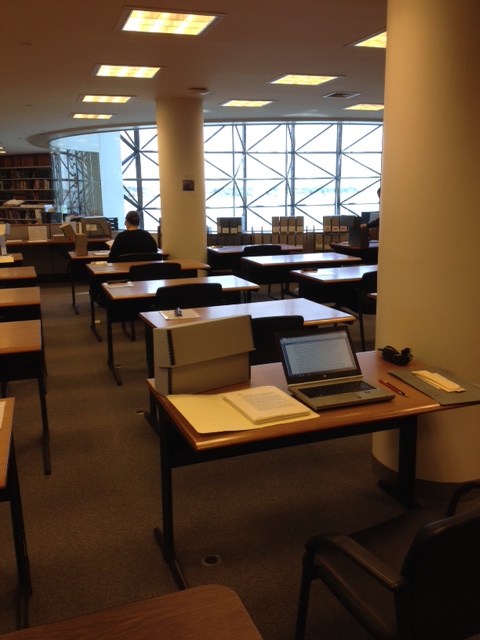
The dawn brought work. The Kennedy Library’s enormous, white, flat tower soars like a sail into the sky and overlooks the bay that reminds visitors of Kennedy’s love of the sea. The commissionaire found my name on the list, led me to an elevator in the back and with the turn his special key I was lifted to the fourth floor archives. For the rest of the day and the next two I time travelled to the 1960s. Tapping away on my laptop I recorded notes from box after box and file after file.

Kennedy library archives

My spot on the 4th floor.

On the afternoon of the third day I declared a break to finally see the museum. I stood with a group of women enchanted by home movie clips showing the Kennedys at play in Hyannisport. Kennedy smiled as he swung a golf club, sailed, swam, and at one point drove a gaggle of laughing, bare-chested, sun-tanned children far too fast on a bouncing golf cart. They were pictures of a family and life about which only the stone-hearted could not feel warmth. It was then on to politics. Films and artifacts depicted the nomination and then the election. No wonder people watching the debate thought he wiped the floor with Nixon. No kidding, did people really wear those goofy buttons and hats?

It was all good. I wandered with the gentle acceptance that like most museums its analysis was skimming as a stone over very deep ponds with its focus on entertainment more than education. But then I arrived at the gallery dedicated to the inauguration. The large screen with seating before it invited you to suspend belief and imagine you were there. About fifteen people were doing just that. There was a clutch of teenage boys with their big caps and big feet, three or four couples about my age, and a young man and woman whose eyes and hands betrayed either a honeymoon trip or one in the offing. I stood at the side not expecting to stay for the whole thing but I became entranced. There was Kennedy, tanned on that freezing January afternoon so long ago and speaking in that Boston twang. And here were these people, generations later sitting silent, eyes wide, many mouths agape, drinking in the idealism of his message as if cool water in a steaming desert oasis. I listened to him but watched them.

Kennedy inauguration

It was then it happened; a tear found my eye. I smiled and my lip quivered. I let it hang there and then run down my cheek, closed my eyes, and nodded. My mother has been gone for years now and I had not felt so close to her in a long while. The tear was not mine – it was hers. After all this time I think I finally understood that November afternoon.

The day Kennedy was murdered tore time. For millions of people the irreparable rending forever split the before and after. The violence in Dallas was visited not just upon the man but also on the very idea that everything was possible and all problems solvable. As I watched the people watching him and smudged my cheek I realized that in the final analysis, Kennedy’s gift was not his programs and polices but himself. His contribution, and the one that brought my mother to him then and the people to his museum now, was the courageous determination that idealism is not naive, hope is not silly, that acting collectively is not surrendering liberty, and that community can extend beyond one’s family, or city, or even country.

Of course Kennedy was a flawed man. The museum is silent about his hiding crippling health issues and the cocktail of drugs with which he was injected each day to carry on. It did not mention the women. He was a flawed leader. The museum ignored his ballooning the deficit to build a mammoth military and glanced over his being late in joining the march to civil rights and his having started the march to Vietnam. But that’s okay. There is no such thing as a perfect man or leader.

Now I’m back in my hotel scrunching notes into prose. When this book is published I hope that readers will understand Kennedy’s time a little better and consider the effects that his policies and personality had on Canada. What they will not know is our secret; that in the book’s writing I came to an understanding far more profound. In a city far from home, and for just a moment, I was once again my mother’s little boy.

Who Are We and Who Do We Aspire to Be?

The bread and circuses of patriotism thrives on songs and slogans. It swaps history’s complexity for misty-eyed nostalgia. Defining, unifying, inspiring state nationalism, on the other hand, is harder. Patriotism is about celebration but nationalism is about identity. While patriotism loves songs, nationalism demands sovereignty. After all, if your identity is up for sale to the highest bidder then you have no identity at all and might as well grab a funny hat and enjoy patriotism’s parade.

Two Canadian leaders whose parties and personalities were miles apart were quite similar in asking Canadians to look beyond the balm of patriotism to the challenge of nationalism. They asked Canadians to consider who they were and who they aspired to be: John Diefenbaker and Pierre Trudeau.

The Trudeau campaign in 1968 was reminiscent of John Diefenbaker’s in 1958. Both raised a number of concerns and ideas but quickly became less about issues than a vague vision and more about charisma than anything. In 1958, reporters did not know what to make of Diefenbaker’s evangelical appeal. Ten years later, with the Beatles craze fresh in their minds, they wrote of Trudeaumania.

Once in office Trudeau channelled many of the old Chief’s strategic goals. Trudeau was inspired to enter public life by a desire to fight Quebec’s ethnic nationalism that he saw as dangerous to the country and an insult to Quebecers. Diefenbaker’s 1960 Bill of Rights had similarly sought to combat Canada’s ethnic and racial divisions by protecting the rights of all as individuals – as citizens. Trudeau took that vision a step further with the creation of the Canadian Charter of Rights and Freedoms and its insertion in the constitution. Trudeau’s Canada was Diefenbaker’s “One Canada”. Both reflected a belief in a vibrant pan-Canadian identity.

Trudeua and Diefenbaker

Trudeau, Pearson and Diefenbaker

Diefenbaker and Trudeau’s state nationalism also reflected their understanding that Canada needed to be constantly vigilant in guarding against a chipping away at the frail and fragile walls protecting its sovereignty. This involved standing up to the United States. Trudeau spoke before the Washington Press Club in 1969 and famously quipped: “Living next to you is in some ways like sleeping with an elephant. No mattered how friendly and even tempered the beast, if I can call it that, one is affected by every twitch and grunt.”

It was an apt metaphor describing the asymmetrical nature of the Canadian-American relationship that Diefenbaker and Lester Pearson accepted and upon which President Kennedy had based his bullying ways. At that point and for years, after all, Canada had a tenth of the American population, its economy was about was a tenth as large and a comparison of military clout was not worth making.

Trudeau’s Foreign Investment Review Agency and the crown corporation Petro-Canada were not attempts to reduce Canadian-American trade and investment but rather to manage it while diversifying Canadian markets. They and other initiatives sought to render Canada less dependent upon the United States by increasing Canada’s economic autonomy. The old adage is that when the American economy gets a cold, Canada gets pneumonia. Diefenbaker and Trudeau both sought to strengthen Canada’s immune system. Part of that infusion of antibodies involved taking steps that Kennedy had warned Diefenbaker not to dare but he did anyway; he continued Canada’s trade with Cuba and China. Trudeau went a step further. He created even more trade links with both and even visited Castro and Mao.

After a long and complex review, Trudeau’s government published six booklets entitled Foreign Policy for Canadians. They presented recommendations that Diefenbaker’s government would have championed and a rejection of nearly everything to which Pearson had dedicated his diplomatic and political career. It insisted that foreign and defence policies should narrow its focus to reflect and advance Canada’s national interests. It should not, Trudeau said in an obvious slight to Pearson, involve Canada’s acting as a “helpful fixer” to the world.

It took a few years but by 1984 Trudeau had returned all the American nuclear weapons that Diefenbaker had said he did not want but that Pearson had welcomed into Canada. As Diefenbaker had during his tenure, Trudeau advocated and supported a number of initiatives to reduce the number of nuclear weapons in the world and to halt nuclear proliferation.

When an American oil company’s ice breaker called the Manhattan planned to move through Canada’s arctic waters, Diefenbaker rose in the House to demand Trudeau protect Canada’s sovereignty. Trudeau shared Dief’s hopes for the North’s potential and knew that potential would be dashed if Canada did not demonstrate its ownership of all its land and waters. Consequently, Trudeau managed the issue carefully and ensured that a Canadian ice breaker – the Sir John A. Macdonald, no lessescorted the American vessel. He also had Canadians put on the Manhattan’s bridge. Diefenbaker had promised to open the North by building roads to resources. Trudeau recognized that another of those roads was the North West passage.

As had happened with Diefenbaker, Trudeau’s standing up to the Americans and pushing where he could to promote and protect Canadian sovereignty was not well received by America. Echoing President Kennedy’s thoughts on Diefenbaker, President Nixon’s Secretary of State Henry Kissinger noted, “It cannot be said that Nixon and Trudeau were ideally suited for each other…he tended to consider him soft on defence and in his general attitude toward the east.” In fact, in private Kennedy often called Diefenbaker a host of derogatory names and the Watergate tapes revealed Nixon calling Trudeau a ‘son of a bitch’ and an ‘asshole’. When told of the slurs, Trudeau responded that he’d been called worse things by better people.

Despite these personality problems, when in 1971 Nixon implemented a tax policy that threatened to damage all of its trading partners, Trudeau was able to sit in the Oval Office and negotiate a Canadian exemption. Once again, just as Diefenbaker had proven when there was a run on the Canadian dollar and Kennedy had helped; personal differences do not have to stand in the way of policy solutions.

Trudeau’s actions and intentions garnered criticism from the same groups of Canadians that had turned on Diefenbaker. Provincial premiers, business people and political elites who stood to lose profits, power and tax revenue objected to attempts to increase Canada’s autonomy.  A politician without enemies is a politician doing nothing and worthless.

In 1965 George Grant published an important book entitled Lament for a Nation. It lamented the end of Canadian nationalism and the surrendering of Canada’s sovereignty to the United States. He wrote that Diefenbaker represented the last gasp of Canadian nationalism. He was wrong.  Pearson gave Canada its flag and Expo ’67 but they represented merely shallow, transitory patriotism. Diefenbaker had gone further by challenging Canadians to think not as patriots but as nationalists. Three years after Grant bemoaned nationalism’s death, a new political leader took up Diefenbaker’s legacy and challenged Canadians all over again.

Like all political leaders, Diefenbaker and Trudeau sometimes lost their way and traded strategic goals for tactical victories; but both did the best they could. While addressing the myriad decisions and crises that came their way they asked Canadians to raise themselves from the muck of the everyday. Diefenbaker and Trudeau challenged Canadians to consider, if even for a moment, if Canada is a country worth fighting for.

Lessons Learned from Fear, Vision and Tradition

On a cool September afternoon a group of Canadians aboard a luxury ship arrived at the picturesque Charlottetown harbour. They dressed in their best finery and awaited a grand welcome. It didn’t come. Instead, a lone man appeared in a row boat far below and shouted up an invitation to dinner. It was an unexpected beginning to a week that for many would have an unexpected end. Within nine days, most of it spent dining, drinking, and dancing, a new country would be born.

The men assembled embarked on an audacious experiment that remains underway. In the shadow of a brutal war and the demands of an unforgiving clock they attempted to improve on what the British had bequeathed and the Americans seemed intent on burning. We can better understand today by considering what they created then.

Wily politician and political survivor John A. Macdonald led the Canadian delegation. At that moment – September 1, 1864, 150 years ago – Canada was a dysfunctional amalgam of what are now the southern bits of Ontario and Quebec. They were crashing a previously arranged meeting of delegates from New Brunswick, PEI, and Nova Scotia who were gathering to discuss a possible Maritime union.

photo


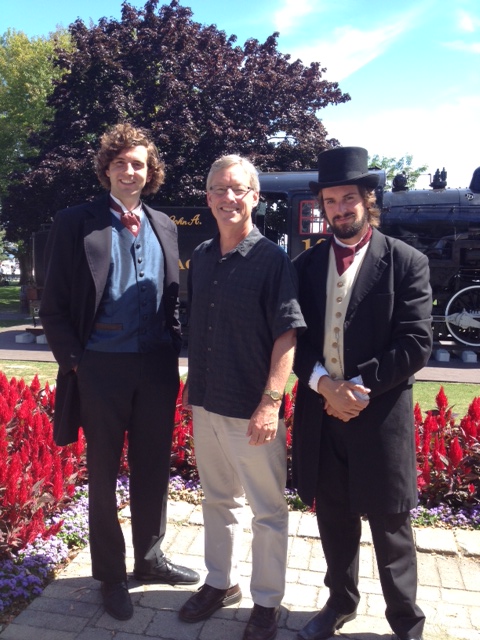
Author with Sir John A. and George Brown (OK, not really)

 
Confederation had been discussed and dismissed for years. But changes in the United States and Britain meant that to save itself Canada had to create itself. America had fallen into Civil War. It left cities burned and families destroyed. If we extrapolated the population then for now it would claim the equivalent of over six million lives.

Canada and the Maritimes were officially neutral but most newspapers were pro-South, Halifax and Saint John ports sold goods to both sides, factories ran weapons to the South, an anti-Lincoln political party operated from Windsor, and a Confederate spy ring organized raids from Toronto and Montreal. American newspapers and generals threatened and Lincoln hinted that when the war ended, the Northern army would turn north.

Britain had dispatched 11,000 troops to the border but a powerful group of British politicians were questioning the cost of that defence and of imperialism itself. They wanted the expensive and troublesome British North American colonies to find their own way.

Canada resembled a teenager whose parents were kicking her out of the house. She wouldn’t move in with the neighbours because their house was on fire. She needed to build a new house. The architects met in Charlottetown. They were government and opposition members who had pledged to surrender partisanship for the greater good.

The United States was the world’s first and most successful manifestation of John Locke’s 18th century Enlightenment ideas. But the men (and they were all men) in Charlottetown believed that while the sentiments were noble, the Civil War was demonstrating that America’s attempt to create an enlightened republic was a blazing failure. They channelled Irish nationalist and British Member of Parliament Edmund Burke. He believed that governments should not be based upon temporary popularity which he equated to shouts from a mob, but on tested and respected tradition. Facts and the circumstances of the day should dictate reasonable solutions; decisions should never be based on blind adherence to an ideology. With admiration for Burke and Britain and America as their negative example they envisioned Canada.

Power, they said, should not rest with the executive – they derided the American president as a four-year dictator – but with parliament. Through free elections, they argued, the people should not pick a prime minister or even a government. Rather, voters should create a House and the House would choose the government according to which group could earn support. Members of parliament must not be delegates merely echoing the views of their constituents but thoughtful free thinkers unencumbered by the often un- or ill-informed electorate or partisan newspapers. The Senate must be appointed to keep it illegitimate so that real power remained where it belonged – in the House. The struggle for State’s rights had led to the Civil War so they insisted that the federal government alone speak for Canada. They saw provinces as municipal in nature and restricted their power to areas on a short, proscriptive list. The British monarch should oversee it all as Head of State.

Anniversaries, and a 150th is one of significance, are invitations to reflect on the past and ponder the future. Canada was born of fear, vision and tradition. What of the old fear? The Americans may not be ready to bomb us anymore but have they bought us? What of the old vision? A democratic state locates power to best serve the nation but are we happy with where power has been relocated? What of the old tradition? Should we pursue our sovereignty by eschewing the sovereign? What would Sir John say? More importantly, on our collective anniversary, what do you say?

An edited version of this article appeared last week in the Ottawa Citizen, Montreal Gazette and Vancouver Sun. To discover more about Canada’s birth in the shadow of the American Civil War and about Canada’s involvement in that war please see “Blood and Daring: How Canada Fought the American Civil War and Forged a Nation”.

http://www.amazon.ca/Blood-Daring-Canada-Fought-American/dp/0307361462/ref=sr_1_1_title_2_pap?s=books&ie=UTF8&qid=1410174613&sr=1-1

The Legend of the Six Inch Triple

It was the top of the last inning of the championship game and we were down by a run. We had players on first and second. The count was three and two. Everything hung on the next pitch. The park fell into a silence as ominous as the inky, dark clouds roiling overhead. We held our breath as an apparently equally enthralled Mother Nature held her rain. Finally, after chicken scratching at the mound, the pitcher released the ball. It seemed to hang at the top of its arc for a long, lingering moment and then Val stepped into a mighty swing. Her aluminum bat kissed the top of the spinning lime green ball which dropped with a thud at her feet – but fair. Val didn’t care. The bat flew and she was off like a rocket. The catcher leapt forward, snatched the ball but then, inexplicitly, sailed it two feet over the first baseman’s outstretched glove.

Our bench exploded. Our base coaches screamed. Our man at second did not slow down over third and passed home. Their right fielder’s angle must have convinced him that the ball was out of play for he was ambling toward it with a cool casualness, but we could see it. The ball lay clearly within the chalk line and so like the Monty Python villager it was not quite dead, in fact, it was still very much alive.  It was their bench’s turn to scream but Val was already sprinting to second as our other runner rounded third.

Their fielder finally awoke to the moment, ran to the ball and with a long stride hurled it toward home. Our runner from first was puffing toward home and nearly there. The ball was nearly there. The catcher’s glove smacked and the umpire yelled, “Safe!” We had done it. Really, Val had done it. She stood on third base breathing hard and beaming. We were jumping and cheering and high-fiving each other, but, it was not over.

We were soon on the field for their last at bats. We were up by a run but earlier in the game they had scored seven in a single inning and so we respected their speed and power; we feared it. We knew they were younger and stronger than us. As one of our team mates had noted earlier: “They don’t even jiggle when they run!” A one run lead was nothing.

A long loping hit to left field put a man on second and with a bloop single he advanced to third – the tying run. Two quick outs and a couple of pitches later they were same spot in which we had found ourselves only minutes before. There were two strikes on the batter. It all came down to this pitch. He swung hard but spun the ball into a high pop fly in foul territory just a couple of yards from third base – my base. I edged carefully forward and to my right and moved my free hand to the back of my old black glove. I could not drop this. I had time to think: “Don’t drop this. Do not drop this!” I felt it find my glove and squeezed as tightly as I’ve squeezed anything. I heard the cheers. I heard the shouts. I stood with the ball in my glove still held high above my head. We did it. We won.

It was the second year in a row that our team, the Black Plague, had won the championship. This year was even sweeter because a dear friend of ours, a giant of a man who lived meagrely and gave generously and whose laugh sparked laughter in all he met, had died. One of his many nicknames was spray painted on the snow fence that delineated the outfield. Another was on the shoulder of our new jerseys. We had dedicated the season to him and now we had won.

Black Plague

The Black Plague is one of eight teams in the Trent University slo-pitch softball league that has been playing for fun for thirty years. Everyone involved works at, attends, or went to Trent. The weekly games on soft summer nights bring hearty cheers, good-natured jeers and shouts of, “Yay Dad!” and “Way to go Uncle Mike!” During the season the diamond has neither lines nor umpires. The arcane rules that no one seems to fully fathom are enforced by mutual consent. Hit the plywood board and it’s a strike. The catcher calls outs and foul balls. No leadoffs. No stealing. There are occasional discussions but never arguments. One of the rules states that a team must have at least three women on the field at all times. I think it must be a hold-over from another era because nearly all the women are terrific players; many are a lot better than a lot of the men and nearly all are better than me.

You see, I love baseball. I love listening on the radio and following the season. I love the pace, the strategies, and the fact that it is a team sport that comes down to individual moments. I love that there is no clock, no regulation field size, no best way of doing anything and I love the game’s rich and storied history. It’s great that statistics say it all but the legends say even more. I love that every season starts as a story, slows to a paragraph and ends as a sentence.

My grandfather was a Yankees fan and so as a boy I was too. While I cheer for the Blue Jays now there’s still something about the Yankees that moves something within me no matter how much I try to dislike them and their pennant-buying, celebrity-driven ways. I’ve been to Yankee Stadium and Cooperstown. I saw the Expos at the Big O and saw Ripken play at Camden Yards and Griffey hit one into the Sky Dome’s third deck. But loving something does not automatically make you any good at it. In fact, despite loving the game I am really no good at it at all.

I take my turn at third base and most times I can stop and sometimes even catch balls coming my way. Most times I can make the long throw to first but I occasionally bounce them. My hitting is laughable. I try so hard. I try to ignore the ball jumping erratically every time its trajectory carries it in and out of my bifocal range. I desperately try to be patient and to wait for the ball to fall into the strike zone and to keep my elbow up and to swing level and to follow through and to turn my hips and to do everything else that jumbles my brain at the plate – at the board, that is. I have hit a few doubles and a couple of triples and a slew of singles but far too often I just pop it up or smack a toothless grounder to the short stop.

My lack of prowess is sometimes embarrassing but my team mates are as patient as they are kind. They coach. They tease a little, but they never criticize and I always get my turn. Despite being so bad at it I have fun. And that’s the point.

Because you are good at something does not mean you have to do it. Consider that upon the birth of his second child, John Lennon retired from the music business. He didn’t publicly sing a note or record a song for five years. He wrote, “I’ve already lost one family to produce what? Sgt. Pepper. I am blessed with a second chance.” He baked bread and changed diapers and read stories and took his son for long walks in Central Park. Finally, right there at home, he found what he had been seeking for so long – peace.

Because you are bad at something does not mean you should not do it. It would be a quiet forest indeed if only birds with the sweetest voices sang. So I look forward to next spring’s baseball season. I will try harder but probably not be much better, but so what? For now, the Black Plague has received not a single challenge from any other team on the planet. That makes us World Champions. A few months from now, in the depths of a cold, Canadian winter, that thought and memories of Val’s legendary six-inch triple, will offer a little warmth. And could we all not use a bit of that from time to time?

Honour in the Worst Jobs

All work is honourable but some jobs are awful. The luckiest among us marry jobs and passion and often have smaller houses but broader smiles. The saddest folks labour only for money and many end up struggling to fill holes in their soul with stuff. There is something to be learned from all work and perhaps the best lessons are offered by the worst jobs.

My worst job was not the winter I laboured as an Esso gas station attendant. Besides cleaning the bathrooms, sweeping the place and occasionally swiping stale chocolate bars, I would have made Pavlov grin when at the ping of the ding I jumped into coat and hat to leap to the pumps outside. With the temperature often far south of zero, I became quite adept at yawning hoods and checking oil in mere seconds and at kicking the frozen pail of ostensibly un-freezable blue goop to squeegee windshields. I had a cold all that cold winter. I received one tip – fifty cents.

My worst job was not the two summers with the Peterborough parks department. I enjoyed one morning each week when I drove the golf cart to ball diamonds around town to drag the angle iron in circles and then chalk baselines. But I also pierced garbage with a broken hockey stick with a bent nail in the end. In a hard hat and steel-toed boots, I ignored my allergy to freshly cut grass while pushing a lawn mower in circles around trees and up and down hills and other places the big tractors couldn’t go. I nodded obediently when my suggestion for punctuation was ignored and then dutifully erected thirty signs that read: No Golf Playing Motorized Vehicles. They were certainly effective because after that I didn’t see a single motorized vehicle playing golf.

When it rained, the three crews of university students were gathered under the Hunter Street Bridge where we sat in a large bunker-like room on makeshift seats with traffic rumbling above and covering us with dust. Against one dank and filthy wall lay a mountain of tulip bulbs. For several chilly, soggy days, hour after excruciating hour, we peeled each bulb and placed it in the correct bushel baskets: large, medium, small, and rotten. There were bulb wars and songs and jokes and one afternoon a guy entertained us with Penthouse letters; he inserted the word blank for the nasty bits, making each depraved offering seem even nastier still.

My worst job lasted only one night. My friend Chris and I were fifteen when we saw the ad in the paper and showed up at the Towers Department store parking lot that night at 9:00. At the yelp of the crew-boss, we boarded the ancient yellow school bus, gasped at the smell, and tried not to make eye contact with any of the scary looking people around us. We bounced in silence beyond the city’s lights to a rural golf course that in the inky darkness was as creepy as our workmates. Given no instructions, we followed the others and secured miner’s lights to our foreheads. Using big elastic bands we fastened empty juice cans to our ankles and scooped a handful of sawdust into the left one. We began following the safest looking man but in a truly impressive demonstration of the manner in which the “F” bomb can be noun, verb and adjective in a single, complex sentence he suggested that we find our own spot. It took a while, but we finally wandered to an empty fairway.

We had been promised a cent a worm. Chris had calculated how much we could make in only one night and all afternoon we couldn’t wait to begin. But now that we were there, stumbling through the chill and darkness, we couldn’t wait to earn our first penny.

We couldn’t find a worm anywhere. It was nearly thirty minutes before I lunged at my first victim. I missed him. It was another thirty before we mastered the plunge and yank needed to can one, as we began calling it. We jumped and ran when the automatic sprinklers clicked to life but then smiled when worms began appearing on the wet grass that glistened black under the August moon. We learned to time the rotations. We’d run in, can a couple, and then scamper back without getting too wet. The sawdust on our fingers kept the slippery buggers from sliding away and we learned to be quick. With a slip on the wet grass I lost nearly half my catch but we kept going.

Honour in the Worst Jobs

(Photo: www.oregonlive.com)

We worked hard all night and at the horn’s blast returned to the bus. We were stiff and dog tired but stood proudly in line to present our haul to the crew-boss who sat behind a long beat-up wooden table. Some of our work mates had earned the money that we had dreamed about but I had managed to pick only one full can – 250 worms. The tough looking women with the Ukrainian accent counted out two dollars and fifty cents. Chris earned just a little bit more.

We napped on the dirty bus and stumbled out bleary-eyed and filthy. The city was shaking itself awake with cars piercing the morning mist as we shuffled across the street to the neon glare of the donut shop. We bought donuts and chocolate milk until our night’s pay was gone. Later that afternoon, Chris called and we agreed that one night of worm-picking was plenty.

Over the years, I’ve written a number of resumes but I never listed worm picker. Perhaps I should have. This evening, when I slide between clean sheets, I’ll afford a thought for folks who will spend the night standing guard, serving coffee, buffing floors, dumping garbage, and yes, even hunting worms. There is honour in all work. Perhaps there is even more in work that needs to be done but most of us would rather not do and when we would rather not do it and all for wages we would rather not accept.  Maybe it is in that work, at three in morning, with folks doing the best they can for the families they love, that lies the most honour of all.

If you enjoyed this column, please send it to others and consider seeing more at http://www.johnboyko.com

Top Ten Ways that Canada Fought the American Civil War

The American Civil War was America’s third civil war. The first occurred within the Revolutionary war when about a third of the people were neutral and another third were loyal to the British king. Many loyalists were harassed and killed and thousands fled to the safety of what would become Canada. The second American civil war began in 1812 under pretences so rickety they would blush the chalky cheeks of Dick Cheney. Because so many of those dying in Canadian border towns were the same un-American Americans who had fled the Revolution, the War of 1812 was really a cousin’s war.

We are as wrong to consider the 1861-1865 American Civil War the country’s first and only civil war as we are to consider it only an American war. France, Britain, Russia and what was becoming Germany were all active participants. More than any other country, however, Canada fought the American Civil War.

At the time, of course, Canada was not yet a country but a group of British colonies lying on America’s porous border. The colony called Canada was a squabbling and politically dysfunctional amalgam of Canada West (Ontario) and Canada East (Quebec). Most Americans also called New Brunswick and Nova Scotia Canada but such name-calling would spark a fight in any Halifax or Moncton bar.

Many Americans made no secret of coveting Canada with newspapers and politicians regularly reporting plans to buy, bomb or annex it. America had invaded Canada in the Revolution and again in 1812. The new civil war had Canadians steeling themselves to fight again.

Canada was involved in the Civil War’s cause, course and consequences. It affected when Canada was created and the nature of that creation. Here are the top ten ways that Canada fought the American Civil War:

  1. Slavery – Canada abolished slavery in 1833. About 30,000 racial refugees followed the North Star to forge lives of dignified freedom. Southerners were enraged because ex-slaves living happy, productive lives challenged everything they were saying about Black people’s desires and potential and the foundation upon which their society rested. The Canadian examples inspired Northern abolitionists. The Underground Railroad grew along with the animosities between North and South. Harriet Beecher Stowe based Uncle Tom’s Cabin, the book that Lincoln said caused the war, on an escaped slave living in Canada.
  2. Self-Defence – With war on the horizon, Lincoln’s newly appointed Secretary of State William H. Seward secretly advocated reuniting America by instigating a war with Britain by capturing Canada. The attack, he said, would lead Southerners to rally around the flag and forget secession and Britain would negotiate an end to the war by ceding Canada to America. Lincoln considered the idea but said no – for now. British and Canadian officials took Seward’s public threats quite seriously. Canadians helping the South through arms sales and other means led many American newspapers, politicians and generals to call for invasion. Over eleven thousand British soldiers were dispatched to the border. The Royal Navy was redeployed. Canadian militia were trained and armed. Border fortifications were enhanced and artillery stood ready.
  3. Soldiers – About 40,000 Canadians donned the blue and gray. Nearly all fought in Northern regiments. Most volunteered, some were tricked, and others, even children, were kidnapped and forced into uniform. Canadians fought in every major battle and 29 earned the Congressional Medal of Honor. Canadians swept down from Gettysburg’s Little Round Top, stood with Grant at Lee’s surrender and a Canadian led the troops that captured Lincoln’s assassin.
  4. Spies – When the war began turning south for the South, Confederate President Jefferson Davis created a spy network in Canada. Stationed in fancy Toronto and Montreal hotels, spy leader Jacob Thompson organized Confederates and their Canadian sympathisers to run communications for and weapons to the South. In Halifax, money was made selling supplies and information to Southern blockade runners and then to the Northern ships pursuing them.
  5. Sorties – Jacob Thompson disturbed and distracted Northern military operations with raids to free Confederate prisoners. He had yellow-fever infected clothing distributed in northern cities. He organized the plot that saw theatres and hotels simultaneously burst into flame along Manhattan’s Broadway. The raid on St. Albans, Vermont led to deaths, an incursion of American troops into Canada and Congressional reprisals designed to punish Canada.
  6. Separation – The Copperheads hated Lincoln. They were Northerners who wanted the war stopped with slavery and the Confederacy preserved and, failing that, the formation a new country comprised of several mid-west states. Lincoln called the Copperhead movement “the fire in the rear” and said that he feared its power as much as the Southern armies. The Copperhead’s chief spokesman was Clement Vallandigham who inspired Copperheads and campaigned to be governor of Ohio from his headquarters in Windsor, Canada West.
  7. Salvation – Joining Canada with the Maritime colonies in a new political arrangement through a process called Confederation had been discussed since the 1850s. When it appeared that Lincoln would win the war and then feared that he would then turn his massive army northward, the notion became a necessity. Canada needed to be bigger, stronger, richer and more efficient and the civil war meant that it needed it all now rather than some dreamy someday. Canada had to create itself to save itself. Former Reform Party leader and owner and editor of the powerful Globe newspaper George Brown got bickering politicians from both parties in a room, Macdonald kept them talking, Cartier forced federalism, and Tupper and Tilley brought in the Maritimes. The talks began in the fall of 1864 in the shadow of war and led to the birth of nation forged in war.
  8. Suspicion – Days after the guns fell silent there was a shot in Ford’s Theatre. Even while Lincoln lay dying in a boarding house across the street, investigators turned to Canada’s involvement in the president’s shooting and the attempted assassination of Seward. The border was shut. Agents were dispatched to Montreal. Weeks later, the very first question asked in the trial of the conspirators was about their links to Canada. It was proven that John Wilkes Booth had spent time planning the assassination while with Jacob Thompson’s Confederate conspirators and spies in Montreal.      
  9. Sanctuary – With the war over, many Confederate leaders faced either prosecution or life under the military occupation of their enemy. Many fled to Canada. Among them was General Pickett who led Gettysburg’s tragic final charge. President Jefferson Davis’ family had been in Quebec for some time and after his release from prison he joined them. Cheering crowds welcomed his appearance in Kingston, Toronto and Niagara Falls. The haggard, sick man lived peacefully in Canada until an amnesty allowed him and his compatriots to return home.
  10. Self-Preservation – Britain had helped the Confederacy by allowing ships to built in Britain and sold to the small Southern navy. One of the most deadly was the Alabama that roamed the seas sinking Northern supply ships and even a military vessel. After the war President Johnson and then President Grant demanded an inordinate sum from Britain as reparation – it was called the Alabama claim. American and British officials discussed erasing the debt owed in exchange for Britain ceding Canada to the United States. In 1871, Prime Minister Macdonald ventured to Washington to negotiate Canada’s survival in what became the Civil War’s final battle.

Canada played a role in causing the war, 40,000 Canadians fought in the war, and its border, streets and harbours were involved in the war. Those who created the country used the United States as an example of how not to organize a society; after all, they invented Canada while the war was demonstrating the American model’s abject failure. Canadians today are children of those who were inspired by the fear of one country and the vision of another.

An edited version of this article appeared in this week’s Macleans magazine. To learn more, check out Blood and Daring: How Canada Fought the American Civil War and Forged a Nation available through Amazon, Chapters and sensible book stores everywhere.

Gordie Howe and the Importance of Heroes

Hockey was my world. Road hockey, table-top hockey and most of all ice hockey filled my eight-year-old mind with fun and possibility. My bedroom walls were festooned with pictures of NHL hockey players. Most had been carefully snipped from the magazine that arrived every Saturday with my Dad’s Hamilton Spectator. Every week I mailed away the little paper ring from a Bee Hive Corn Syrup container and the good people at the St. Lawrence Starch Company of Port Credit, Ontario rewarded my gorging on the gooey stuff with another picture. Some were even autographed.

So there on my wall was Bobby Hull, Frank Mahovlich, Terry Sawchuk, Stan Mikita and more. They were all handsome but scarred. They posed as gladiators, armed and with the power and violence of savage youth just behind their eyes. There were a lot of pictures but one player had a shrine – my hero – Gordie Howe.  When I was eight, Gordie Howe was playing for the Detroit Red Wings and he was the best there was and the greatest there had ever been.

beehive1 gordie howe

Bee Hive Corn Syrup Picture of Gordie Howe

Every winter my Dad flooded our backyard. The huge rink had nets, boards, benches and even a penalty box. For night games he hung floodlights. Every winter afternoon I would rush home from school, suit up, and hit the rink. All the neighbourhood kids were there but we did not just play hockey; we became the players on our trading cards and bedroom walls. I was always Gordie Howe. We were living Roch Carrier’s The Hockey Sweater a generation later and a province over but with the same passionate imaginations.

My shameless whining earned me a complete Gordie Howe uniform. You can see by the picture below that I’m on the rink with my mitts and hat to stay warm but still safe in my helmet. The two slabs of thin, brown leather front and back is a galaxy removed from the storm trooper helmets of today. Plus, and this is something my Dad can still not explain, he had bought me a helmet that placed on my forehead a large bull’s eye embossed with the word TARGET. Amazing! Perhaps it was too many pre-pubescents availing themselves of the invitation to practice their aim that turned that cute face into the one that now haunts my cruel shaving mirror.
me as Gordie Howe

The author as Gordie Howe

Gordie Howe was my hero because he had attained excellence. He won the NHL’s MVP 6 times and 29 times he was chosen for the All-Star team. He won nearly every trophy and award for which he was eligible. He was the Red Wings number one goal scorer year after year and in the league’s top five for 20 consecutive seasons. Upon retirement he had amassed an astronomical 1,071 goals and most of those in the era of low scoring games and against Hall of Fame goalies.

He was tough. Gordie Howe was his own enforcer. To create a little more room and time he would hit, elbow and fight. Players understood that he would exact a price for every slash or slight. Current players still speak of a Gordie Howe hat trick: one game with a goal, assist and a fight.

Howe had natural athletic gifts but he didn’t rest on them. Rather, he worked endlessly to hone them. He would arrive at practices a half hour early. Alone, in a silent Olympia Stadium, driven by nothing but his conscience and determination to be the best he could be, he would improve his puck-handling, footwork and prowess with shooting right or left with equal speed and accuracy. He was the hardest worker at every practice and when his team mates hit the showers he would work some more.

Howe also had a sense of community. He leant his name and presence to a variety of charitable causes. When on the road he often left other players relaxing or partying and took sticks and pucks to hospitals where he visited sick children to sign autographs and pose for pictures. There was no publicity. He did not do it because it would look good; he did it because it was good.

One day my Dad told me that a nearby Golf Club was hosting a charity tournament that would be attended by a number of NHL hockey players. I sat up. Among the players, he said, was Gordie Howe. I was on my feet. And then, when I was about to explode with excitement, he said that he had purchased tickets.

I dressed up in my chino pants, desert boots, golf shirt buttoned right to the top, and my favourite cardigan sweater; the one with the diamonds. We arrived at the course and wandered a bit until…there he was. I could barely believe it. And then, with wide and disbelieving eyes, I saw my Dad actually approach and then speak with him. And then, my God, he waved me over. I looked up, way up at Mr. Howe and….well the rest I don’t remember.

My Dad told me later that Mr. Howe rubbed the top of my head as adults often do with little kids and said, “So son, do you play hockey?” I apparently looked up and said…..nothing. Not a word. Not a syllable. My Dad said, “Yes sir, he does.” Mr. Howe then reportedly asked, “What position do you play son?” I swallowed hard and I guess my lips moved but I said…again…nothing.  My Dad asked if Mr. Howe would pose for a picture. He grinned gently as my fists clenched with the excitement of an eight-year-old who had, for him, just met the equivalent of God, the Son, and Holy Ghost all in one man.
Gordie Howe and I

Gordie Howe and the author.

I was privileged to meet Mr. Howe again at a taping of Don Cherry’s Grapevine – a short-lived TV show set in a phony bar. This time I was an adult and so while still in awe, I managed to enjoy a brief conversation. I told him of my speechlessness at our first meeting and he assured me that it happened all the time. He was humble and kind. I was thrilled but also relieved that my childhood hero was a nice guy.

It is a revealing and worthwhile exercise to consider whether you had or have a hero and who a society celebrates as heroic. A hero is not just a celebrity. Fame, after all, can often be transitory, tawdry and earned for the wrong reasons or won but not really earned at all. On the other hand, a hero is one whose character and deeds epitomize that which you value. A hero inspires and guides with genuine and unique talent, industry, generosity, and humility. Heroes are usually famous and often powerful but they needn’t be. My grandfather was another of my heroes and he was neither. But if, like Gordie Howe, more people were more like him then the world would be a little better place.

A few years ago a CBC radio host asked Ken Dryden to name hockey’s best era. He said, “Figure out what year it was when you were ten years old. That was hockey’s best era.” He’s right. Hockey players no longer decorate my bedroom. I have other heroes now and none of them are athletes but Gordie Howe remains deep in my heart. It’s sad that he is now fighting the ravages of Alzheimer’s disease; that mean, long goodbye. But to me Gordie Howe will always be young, strong and important. I will always recall that skinny kid skating alone under the lights on a frigid Canadian winter night and begging Mom for just a little while longer; just a few more minutes to imagine himself bigger, stronger, and better; just a few more minutes to be Gordie Howe.

We Always Recall the First

George Washington was America’s first president but who was the second? Can’t recall? It’s a rare Canadian that couldn’t name Sir John A. Macdonald as their first prime minister but how many know their second? We seldom remember the second of anything. Because the purpose of History is to recall our past without prejudice in order to better understand our present with clarity our natural predilection to focus only on the first is a shame.

Canada’s second prime minister, like America’s second president, was a man whose character was sound, ambitions restrained, and accomplishments significant. Are those not qualities that we value in leaders and celebrate in those who helped shaped our story? It is with this perspective that we should recall and understand Canada’s second prime minister, Alexander Mackenzie.

Those who work with stone must be patient. To rush is to risk crumbling what to an untrained eye seems indestructible but to the skilled mason can be carefully shaped to stand and serve forever. Imagine a stone carver bringing that sensibility to the leadership of a nation.

Mackenzie learned to work with stone while a boy in his native Scotland. He was born in 1822 to a large and poor family. By the age of 16 he had mastered his craft and was helping with expenses. The Mackenzie family was one of thousands who fled poverty for the hope of a better life in Canada. Mackenzie’s skills acquitted him well and he soon secured contracts to build houses, churches, canals and public buildings. He eventually settled in Sarnia, Canada West.

A dour man, Mackenzie was slow to smile, joked only to jibe, drank very little for those hard-drinking days, and believed sports a waste of energy. He was none the less a popular figure in Sarnia and became active in public affairs including serving on the fire brigade and school board. He was attracted to the Reform Party (a precursor to the current Liberals) which reflected his belief in free markets and rewards based on merit and effort. He won a seat in the legislature in 1861, just as the American Civil War was seeing the butchering of brothers and the increasingly belligerent neighbour was leading Canadian political leaders to sense the urgent need to protect the country by growing the country.

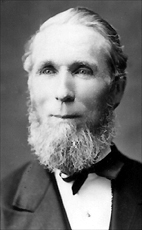
alexander mackenzie Mackenzie

At first Mackenzie opposed his party’s joining with the hated Conservatives to bring about Confederation. He was not convinced that the scheme was a good idea and he had little respect for John A. Macdonald who he considered politically duplicitous and personally unsavory. The Great Coalition government nonetheless created the skeleton that would become Canada.

The Confederation negotiations led to Reform leader George Brown’s resignation in 1865 and a party crisis. Too many men of too little talent vied to succeed him. Mackenzie watched the leadership competition with disdain while continuing to work hard at his craft and in both the provincial and federal legislatures. His talents and diligence were rewarded when in March, 1873 he won the party’s leadership. He had little time to celebrate, however, for within a month the Pacific Scandal rocked the Macdonald government. In November it fell.

Mackenzie was asked to form a government and shortly afterwards he called for an election. Few outside of south western Ontario knew him. Although disgraced, Macdonald remained a giant. To Canadians he was a rogue but he was their rogue and they had grown used to forgiving his mistakes and foibles. The scandal, however, had been too much. Canadians turned on him and handed Mackenzie a handsome 60-seat majority.

Mackenzie faced a number of problems going forward and the first was the knives in his back. The Reformers/Liberals were at war with each other and the worst of the lot was the conniving and ambitious Edward Blake. He believed he should be party leader and even had the temerity to ask Mackenzie to step aside so that he could become prime minister. Of greater importance to Canadians was that the country had slid into a deep recession. Contracts were cancelled, trade declined, and unemployment climbed. Absent today’s social programs, the suffering was devastating. Another leader may have panicked or taken rash action but the stone carver weighed options and moved slowly.

Plummeting tax revenue met demands for more funds to continue the massive railway project that Macdonald had begun. Mackenzie was forced to slow construction and even ask the people of British Columbia who had been promised the line to entice them to join Canada to wait a little longer. Railway construction continued but at a much slower, more affordable pace.

Canada was less than a decade old. While Mackenzie needed to address current issues he also recognized his responsibility to build the infant country. In 1875, he created the Supreme Court of Canada. It was designed to wrest power from Britain’s Judicial Committee of the Privy Council which at that point was Canada’s court of last resort. It would not be until 1949 that Canada’s Supreme Court would be truly supreme but Mackenzie’s action was an important step in Canada’s march toward judicial independence.

Mackenzie had been a militia major and respected the military’s role in securing Canada’s defence and establishing its sovereignty. He undertook a complete overhaul of the Department of Militia and Defence. He also established Canada’s first military training college in Kingston.

He completely revamped Canadian democracy. Mackenzie introduced the secret ballot. He passed laws that led to elections being held in all ridings on the same day. He removed property as a qualification for candidates for public office. To protect the people from unscrupulous politicians he created the office of the Auditor General and had it report not to the prime minister but to parliament.

The sprawling country was linked with three bold new laws. The Post Office Act created door-to-door delivery to cities across Canada. The Weights and Measures Act said that everyone had to begin using the same systems. The Collection of Criminal Statistics Act modernized police services across the country through the gathering, filing and sharing of information.

Mackenzie’s government had accomplished a great deal but the people cared more about the government’s addressing immediate needs and those needs had become desperate. There were even food riots in Montreal. While all of this was going on Sir John was reinventing campaigning by creating the political BBQ. He travelled the country attending outdoor picnics where he worked his inimitable charm and slowly earned forgiveness. In the election of September, 1878 Canadians returned the old chieftain to power.

Alexander Mackenzie’s service as Canada’s second prime minister was one of significant accomplishment. He acted with the stone carver’s patience and precision. He slowly did what could be done, left what should be left alone, and carefully moved the project along – the Canada project – the sculpture that to this day remains, as it should, under construction.

(And by the way, the second American president was John Adams.)

A version of this column appeared originally on the excellent site Leaders and Legacies. Find it at http://leadersandlegacies.com/2014/06/26/building-a-nation-brick-by-brick-canadas-forgotten-prime-minister/

Bullwinkle and Seven Lessons about Russia

Maybe Bullwinkle J. Moose taught me everything I need to know about Russia. I was a child when Khrushchev and Kennedy nearly blew me up and I didn’t understand the air raid sirens that were regularly tested in my hometown. But I understood that Bullwinkle and Rocky were the good guys and that Boris and Natasha, those nasty Russian spies, were no good at all.

We were good and they were bad and that is all we needed to know. But then, as always happens and always will, things changed. In 1985, Mikhail Gorbachev, the son of poor peasant farmers, became Russia’s leader. He realized that a country can have guns or butter but not both. The Americans are still trying, by the way, but ask them about their debt and deficit.

His revolution began with glasnost – openness. He slowly ended the brutal totalitarian control that had been created by Lenin and cemented in place by Stalin. The media was afforded more freedom and the arts encouraged to embrace criticism and satire and to, oh my goodness, have fun for fun’s sake.

gorbachev

Mikhail Gorbachev

It continued with perestroika – restructuring. Multi-candidate, secret ballot elections were held for the first time in history in municipalities and then to create a new parliament. The party and the state began surrendering its iron grip on the economy as Gorbachev introduced free market and land reforms.

The Cold War warmed as Gorbachev scrapped hundreds of nuclear weapons. Rather than dispatching tanks as his predecessors had done in Hungary and Czechoslovakia, he allowed Polish protests to play out. He ended Russia’s withering Afghanistan war and began withdrawing troops from Eastern European satellites.

It was about then that I arrived in Moscow. I was among a group of teachers escorting 96 teenagers for a week in March, 1989. These are the seven lessons I learned:

Bureaucracy Can Be Crazy: On our bus from the airport I asked Svetlana, our guide, about the soldiers perched in glass fishbowl stations at major intersections. I was told they worked the traffic lights. When I quipped that it must be a boring job at three in the morning she said that at night the lights are switched to work automatically. Before I could ask the next and obvious question Svetlana whispered, “In Russia, everybody works.”

People Are Resilient: I waited in a long, silent line to purchase a ticket, then in another line to present the ticket, and then in a third line to finally pick up a half dozen bagels. There were long lines everywhere and for everything. People lined up to buy the red rubber boots that we saw on every child. They lined up for meat, for clothes, and for toilet paper. At the giant GUM department store across Red Square from the Kremlin we found empty shelves and empty stores. But people carried on. Nearly all had a look – a Russian look. It was in the eyes. The eyes betrayed people who had been worked too hard for too long for too little; people who were too tired for too long and had been too long lied to and lied about. But there they were every day lining up, going to school and to work, families together in parks, teenagers in love, old folks holding hands, and all just carrying on as best they could.

Arts Should Be Accessible: We attended a performance of the Bolshoi ballet. Established in 1776, the company is world renowned and performs regularly in an enormous and gorgeous theatre. The place was packed. A ticket cost the equivalent of about 25 cents. The circus was cheap. Theatre was cheap. Like Washington’s Smithsonians, the museums were free. Even as the government struggled to reform a sputtering economy it funnelled tax dollars into the arts – the voice and spirit of the nation – to keep them accessible in both senses of the word not just for the privileged few but for all.

There is Such a Thing as Evil: The siege of Leningrad began in 1941 and lasted for 900 horrifying days. Over 600,000 Russians died with 4000 starving to death. You can still see bullet and shell marks in many buildings. No one can visit Piskariovskoye Cemetery without tears. We walked past the monument of a grieving mother to stand in awe before the 186 mounds vanishing beyond our view, beneath which lay over half a million people in mass graves. Not one of them deserved to die. Not one of us should forget the price Russians paid while living within one evil, to defeat another that was visited upon them.

There is Beauty Everywhere: It is not called Red Square because of the bricks or communist party but rather because the Russian word krasnaya can mean either red or beautiful. The square witnessed too many testosterone-riddled displays of phallic missiles but it remains beautiful indeed. St. Basil’s Cathedral at one end and Kazan Cathedral at the other are stunning. The Hermitage Museum’s artifacts and architecture are breathtaking. But there was also beauty in the little boy who stood alone beneath a Leningrad bridge with his fishing pole and a look of patient concentration but who smiled for my camera. There was beauty in the young mother who gently picked up her crying baby and rocked him to sleep amid the bustle of the city and her busy day. Like at all airports, there was beauty in the Russian families welcoming tired travellers with hugs and smiles.

Hermitage

Hermitage

We Can Never Judge a People by Their Government: As we toured and wandered and met more people, I thought of the many Canadians who at that moment were disavowing everything Prime Minister Brian Mulroney was back home doing and saying. He was not me and I would have shuddered to be judged according to everything he said and did, or by everything Mr. Trudeau said and did before him.  We know this about ourselves and others. We know that it is especially true when considering people whose governments are not democratic; but we sometimes forget.

There Are Good People Everywhere: Another teacher and I were enjoying some free time by exploring the justifiably famous Moscow subway. A gentleman in a business suit noticed our Canadian flag pins and through heavily accented English offered to show us some of the more celebrated stations. We saw spotless, gleaming subway platforms that more closely resembled churches, museums, galleries or shrines.  We toured for over an hour and a half with our new friend waving off his afternoon appointments. With our goodbyes we gave him some Canada pins and he said, “When I thought of Canada I always thought of hockey but now I’ll think of Paul and John.” I replied, “And from now on when I think of Russia, I’ll think of Pavel.”

Today, for the first time in a long while, I again thought of Pavel. I had read about those who thought Gorbachev was going too fast and others who insisted he was moving too slowly. I had read of the coup and sadly followed the years of Yeltsin’s chaos.  I had thought of Pavel when former KGB chief Vladimir Putin began reversing Gorbachev’s reforms by closing all that had been opening. I thought of Svetlana who said that we could measure Russia’s progress by the degree to which Lenin became accepted as a bad leader. I wonder what she thinks now that Mr. Putin has clearly established himself as an heir not to Gorbachev but Lenin.

Today, as Russia moves forward by moving backward in its application of history’s wrong lessons, I wonder about Pavel and Svetlana, and the little fisherman and the young mother. I wonder if the Russian look is returning to too many eyes.

Roman Was a Russian

Roman was Russian or maybe Ukrainian. The folks of his town went from one to the other with each shift of the restless border. From the bitter cold of the 1905 winter came a worker’s revolt. Tsar Nicholas reacted first with concessions but soldiers were soon attacking trouble-makers, including those with books deemed dangerous. Roman’s uncle imperiled his family for reading, among other things, the poetry of Ukrainian nationalist Taras Shevchenko whose words inspired the oppressed to feel power and the shamed to know pride.

With rumours of soldiers on the way Roman’s parents told him to run. The eighteen-year-old hitched rides and jumped trains until finding the coast. He snuck aboard the first lackadaisically secured ship he could find and hid beneath a lifeboat’s thick tarp. After two days at sea he emerged dirty and hungry and agreed to work for his fare.

 A long and roiling journey took him to Rio de Janeiro. For nearly two years he hacked roads to resources through the Amazonian rain forest. One steaming afternoon a workmate rhapsodized of a place with more high-paying jobs than people – Canada.

Roman bought a ticket for the first northbound ship but was tricked. Declared a stowaway, he was forced into back-breaking labour as the hulking cargo vessel steamed around the world. After nearly a year of depredation he gazed longingly at the Statue of Liberty.  Excited for his first leave in months, he and two friends signed for their meagre pay but then were grabbed, lashed, and thrown onto their bunks; they’d been duped into re-upping for another year.

Just before dawn a sympathetic crewmate cut the ropes and helped them sneak to the deck where they leapt into the cold, dark water. Three unkempt young sailors shuffled through the Battery’s morning mist. A gentleman with an expensive suit and friendly smile said they looked lost. In his best but broken English Roman explained that they were on their way to Canada. The man laughed and said they must be the luckiest boys alive because he worked at the Canadian consulate. The sorry little gang were given train tickets to Montreal.

Montreal was a French city run by the English, and all on the backs of those speaking a hundred tongues. Roman found a job in a large and dirty iron works and happiness in the city’s thriving Ukrainian community. After a particularly trying shift he was told that steel factories offered safer work and better pay and that an American had just started a new steel company in Ontario. Within days he was on a train to Ontario.

Hamilton was a tough, hard-hat town. Factories hugged Burlington Bay, shady bosses held sway in the multi-ethnic east side, and everyone called the towering Niagara escarpment that watched over it all the mountain.  The place brimmed with the power and potential of the industrial age. Roman was among the first employees at Hamilton’s Dominion Steel and Casting Company that became Dofasco.  Roman was a molder. He created castings into which molten metal was poured to make machines, the bank vault now part of the Hockey Hall of Fame, and even the Hoover Dam’s turbines. He built weapons for the First World War and in the Second his three daughters were among the women who traded dresses for overalls to defeat Hitler. 

Upon retirement, Roman purchased a farm near Port Dover. He grew corn and every year turned 11 acres of grapes into sweet wine. His grandson worked the farm each summer. He walked his great-grandson among what to the little boy were towering corn stalks and he tried but failed to reassure him that chickens were not terrifying.

Today, above my piano, is a painting of my great-grand father’s Port Dover farm. It is more ideal than real; perhaps like elements of his adventurous escape. But that’s okay. Societies need myths that define and inspire and so do families. Like the tenacious Ukraine, my family is a little dysfunctional at the edges but rock-solid at its core. In the New Year, we’ll welcome a baby. The child will embody an audacious confidence in tomorrow, 1905’s legacy, and Roman’s latest gift.

Meanwhile, Russia is back fighting for imaginary lines and Shevchenko’s poems are again on Ukrainian lips.  As we watch egos and power and money at war let’s pause to consider the people in those border towns who wake up each day and do their best. I know, as do thousands of others living in Canada today that their struggle will echo for generations and in ways we can’t imagine.