Job Losses and Bean Sprouts

Kindergarten teachers have children plant beans in little cups. The exercise is simple but the lesson profound: everything is born, everything constantly changes, and everything dies. One of the smartest people I’ve known once reminded me of that lesson.

Job Losses and Bean Sprouts

(Photo: http://www.lessthanperfectparents.com)

For 42 years, my grandfather worked in a Hamilton, Ontario steel plant called Dofasco. Years after his retirement, he read of a new round of layoffs that were shrinking the place to a skeleton of what it had once been. He shared nostalgic stories of the post-war years when Dofasco thrived. He spoke of how the company president, whom he always respectfully called Mr. Sherman, would often mingle on plant floors speaking with the workers, asking opinions, slapping backs, and shaking hands.

The Dofasco golf, bowling, hockey, and baseball leagues for workers and their families contributed to the sense of community and created a feeling of family. At the huge annual Christmas party, Santa had a gift for every child. When union organizers came to Dofasco every few years they were run out of the place because the trust that existed between management and labour rendered unionization unnecessary.

My grandfather retired in 1975. The OPEC oil shock had just happened. The western world’s industrial revolution that, for a century, had built manufacturing plants like Dofasco was ending. A right wing movement that would alter government’s role in protecting workers and regulating corporations was beginning. The beanstalk in the little cup was wilting.

Dofasco’s big shrink began in the ‘80s. By the ‘90s, whole departments were shuttered, equipment was sold or scrapped, and buildings were torn down. My grandfather called one day and invited me to a Dofasco open house. It was great. There were old guys who remembered him and I was proud of the reception he received. He marvelled at the computers in a control room that had once been manually operated. He was shocked by the cleanliness of the pickle line and by how few people were making it all work.

More than the technical changes, however, on the drive home he spoke of his old buddies confirming what he had already surmised. With the new challenges and changes had come new managers and management systems. Mr. Sherman, and all he had represented, was gone. Globalization and domestic economic and political changes were not the fault of the current CEO but when old ways began to die he was none the less accused of murder and his middle managers deemed accomplices. First trust, then loyalty, and finally community disappeared. There was talk of union.

But my grandfather was smart. He said, “Johnny, nothing ever stays the same forever.” The Dofasco he had known was gone and would never be back. Its tag line remained Our Product is Steel Our Strength is People, but no one believed it any more; it had become a cynical punchline. He spoke of how young people working there now would never understand how the place used to be and even less of how it felt. A few years later there was another open house. He didn’t want to go. There was nothing for him to visit. The bean in the cup had died.

Deaths are always hard. We all know that fundamental change in any organization effects most is what can be empirically measured least. We all know that stages of grief are suffered by those asked to leave and by those left to mourn what and who were lost. We all know that decisions made at one level always have consequences on others. We also know that losing money is seldom a job dismissal’s highest price. The theft of identity, dignity, community, and faith in what was once sincerely believed are much deeper wounds that, for some, even in those left behind, never heal. That was my grandfather. Dofasco had afforded him a living and source of pride, right up until it broke his heart.

Next September, Kindergarten teachers will have children plant beans in little cups. The kids will proudly bring them home and parents will share in the watering and excitement of growth. Then, inevitably, they will dry tears when the little sprout, once so healthy and lovingly tended, dies and never comes back.

If you enjoyed this column, please share it with others through your social media of choice and consider checking others at http://www.johnboyko.com

Three Things You Want Said at Your Professional Eulogy

Departure speeches are often painful, especially when it’s the boss. Those trying to be funny are the worst. Next are the maudlin moaners or snidely sycophants, sadly unaware that their gig is up. The best are by those who understand that it’s a funeral, professional not personal, but a funeral nonetheless. The boss is going and he’s not coming back.

A professional eulogy offers an opportunity to sum up all that was best about the person and his contributions. That being said, consider that your professional eulogy is now being composed because, let’s face it, we all have one coming whether we are eventually retired, fired, or alternatively hired.

Here are the three best things a boss could hear in his or her professional eulogy.

  1. You Made Us Feel Good.

Recall your favourite teacher. We all have one. Few were the smartest, funniest, most technically savvy or academically astute teacher in the school. It’s never the one who slavishly obeyed the educational bureaucrat’s dictates, knew the latest edu-babble, or even the one who doled out the best marks. Your favourite teacher was the one who gently guided and inspired while making you feel better about yourself, your potential, and your abilities.

Nothing changes as adults. The best boss is like the best teacher because how talented, powerful, gregarious, well informed or well connected he may be matters not one whit if he makes you and others feel unappreciated, lazy, or stupid. His job is not to make you feel good. But when he does, through respectful, transparent interactions, honesty, and modesty, his job becomes easier because his staff feels better and works better.

Empathy, humility, compassion, and caring can’t be faked. When they are genuine, they trump tough situations, mistakes, and shortcomings. When they are absent, a boss will be obeyed but not respected. Jobs will be done but without passion. Then, nobody wins.

You made us feel good.

  1. You Absorbed and Deflected.

Sometimes things go well. Sometimes, no matter how well planned and executed or how many signed off, things go horribly wrong. Consider President Kennedy’s approving the 1961 Cuban Bay of Pigs invasion. It had been planned by the previous administration and carried out by Cuban refugees. It was a disaster. Kennedy appeared on TV the next day and said, “Success has many fathers but failure is an orphan.” He then personally accepted full responsibility for the entire debacle. His approval rating soared.

Kennedy’s lesson is clear. When things go well, deflect all credit. When things go badly, absorb all blame.

You absorbed and deflected.

  1. You Were a Conductor:

Some bosses lead like slave galley captains. They demand everyone row the same way at the same time and they publicly punish those who slip out of rhythm. Only the captain faces forward and shares nothing of the ship’s progress or destination with those who row not in the pursuit of a shared goal but in fear of the lash.

Some bosses lead like cowboys. They are at the back, nudging and cajoling the herd as it stumbles blindly forward with no say and little hay. The herd only ever sees the boss’s minions and then only when roped back to the shuffling wanderers after having demonstrated the temerity of forging a unique trail – the crime of independent thought.

The best bosses are conductors. They celebrate that each member of the orchestra is the master of his own instrument and plays a different portion of the score. This boss champions individual expertise and initiative, knowing that the elegance of the whole derives from trusting each member to play unique notes at unique times. The conductor understands that he chooses the music, but when in performance, his work is less important than the skill and passion brought by talented individuals. He is comfortable with the fact that only those he leads can see the audience and so can really judge reaction. He knows that without them and their dedication to excellence, he would just be a guy waving a stick.

You were a conductor.

Three Things You Want Said at Your Professional Eulogy

(Photo: abcoautomation.us)

So, if you are a boss or hope someday to be one, imagine what you would like said when, for whatever reason, you leave your position and hear your professional eulogy. Let’s bet that if these three pillars of praise can be sincerely said about you then your leaving will be pleasant. Further, if all three are really true, then not only will you be missed but when and how you leave will probably be up to you.

If you enjoyed this column, please consider sharing it with others and maybe even following my blog where I post a new column every Monday morning.


The Year of Whispered Warnings

In Manhattan’s Times Square, over half a million revelers cheered as the twelve-hundred-pound illuminated silver ball perched high above them began its flirtatiously slow, seventy-foot descent marking the final seconds of 1957. When it finally it came, there were screams, kisses, toasts, and Guy Lombardo’s Auld Lang Syne. Few noted that the ball had flickered off before the bottom and that the 1958 sign had sparked on a trifle too early. The glitch reflected warnings offered by the year just passed about many things that were no longer as they had been.

The Economy. After the Second World War there were more than enough new jobs for skilled and unskilled workers. Luck, timing, progressive governments, hard work, unionized labour, and the burgeoning manufacturing sector had helped create a thriving, urban middle class and economy that had never been so good for so long.

In 1957, however, growth fell from a decade of 6% per year to an anaemic 1%. Paramount among its causes was that Europe and Asia had rebuilt and needed less of our stuff. Our monetary policy was being clumsily adjusted to meet the new reality. The good times that many had come to believe would never end were ending. A recession was only months away.

Popular Culture. In 1957, for only the second year, rock ‘n’ roll gave voice to the young or young at heart who, perhaps unconsciously, rejected the white, Christian, male attitudes that reflected post-Depression and post-war cravings for calm, safety, and stability. Elvis Presley was rock ‘n’ roll’s most popular star. His concerts were always sold out and one Presley record or another was atop Billboard’s 1957 charts for 25 weeks. He epitomized everything that rock ‘n’ roll offered and threatened: a heterosexual in a gold lamé suit, a poor kid in a Cadillac, a white man singing black, and a mama’s boy who suggested all that mamas warned their daughters about.

The Year of Wispered Warnings

Elvis in Toronto, 1957

The flip side of rock ‘n’ roll was the Beat movement. The existential yearning at Beat’s core was expressed in Jack Kerouac’s scorching novel On The Road, published in September 1957. It followed Sal and Dean’s futile search for meaning in an America they found suffering from the emptiness of middle class consumerism.

Beat met rock ‘n’ roll in July 1957 when, at a Liverpool church fête, sixteen-year-old John Lennon met fourteen-year-old Paul McCartney. The name of the band they formed – the Beatles – was a pun that poked fun at their music while nodding to the Beats.

When times get tougher, pop culture always gets fluffier. When rebellions begin the grown ups fight back. Presley’s January 1957 TV performance showed him from the waist up to spare audiences the outrage of his gyrations. October saw the premiere of Leave It To Beaver. It joined similar TV fare legitimizing values that so many of the white, urban, middle class had internalized and assumed to be natural and perennial. They could be excused for not noticing so many of their children reading Kerouac, listening to Elvis, and that not everyone thought like Ward Cleaver or them.

Race. For decades, Jim Crow’s unwritten rules separated Black and White in American and Canadian cities and towns. In January 1957, Martin Luther King became the founding president of the Southern Christian Leadership Conference. It drew legitimacy from the Bible, Declaration of Independence, and Constitution, and its non-violent tactics from Mahatma Ghandi. In September, inspired by Dr. King’s message, nine African American children attempted to enter Little Rock’s all-white Central High School. They were stopped by a screaming white mob. President Eisenhower sent federal troops. Every morning, armed paratroopers escorted the kids to class. Eisenhower introduced the first federal civil rights legislation in 82 years.

The Year of Whispered Warnings.

One of Little Rock Nine wading through racists to go to school.

While slavery is America’s original sin, Canada’s is her treatment of aboriginal people. In 1957, the government and churches continued to ignore the protests of aboriginal parents by dispatching police and priests to steal their children. Native kids were forced into Residential Schools where many were beaten, sexually abused, and subjected to quasi-scientific experiments while taught to reject their heritage and themselves. Six thousand children would eventually die at the schools.

In June 1957, Canadians elected Prime Minister John Diefenbaker. He championed civil rights and cultural diversity within a unified Canada. He would enact legislation granting Native adults the right to vote and then a Bill of Rights declaring all citizens equal under the law.

Gender. Girls were taught in school and indoctrinated through movies, television, and advertising that their only responsible option and reasonable ambition was to marry and raise children. In 1957, Senator John F. Kennedy participated in a debate at Hart House, the University of Toronto’s academic and cultural hub. He was escorted past twenty young women protesting that only men were allowed in Hart House. When asked his opinion, Kennedy said, “I personally rather approve of keeping women out of these places…It’s a pleasure to be in a country where women cannot mix in everywhere.”

However, also in 1957, Betty Friedan was asked to undertake a survey among her Smith College classmates who were preparing for their 15th reunion. She found complaints of having a family but not happiness and household gadgets but not fulfillment. Friedan identified the problem without a name and was inspired to dig deeper. Her research became The Feminine Mystique. The book would unleash the second and most powerful wave of the women’s movement.

In June 1957, Prime Minister Diefenbaker appointed Ellen Fairclough to his cabinet. She was first woman to enjoy such a position.

Cold War. In October 1957, the Soviet Union launched Sputnik, the world’s first artificial satellite. Every orbital beep was a braggart’s boast; Soviet scientists had bested Americans who, for two years, had been working on their own satellite. Sputnik threatened that nuclear weapons could be delivered not just by bombers that could be shot down but also by rockets against which there was no defense.

Air raid siren tests pierced quiet afternoons. Emergency network drills interrupting television shows. People were taught to fear reds under their beds and over their heads. From now on, wars would have us all on the front line.

Some years are portentous for what occurred and others for the warnings they whispered. The Times Square New Year’s Eve glitches were metaphors for 1957’s cautioning us that change was coming and a great deal that had been perceived as right or permanent were neither. In many ways, we continue to rewrite the rules and retest the assumptions that 1957 told us no longer applied.

If you enjoyed this column, please share it with others through your social media of choice or even consider checking out one of my books: http://www.chapters.indigo.ca/en-ca/home/search/?keywords=john%20boyko

Book Review: Three Weeks in Quebec

Christopher Moore’s latest work, at its core, is about long meetings. In the hands of a lesser writer, it could be as frightfully boring as most meetings themselves. Instead, the book crackles with wit, intrigue and, despite knowing how it all ends, genuine tension. Three Weeks in Quebec City is an entertaining, informative and gracefully written must-read for every Canadian concerned about the state of our country’s democracy. The story begins in the fall of 1864. British North America is comprised of the poor and poorly governed colonies of Newfoundland, Prince Edward Island, New Brunswick, Nova Scotia and Canada that was united in the forced marriage of what are now the southern portions of Quebec and Ontario. The Charlottetown Conference had taken place the month before. Delegates had agreed to form a new federal state. The goal of the 33 men assembled in Quebec was to forge a constitutional framework for their bold and improbable idea.

A harsh critic might note that Three Weeks in Quebec City is merely a rewrite of Moore’s 1867: How The Fathers Made a Deal. Let’s concede that Moore’s hugely successful 1997 book is at least his newest work’s father. Both hang their narratives on mini-biographies and invite us to the dinners and balls where alliances were made. Both take Sir John A. Macdonald down a peg. They note his being reluctantly dragged to the idea of Confederation, drinking too much and even fiddling with the minutes to balloon his actual importance.

The main point of both books is also the same. Moore believes, as did our founders, that the complex Canadian nation is best served by a state with power located not in the provinces but the federal government and not in the Prime Minister’s Office but Parliament.

The founders’ dedication to parliamentary democracy was demonstrated when each of the five delegations arrived with both government and opposition members. Important initiatives and decisions, they believed, are not the sole purview of the executive. Once assembled, they comfortably ignored public opinion. After all, parliamentary democracy empowers representatives to act responsibly on the citizenry’s behalf. They never discussed the creation of a Bill of Rights. A properly constituted and operating parliamentary democracy, they thought, is all the protection from the state a citizen needs.

The constitutional framework they forged reflected their fundamental beliefs. The longest debate, for example, involved the Senate. They wanted appointed senators to ensure the undemocratic body would enjoy nothing but dignified, advisory, ceremonial power. A neutered Senate met their goal of aping Britain’s bicameral parliament while locating real power where it belonged – in the elected House.

They afforded the central government a long list of powers to ensure its dominance. Important among them was the ability to disallow provincial laws and that any new areas of jurisdiction would become federal responsibilities. This division of power was fine with Quebec that needed to protect its French culture and tradition, the Maritimes that sought to avoid being swamped by the central Canadians and Macdonald, who didn’t want provinces in the first place.

The Conference did not, as the book unfortunately hints, occur in a vacuum. Moore merely mentions at various points that the American Civil War was happening at the time. In fact, Canadian and British actions, including a well-financed Canadian-based Confederate spy ring, led to real and perceived threats of American reprisals that focused minds on the urgency of getting Confederation done. Moore mentions the Irish American Fenians but ignores how their threats influenced Maritime support for Confederation. Similarly, Moore affords scant attention to the growing power of Britain’s Little Englander movement. Its advocating an end to colonialism rendered the old idea of Confederation a new and urgent necessity. The impatient Brits and angry Americans were the twin elephants in Quebec City conference rooms where Confederation was born and in the pubs, papers and Parliaments where it was later debated.

Much of what the founders created during their three weeks in Quebec remains in force. However, shortly after Confederation, court cases began handing more power to provinces. Beginning in the 1960s the executive began hoarding more power to itself. Macdonald, Cartier, Tilley, Tupper and the others would not recognize and would rage against today’s Americanized balances of power.

Three Weeks in Quebec invites readers to mourn Canada’s slow drift away from its centralist, parliamentary democratic founding principles. As recent events and trends have led many of us to consider the state of our state, the book’s greatest gift is its glimpse at original intentions. Moore’s insightful and valuable work encourages Canadians to ponder what has been lost and perhaps what needs to be won again.

This review appeared in the Globe and Mail on Saturday June 7, 2015.

Love Letter to a Country

Dear Canada,

It’s been said that you have too little history and too much geography. It’s a nice quip but the first part just speaks of too many bad history teachers convincing generations of kids that your past is short, boring, and without inspiring heroes and snidely villains. None of it is true, of course, but once a myth takes hold, it’s hard to shake.

The geography bit is interesting and a trifle more accurate because Canada, you are indeed massive. While old, thankfully gone history classes were having us memorize dates and the deeds of dead white guys, geography teachers were bragging that only the Soviet Union was bigger than you. Since, no matter what anyone says, size does indeed matter, it was exciting when Mr. Gorbachev let the ailing Soviet giant fall. The sparkle of elation was followed, however, as often happens, by the snuffed candle of disappointment. Even when shorn of its satellites, Russia remained biggest. But that’s alright. Famously modest Canadians would have been embarrassed to chant “We’re Number One”, so perhaps it’s for the best. But you’re still big.

A fun exercise is to have a friend close her eyes and then place her index fingers on an imaginary map, starting at the western tip of Lake Superior. Then, slowly move east and west to St. John’s and Vancouver Island, and then turn north with both fingers, angling in by the Yukon and Labrador to finally meet at the North Pole. If she squints just the right way, she has just drawn homeland as a home plate. That’s kind of nice.

Like in baseball, home is where we start. And during the frantic efforts of love and loss and jobs and kids and moving and moving again and through the trails and trials and travails of constructing our scrapbooks of madness along the base paths of our own design, home remains the constant, home remains the goal. After all, through it all, through the problems we invent for ourselves or have visited upon us, all we really want is to get home, and to be safe. Plus, its kind of nice that Santa Claus is Canadian.

But your geography is deceiving, because while you’re big, you’re relatively empty. Of course there are people everywhere but the vast majority of Canadians live along a two hundred mile swath hugging the American border. It makes sense. It’s warmer there. Crops grow there. But not every country is organized according to those considerations. This is where geography meets history.

The land has been here forever and aboriginal peoples almost as long, but you are not even 150 years old. That fact, by the way, makes you among the world’s oldest countries; but I digress. In the 1860s, the Americans were butchering each other over whether to enslave each other and also threatening, for a host of reasons, to invade and take the British colonies on their northern border. They’d tried before and were ready to give it another go. The bitty, broke Brits with their dysfunctional governments and a mother country more interested in abandoning than embracing them needed to save themselves by creating themselves.

Your birth had many midwives, but primary among them was John A. Macdonald. He linked his ambition to that of the country he envisioned. The conferences that cobbled you together would have failed without him. Much of the constitution is written in his hand. As the first prime minister, he knew two things for sure. First, the Americans still yearned for more land. Second, if the infant country did not grow, the Americans would soon have it surrounded and suffocated. It was grow or be gone and the only way was north and west. And the only way to do that, was with a railway.

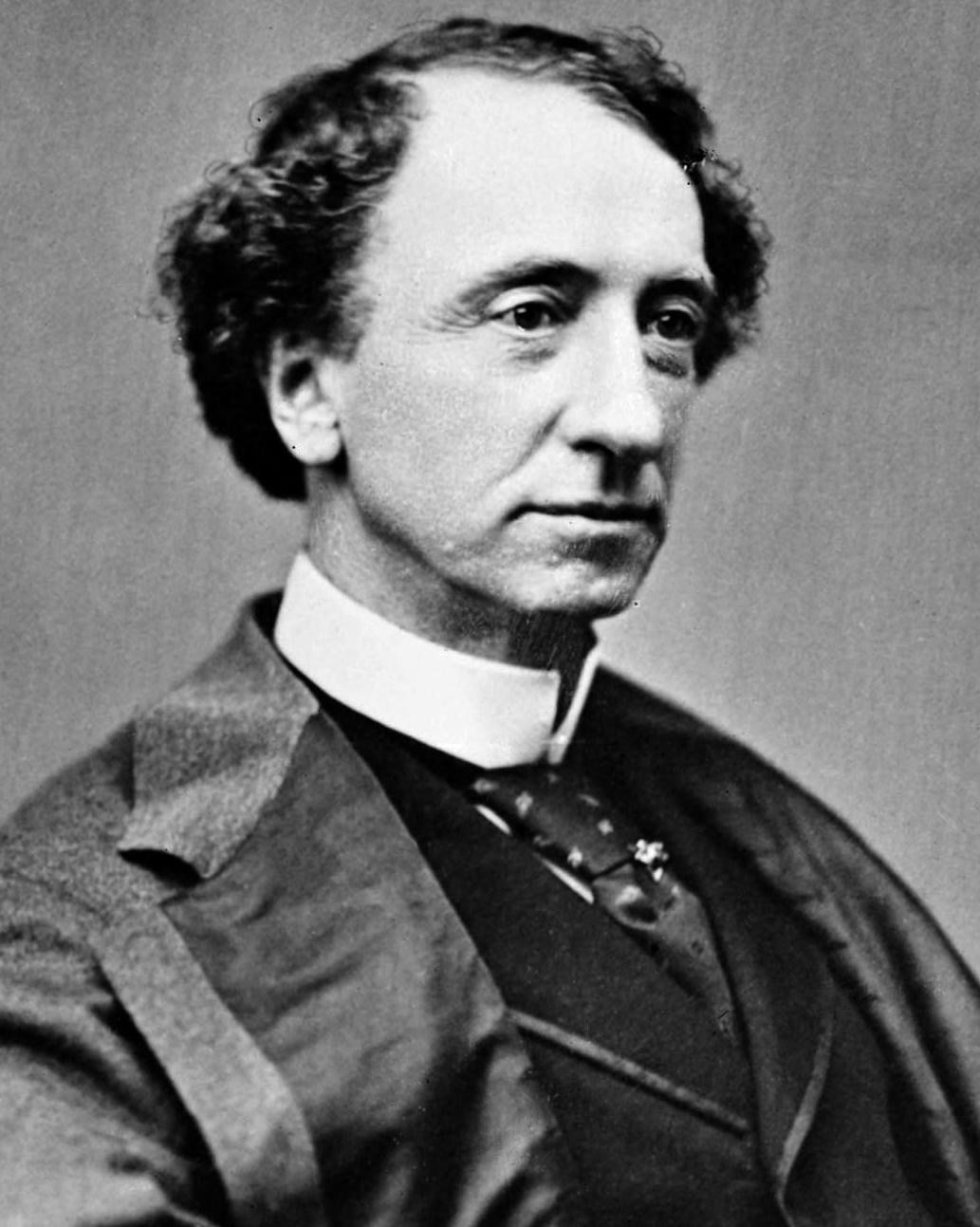
Brady-Handy_John_A_Macdonald_-_cropped

The idea was ludicrous. If completed, and experts lined up to say it could not be done; it would be the longest railway in the world. Not only that, it would be built over the world’s most inhospitable terrain. The rocks and thick forests of the Precambrian shield would be hard, the muskeg that could swallow men and machines whole would be harder, and the snow-peaked Rocky Mountains, well, they were impossible. Macdonald told the people of British Columbia that he would have the steel line to them in ten years and, based on that audacious pledge, they joined Canada rather than the United States which was bigger, richer and just next door. Now, the impossible had to be done.

There is a great deal about Macdonald that deserves admiration. There’s a lot that makes our twenty-first century selves squirm. To build his railway he exploited Chinese workers – the navvies. They were imported to build the line, given the worst and most dangerous jobs and, when finished, Macdonald acted to have them kicked out and the door barred. Native nations were in the way. Macdonald swept the plains by emptying bellies and filling schools in a slow-motioned cultural genocide. He was slapped into the opposition penalty box when caught swapping railway contracts for political donations, but was soon back.

Canadians preferred Macdonald drunk to the sobor alternative and him a little crooked than the less bold a little straighter. Beyond that, the building of the railway and the building of the country had become synonymous. It was both or neither. Without him, it looked like it would never get done.

When the railway was done the country was one. Try the imaginary map again. Start at Lake Superior and draw a straight line west and see if it touches nearly every major prairie city. That’s the line Sir John built. He built it on the backs of the forgotten and dispossessed, but all for the glory of the rest.

Too much Geography? No. you has just enough to hold your bursting potential. Too little History? No again. No one understands where they are unless they know where they’ve been. It is the marriage of geography and history that makes you and makes us. And together, our iron will to continue, to remain whole and strong and on guard for thee remains reflected in the unlikely but ultimately indestructible and now largely metaphorical long steel rail.

Sincerely,

A Friend.

Corporate Coup: Where Have You Gone Teddy Roosevelt?

Does this sound familiar?

  • The gulf was widening between a tiny elite that was growing richer while the vast majority was seeing the evaporation of economic security and social mobility.
  • Political leaders were largely voices of the powerful who backed campaigns and swayed votes with gargantuan political donations.
  • Cities were witnessing growing violence, as people grew helpless and hopeless with police apparently more interested in cracking heads to maintain order than enforcing laws to promote justice.
  • Rapaciously ambitious business interests that government seemed unwilling or unable to regulate for a common good or sustainable future were befouling the air, water, and forests.
  • The media pandered to the lowest common denominator with stories of the latest crime, tragedy, or scandal while ignoring what truly mattered.

It was the United States. It was 1895. Everything seemed to be circling the porcelain facility with gathering speed. But then, something happened.

Theodore Roosevelt was born to a affluent family in 1858. He could have taken his wealth and Columbia law degree and chased women or money or both but instead chose public service. As a New York assemblyman he was aghast at the working and living conditions of the poor to which his privileged upbringing had blinded him. He fought the deep pools of wealth and swirling eddies of political power that sought only to maintain the status quo or enhance its inequity.

A string of family crises took him to the west but he was soon back and with a burning desire to bring right to so much wrong. As New York City’s police commissioner he often took a reporter in tow and toured the city’s mean streets at midnight. He fired cops who were found asleep, corrupt, or unworthy of the badge. He shone light into dark tenements where unfair advantage, unenforced laws, and accepted practice worked against the working poor.

He continued these efforts as New York’s governor. With each demand for reform, he was threatened by those who believed him a traitor to his class and a danger to bosses who ignored laws, rules, ethics, and morality. Roosevelt’s Republican Party, seen as the party of the rich, white, elite, began to move against him.

Many Republicans applauded his being moved out of the way with his appointment as President McKinley’s Assistant Navy Secretary. They were even happier when, after his daring military exploits in Cuba made him nationally famous, he became McKinley’s Vice President. At that time the old joke rang true: One man went to sea and the other to the Vice Presidency and neither was heard from again.

However, McKinley was assassinated in 1901. At age 42, Roosevelt became America’s youngest president. Upon moving in, by the way, it was he who changed the name from the President’s Mansion to the White House.

Where Have You Gone Teddy Roosevelt

Roosevelt moved slowly toward implementing his Progressive agenda and was helped immensely by a growth in investigative journalism. McClure’s Magazine began it all with the publication of a number of fact-filled articles detailing corruption in government, unions, and business. Its greatest writer was Ida Tarbell. She wrote a series that exposed the Standard Oil Company as the worst of the huge trusts that were enriching a very few while exploiting workers, destroying the environment, and making a mockery of democracy and capitalism.

The McClure’s articles, and others that followed their lead, afforded Roosevelt the public support he needed to take on the trusts and their powerful mouthpieces in Congress and the mainstream press. He used the largely toothless Sherman Anti-Trust Act to launch a lawsuit that ended up smashing the trusts and their corporatist Congressional power. Despite what critics had warned, the economy did not collapse, in fact, it thrived as never before as millions were now participants and contributors rather than its minions and victims.

From this effort came what Roosevelt called his Square Deal. It was a program of government action that regulated business to make food and products safer, workplaces more humane, living conditions more human, and, through it all, the American dream more aspirational and obtainable. Hope replaced despair. Again, despite the warnings, the government activity did not end ambition; rather, it allowed it a more fertile field in which to blossom.

The Square Deal attacked the notion that the rich can’t be taxed and poor can’t be helped. This idea was the corollary of the maxim that the rich won’t work because they don’t have enough money and poor won’t work because they have too much. Roosevelt showed both were bosh.

Roosevelt was the first environmentalist president. His National Monuments Act created parks, bird sanctuaries, national forests, and game preserves. Against the baying lobbyists demanding the right to drain profits from untapped resources, Roosevelt protected national treasures such as the Grand Canyon.

Upon leaving the presidency, Roosevelt took pride in the fact that Robber Barons who had been despoiling capitalism and democracy were chastised. A movement for the responsible stewardship of the environment had begun. The role of government as the arbiter for the people rather than apologist for the little elite was established. The practice of socializing risk while privatizing profit was put at bay.

Now, though, it is 1895 again. The slow motion corporate coup d’état that began in the early 1980s in the United States, Canada, and Britain is nearly complete. Those noting the trend and offering solution are, like before, ignored, belittled, or attacked as enemies of the democratic, capitalist ideals they are trying to save from those who sing their praises while violating their principles.

Is that OK? Or is it time to wonder: “Where have you gone Teddy Roosevelt, our nation turns its lonely eyes to you.”

I guess its up to those of us who believe in real democracy and capitalism and not what they have become. It is for us to see through the negative ads, scandal de jour, screeching pundits, twitter trolls, ideologically warped cable news, and bread and circus on offer.

Perhaps those eager for change will not take to the streets but, rather, there will be a quiet but popular rejection of those who are bought and paid for. Maybe a lot of folks – it never takes a majority, just a lot – will call out those who use our money to bribe us and insult us by ignoring us or by hissing “obviously” through smirks. Maybe enough people will make it clear that we actually see through the contradictions between their words and actions and see their irony on parade and the cynicism of their papier-mâché faux patriotism.

Perhaps there is another Roosevelt out there and who know which party he or she is in? Teddy? Are you there?

Postscript: The story is true. Roosevelt was an avid hunter who once refused to shoot a small bear that his guides had leashed to a tree lest he go home without a kill. A toy company heard the tale and produced stuffed bears that it named after the president, hence, Teddy Bears.

If you enjoyed this column, please share it with others and consider checking my other columns and even following my weekly blog.

Two Questions to Never Ask Teenagers

You should never try to teach a dog to whistle for it will result in nothing more than frustrating yourself and annoying the dog. Similarly, there are questions that you should never ask a teenager. The two most important are these:

Question One: What were you thinking?

Last Saturday evening I was leaning on a railing enjoying the majestic view of the river and parliament buildings from Ottawa’s beautiful Major Hill Park. Then, far below, a young man had missed the Frisbee thrown by a friend and they were staring forlornly into Rideau Canal’s shallow, stagnant water fifty feet down.

The taller, skinnier one was suddenly climbing down the lead used by boats in the summer. A small crowd gathered at my railing. We were too far away to intervene but some giggled, some shook their heads, and, like me, others held their breaths.

Two Essential Questions to Never Ask Teenagers

Rideau Canal from the park (www.tripadvisor.com)

At the bottom of the cable, the young man found himself six feet or so from his little yellow toy. He clamoured back up. Soon he had descended again, had a leg linked over the bottom of the cable, and was precariously dangling upside down. He’d gone Cirque du Soleil on us. His friend then dropped a long stick that he miraculously caught. He used it to snag the Frisbee and then sailed it back to the top. Clearly exhausted, he slowly climbed out with his legs visibly shaking. Our little crowd dispersed as our two heroes commenced a spirited victory dance.

Why did he do what could have led to a serious injury or death? It was his brain’s fault.

You see, the last part of our brains to become fully functional is the pre-frontal cortex. It is just behind the forehead. It is the area responsible for being responsible. It links cause and effect. The incomplete wiring renders teenagers not unwilling but unable to fully comprehend situations that adults would consider socially awkward or inherently dangerous. As a result, teenagers often embarrass or infuriate adults or take what an adult would consider crazy risks like, for instance, climbing into a deep, concrete canal.

Scanning of a human brain by X-rays

(Photo: sharpbrains.com)

The nucleus accumbens is another part of the story. That is near the back of our brain and is the first to develop. In teenagers, the impulses flowing through that wiring work overtime. It is the pleasure seeking, reward loving part of the brain. It is the part that inspires action not because it would be right or safe but only because it would be fun. With no frontal cortex to warn of risks, the teenagers are off to the party, into the fast car, skipping away from class, or, like last Saturday, lowering themselves down canal walls.

I wish I had been closer so that I could have warned our young friend about what he was about to do. I could have done as good parents and teachers do and, like a computer’s remote hard drive, acted as his remote pre-frontal cortex. But we spectators were all too far away. And it was just as well there were no adults waiting at the top when he emerged to ask our young climber what he was thinking. His honest answer would have been, “I was not thinking at all.”

Question Two: What do you want to be?

This question is dumb for three reasons. First, it implies that the teenager is nothing now. That’s insulting.

Second, the question is probing for a profession. The problem is that most teenagers don’t know and so will just proffer an answer likely to please. Why encourage lying? Further, according to Forbes magazine, teenagers today will have 15 to 20 jobs in their working lives. So why ask the question left over from the days of gold watches? Plus, one or more of those occupations will likely involve a job that does not now exist. So how can a teenager know what their job or jobs will be?

Most important of all, though, is that the question perpetuates the sad habit of defining oneself by a job. It’s the game show mentality of defining questions: what’s your name, where are you from, what do you do? It’s what crushes the souls of the un- and underemployed, led to baby boomer suicides after the 2008 crash, and makes retirement difficult for far too many. What am I if I am not the teacher, lawyer, or whatever? If a person is more than their race, gender, sexual orientation, class, ethnicity, ability, and body shape, then are they not also more than their job?

So if an adult asks a teenager what they want to be, a good answer would be this: “I hope to be an engaged citizen, a person of good character, a responsible parent, and a person who loves and is loved.” In fact, that would be a good answer for even those of us with fully wired brains.

For now, let’s avoid both questions. Instead, let’s enjoy our non-whistling dogs and the teenagers who are doing the best they can.

If you enjoyed this column, please share it with others using your social media of choice.


The Princess and the Tulips

Princess Juliana was in trouble. The country over which she would someday reign was in crisis and her life was in peril. The Nazi blitzkrieg was pushing its way north and west and her beloved Netherlands was certain to fall to Hitler’s mad ambitions.

Just three years before, with the encouragement of her mother, the powerful and extraordinarily wealthy Queen Wilhelmina, she had married a young German aristocrat named Prince Bernard of Lippe-Biesterfeld. They soon fulfilled the most important part of their royal duties by producing heirs. Princess Beatrix was born in 1938 and then, a year later, Princess Irene.

Despite suspicions of all things German, the Dutch people accepted Prince Bernard. He changed the spelling of his name to be less German and became a Dutch citizen. Now they worried about their future, the future of their country, and that of the Royal bloodline if the Princess and her family were captured by the Nazi horde about which astounding stories of unspeakable horror were being told.

The Royal family was evacuated to London. Queen Wilhelmina oversaw the creation of a Dutch government in exile. A month later, in June 1940, Princess Juliana and her family were sent to an even safer sanctuary in Ottawa, Canada. A spacious house was found in the tony neighbourhood of Rockcliffe Park, home to ambassadors and the city’s elite. The house was called Stornoway. It would later become the residence of the leader of Canada’s Official Opposition.

Juliana followed the tragic news of her country having fallen under the Nazi yoke as she worried about her mother enduring the London blitz. The shy princess led a quiet life and remained aloof from Ottawa society events to which she would have been welcomed. Problems arose in late 1942 when she found herself pregnant. If she gave birth in Canada, the child would have dual citizenship and so be robbed of a spot in the Royal line of succession.

The Canadian government came to the rescue. It declared her rooms in Ottawa’s Civic Hospital to be temporarily extra territorial. In other words, for the moment, Juliana was in the Netherlands. Princess Margriet was born on January 19, 1943. The child became the first, and remains the only, royal personage to be born in North America.

Princess and the Tulips Royal Family

Home from the Ottawa Hospital (Photo: cbc.ca)

Canadians were as pleased as the people of the besieged Netherlands. The news led Canadian radio broadcasts and adorned newspaper front pages. The Dutch flag fluttered atop the Parliament Building’s Peace Tower and its bells chimed out the Dutch national anthem and folk tunes.

Meanwhile, the war raged on. Successful D-Day landings by British, American, and Canadian troops initiated a slow and bloody push toward Berlin. Canadians were assigned the left flank and, in September 1944, they began the liberation of the Netherlands. It was tough. The Nazi army had flooded land, mined ports, and dug itself into intractable defensive positions. The Dutch people did what they could to offer fifth column help. So many were so hungry that they had been surviving by eating tulip bulbs. Many were saved when Royal Canadian Airforce planes dropped food for the starving.

Canadian troops fought gallantly. The Battle of the Scheldt was the most excruciating engagement. Between October and November 1944, the Canadian First Army suffered nearly 13,000 casualties. When it succeeded and Nazi forces retreated, Canadian soldiers were hailed as heroes. As they entered Dutch towns, the tired but smiling young men were showered with flowers and gifts.

On May 2, 1945, after five years in Canada, Princess Juliana and her children were able to return first to London and then, along with Queen Wilhelmina, to a freed and free Netherlands. To demonstrate their gratitude for all that Canada had done for the country and her family, the Princess arranged that 100,000 tulip bulbs were sent to Ottawa. The next year, 20,000 more arrived with the request that they be planted on the hospital grounds.

In 1948, as result of her mother’s long illness, Juliana, became Queen. She ensured that more tulip bulbs were sent to Canada every year. Every spring saw Ottawa resplendent in a riot of colour. In 1952, at the suggestion of noted Canadian photographer Malak Karsh, Ottawa began an annual Tulip Festival. The city hosted a celebration that grew to include concerts, buskers, plays, fireworks, and more. Every year the city’s tulip beds grew even more spectacular.

Princess and the Tulips Photo: magpiejewellery.com

In Canada’s centennial year, 1967, Queen Juliana was enthusiastically cheered as she enjoyed the festival. In 2002, Princess Margriet was the special guest commemorating the festival’s 50th anniversary.

This weekend my family will be enjoying the festival. We’ve been before. It is spectacular. The flowers, so fragile and lasting only a short while, are reminders of a friendship within a tragedy and of our common humanity. They remind us of what can be lost to the insanity of war and blind adherence to a hateful ideology. And, standing boldly in the spring breeze, they symbolize the assurance that after every winter follows the spring and the determined hope that we may someday be sufficiently mature to live in peace.

 This is a rare second column in what is usually a weekly blog. If you like it, please share it with others and consider leaving a comment.

A Woman’s Power

Movie lines sometimes contain more truth than a philosophy tome. Consider my favourite line from My Big Fat Greek Wedding. A mother is patiently explaining to her adult daughter that Dad is indeed the head of the family. However, she adds, “I am the neck.” I love that. I might add that women are also often the glue.

I learned this truth by unconsciously absorbing my paternal grandmother’s lessons. She was the eldest of three strong sisters, the second generation of Ukrainian immigrants escaping turn of the century pre-revolutionary violence. Her mother provided Ukrainian language lessons to other immigrant kids in Hamilton’s hardscrabble east end. One day, the skinny 15 year-old was bored and waiting for her Mom to finish when a shy pupil not much older than her approached. He whispered that she was the most beautiful girl he had ever seen, and that someday he would like to marry her. That was my grandfather. They were married for 63 years.

Her father was one of the first men hired at Hamilton, Ontario’s brand new Dominion Foundry and Steel (Dofasco). He arranged a job for his son-in-law where he worked for 42 years. Later, the Second World War saw North American women doing what many women and most men said could not be done; they fought the war on factory floors. My grandmother worked 8-hour shifts in heavy overalls and beneath a thick kerchief. She lifted, turned, and processed steel sheets. She was, in the vernacular of the day, Rosie the Riveter.

An old Dofasco newsletter shows her and other women smiling broadly and doing their bit with a patriotic passion and rugged determination to make a deeper point. There was celebration when the guns fell silent and the afternoon shift was let out early. Amid the cheers, all the women were given small paper packets containing a tiny bonus and a pink slip. She told me how that she would have liked to have kept working and, like many others, felt used and cheated.

Women Are Glue

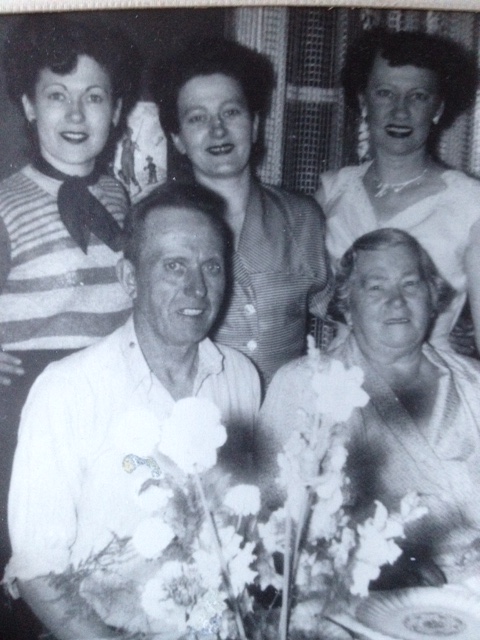
(The three sisters and their parents, my grandmother is standing on right)

When her mother was failing, my grandmother made a promise. She would keep the family together and carry on the tradition of the large gatherings like those at the old Port Dover farm. The basement of her modest Burlington home was refashioned into a party room. Every big occasion, and certainly every Christmas, the room sang with my large and loud extended Ukrainian family. My grandmother met everyone at the door with a smile, kiss, and hug. She was a big woman and when you got hugged, you stayed hugged.

Long tables sagged under more food than even our army of a family could consume and then everything was packed away for my cousin’s band and the dancing. The adults got to drink a little too much and the kids got to stay up past bedtime as the old stories and jokes were told through Export A smoke, smiles, and laughter.

The last time I saw her was in a hospital bed. As I was saying goodbye she put her hands on my cheeks and squeezed them together and pulled me close as if I was a six-year-old again. Perhaps, in her eyes, I was. She said, “I hope you know how much I love you.” I said, “I do. And I hope you know how much I love you.” They were our last words.

She told the doctor that she wanted to go home and he said only when she could walk the hallway and was completely off morphine. He didn’t know her very well. She did both the next day. She arrived home and within 45 minutes she was gone. This last act said everything you need to know about her strength.

That Christmas, there was no party. Everyone was too sad. She wasn’t there to push us through our grief. There was never another party. First the extended family and then some even closer drifted further. The glue was gone.

No family is perfect. Scratch the surface of any family and amongst the litter of love and happy days glowing like Facebook postings, you’ll find scars and unhealed wounds. Despite this fact, family, no matter how defined, constructed, or shifting, is sanctuary. Family is what reminds us of who we are when we sink too low or fly too high. Family is what affords us the courage to carry on when we’d rather quit and the reason and confidence to venture forth in the first place.

Every family has one person that acts as glue and holds it all together when so much seems determined to tear it asunder. Because most men, like me, are dullards about such things and too often too self-absorbed, the job usually falls to women. They are the miraculous caregivers who become the bond between people and generations. They love without judgement. Their lives and the values that guide them become their silent advice. They kiss your cheek or kick your ass or just sit and listen, and then listen some more.

They are the women who only those with enough love can see for who they truly are. Bless these women. They, like my grandmother, are the angels among us now and forever.

If you liked this column, please send it to others and consider following my Monday morning blog.

The Importance of Ignoring Your Rabbits

Journalists, detectives, and hiring teams love hypothetical questions. Those in their sights are asked to imagine situations and predict reactions. Politicians dismiss them. Suspects leap behind lawyers. Pity the sweaty-palmed job applicant spinning an internal Rolodex of possible responses while balancing honesty with guessing the right answer

As an author, I have been interviewed countless times in TV and radio studios, over the phone and over coffee, and before audiences. Speaking engagements always end with a Q and A. In most cases, I am asked about whatever book has just been published and my answers come relatively easily. After all, by the time a book leaves the nest to make its perilous way in the world, it has been re-written so many times that an author nearly has it memorized. Further, after a while, an author hears the same dozen or so questions and it becomes a little like Neil Diamond singing Sweet Caroline – the performance is still heart-felt, enjoyable, and hopefully entertaining, but seldom challenging.

But then, once in a while, down the queue comes the query – the hypothetical. It just happened to me again. I am proud and was humbled to have been invited to be one of six artists, authors, business people, and community leaders to participate in the annual fundraiser for the Greater Peterborough Health Services called Peterborough Speaks.

Last Wednesday evening, each of us took a turn on a chat show-like setting at the Market Hall theatre. We were interviewed for about 15 minutes before an audience of 250 and those who will watch later on television. Media personality Michelle Ferreri began my session with a question about my upcoming book and all was going well enough, I thought, until the end. She concluded with, “What advice would the current you give to your 20-year-old self?”

Ignoring Rabbits (photo: Peterborough Examiner)

Wow! Up in the Green Room, I had heard BrandHealth president Paul Hickey asked that question and so I didn’t think the same bullet would be fired again. I was reminded of the same gulping feeling I experienced when asked by a Calgary CBC journalist during a live radio broadcast: “Of all the Canadian prime ministers, which would have been the best NHL hockey player and why?”

That time, I was on the phone with radio’s cruel absence of the communication crutches of expressions or gestures and the terror of dead air. Now I was on stage before all those people and cameras. I was suddenly like one of the hundreds of job applicants who, in another part of my life, I had interviewed with similarly tough, hypothetical questions. It was my turn to spin the Rolodex.

I said, “I would tell my 20 year-old self to ignore the rabbits and tend the tree.” Michelle looked incredulous and there were smatters of nervous laughter from the audience. I explained;

“When I was 20, I was like a frenetic young man alone in a large field teeming with rabbits. I was armed with a tiny net called ambition. I scurried from one to the next, finding that with every rabbit I snared, two more got away. I wish I could convince that guy to leave the field and seek a sanctuary of silence to contemplate what is truly important. I would implore him to imagine shaping his life less as a hunter and more as a gardener before a young bonsai tree. I would suggest that he slowly nurture its growth by picturing its ideal shape and then, over time, mold it into that shape by snipping off certain people, places, activities, and habits and all else that is destructive and distracting. I’m not sure he would have had the capacity to hear me for winter can seldom warn the spring, but I would advise my 20-year-old self to ignore the rabbits and tend the tree.”

I had considered the metaphor of the bonsai before but never constructed the thought as I expressed it that evening. Now that I have, and because I did it in such a public way and with this writing I am doing it again, I am pressing myself to a new challenge. I will soon be making a couple more snips.

As for the fellow in Calgary, I said, “Sir John A. Macdonald would have been the best NHL hockey player for in the Gordie Howe tradition he had the broadest skill set of anyone at the time and was not above throwing a few elbows.” I hope Sir John and Mr. Howe would have liked that. I suspect that as young men they had learned to ignore the rabbits.

If you enjoyed this column, please consider sharing it with others through your social media of choice and to subscribing to follow my Monday morning blog: http://www.johnboyko.com

The Little Known Canadian Links to Lincoln’s Assassination

One hundred and fifty years ago this week, on April 15, 1865, famous actor John Wilkes Booth placed a small derringer behind Abraham Lincoln’s left ear. Several hours later, the president who had led the United States through the horrific Civil War that had ended only days before, was dead.

With Lincoln went his goal of treating Southerners not as conquered but countrymen. The Senate’s Radical Republicans ran roughshod over a new and weak president to impose their program of punishment and retribution. To a large degree, America’s regional, political, and racial divisions are echoes of the botched reconstruction that Lincoln would not have allowed. We understand the assassination’s consequences for America but few know of its Canadian connections.

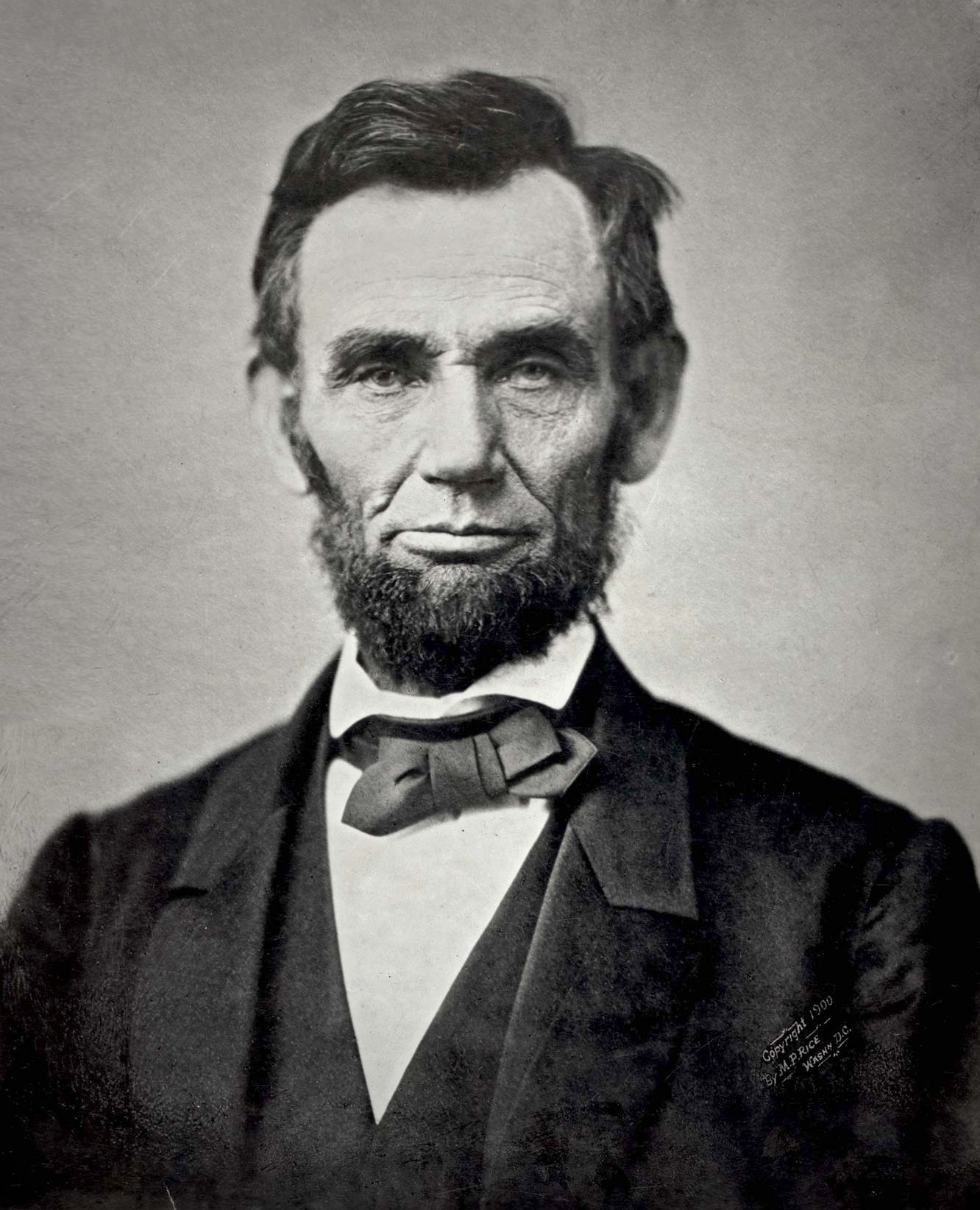
Canada and Lincoln Assassination

(Photo: en.wikipedia.org)

A virulent racist and staunch believer in the Southern cause, Booth gathered a group of like-minded people at Mary Surratt’s Washington boarding house and hatched a plan to kidnap Lincoln. They would release him when the United States, seen by Southerners as a foreign country that had invaded theirs, withdrew its forces. To help organize the plot, Booth travelled to Montreal.

Like many other Canadian cities, Montreal was a hotbed of Confederate activity. A year before, Confederate President Jefferson Davis had appointed Jacob Thompson, a former federal cabinet secretary, to save the South by going north. Thompson established offices in Montreal and Toronto. He organized Confederate deserters, escaped prisoners, and sympathetic Canadians who then harassed Lincoln’s Union with daring raids, Great Lakes piracy, and fifth column intrigues.

Booth arrived in Montreal in October 1864. He took a room at the swanky St. Lawrence Hall hotel that served as Thompson’s headquarters. He met with Confederate spies and gun and blockade-runners. At the Bank of Ontario, he exchanged $300 for gold sterling. Booth worked for 10 days making plans and contacts.

Booth’s failed kidnapping plot and the war’s end led to a new idea. On a single night they would kill Lincoln, Vice President Johnson, Secretary of State Seward, and General Grant. The government would be decapitated and the South inspired to rise again. However, at the appointed hour, Grant had left Washington, Johnson’s assassin got drunk, and Seward survived his stab wounds. Only Booth succeeded.

Booth was hunted down and shot by a 26-man detail led by Quebec-born First Lieutenant Edward Doherty. On May 2, a proclamation stated that the government was seeking a number of Booth’s accomplices, including “rebels and traitors against the United States, harboured in Canada.” Among those listed was John Surratt. He had fled to Canada and was being hidden by priests, first in a Village north of Montreal and then in the city. Canadians helped him to escape to Europe.

Booth’s other conspirators were captured and brought to trial. The prosecution sought to prove their guilt along with the complicity of what it called the Confederacy’s “Canadian Cabinet”. The first words spoken in testimony were by a War Department spy, “I visited Canada in the summer of 1864, and except for the time I have going backward and forward, have remained there for almost two years.” Canada was central to the majority of testimony that followed, including that of a spy posing as a Montreal businessman who later arrived to clear his name. The trial’s final words went to Special Judge Advocate Bingham, “Surely no word further need be spoken to show that…[Booth, Surratt] and Davis and his several agents named in Canada, were in this conspiracy.”

Sensational American newspaper coverage spoke of Canada’s complicity in their president’s murder. Public meetings and vicious letters to editors revealed even greater anti-Canadian sentiment than had developed during the war. There were calls for retribution. The rising tide of hatred led Canadians and Maritimers to renew their demand for Confederation that the Civil War had turned from a good idea to a necessity. Canada had to create itself to save itself.

Today’s divided America and united Canada are the twin legacies of Booth’s smoking gun.

For more on this story and of Canada and the American Civil War please check out “Blood and Daring: How Canada Fought the American Civil War and Forged a Nation”. It’s available everywhere including here: http://www.chapters.indigo.ca/en-ca/home/contributor/author/john-boyko/#page=0&pid=978030736146

What Will A Man Do For Love? He’ll Run!

In the animal kingdom you awake and run. You run to catch food or run to escape becoming another’s meal. The metaphor is unfortunately apt for the business world where one eats or is eaten and so running to, from, and around others is a daily challenge.

But why run when one’s food or rung on the corporate ladder are not at stake? Why change into stupidly expensive shoes to take to roadways and trails to pant and sweat and endure pain and risk injury? Why embark on long treks that always bring you right back to the start?

cartoon runner (Photo: galleryhip.com)

John Stanton has made a successful business from those questions. He founded The Running Room that now has storefronts across Canada. He wrote Running Room’s Book on Running that has enjoyed several editions. Its opening sentence states, “The book is for all those people who want to strengthen their bodies, calm and stimulate their minds and soothe their souls. Running improves us mentally, physically and spiritually.” Well, it certainly continues to improve Mr. Stanton financially. Good on him, I say. But, for me, he’s only partly right.

I began running while in university when a friend spoke of its relieving stress and improving fitness. She was right. I began with short distances and after a week or so I did indeed begin to feel better. I soon began to lose some of the weight my discovery of beer had afforded me and became a big fan of endorphins. Endorphins are neurotransmitters secreted by the pituitary gland and parts of the brain that reduce pain and cause stimulation similar to morphine. They lead to a feeling of euphoria called “runner’s high”. I confess that it’s quite wonderful. But less stress, fewer pounds and a free high are not why I run.

As my distances increased I developed the desire to run a marathon. It’s a silly notion really. After all one can argue that it is natural to run as our forebears ran from wild beasts but no predator will chase you for 26.2 miles. That distance is silly too. It’s based on the ancient Greek tale of Philippides who ran 24 miles from Marathon to Athens to report a military victory. He delivered the news, said, “Joy to you” and then, by the way, dropped stone dead. The final 2.2 miles was added for the 1908 London Olympics so that the race could begin at Windsor Castle and end directly before the Royal Family’s White City stadium viewing box.

I ran the Ottawa Capital Marathon with my youngest brother. We had not trained properly and had the wrong shoes and really had no good reason to finish – but we did. I crossed the line and nearly fell into the arms of my dear wife who supports all of my wacky endeavors with the patience of Job squared. I made her pledge that she would never let me run another marathon.

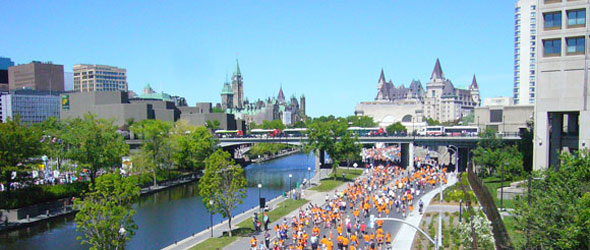
ottawa marathonOttawa Marathon (www.time-to-run.com)

A couple of years later I was preparing to do it again. For the first while I jogged. It’s a nice loping affair punctuated by frequent walks. I then began running, which involves a quicker pace and fewer breaks. I then began training. I created a schedule based on Mr. Stanton’s book, timed myself, recorded my runs, ran hills, ran fartleks (google it), ran in the cold and rain, and tended to frown a lot. Training, after all, is serious business.

I ran the Toronto Waterfront Marathon a lot quicker than I had done the Ottawa. I leapt over the finish line and felt proud of my accomplishment. This time, I could not wait to do another. I completed two more. I ran the last one with a slight hamstring pull so my speed was off and the enjoyment gone.

After a long while off I was pain free but found it difficult to muster the will to move from jogging to running to training. My goal shifted from speed and endurance to the avoidance of injury. In the parlance of the vertical ice cube trays where too many well-dressed, high-stressed people work each day, I guess I’d moved from trying to say smart things in meetings to avoiding saying anything stupid. When that line is crossed, it’s over.

Except, it was not over – not by a long shot. I finally figured out why I run. It is not for the endorphins. It is not to train for another marathon and whatever ego-driven competitiveness those things involve. I discovered it nearly seven years ago. This morning I was reminded.

This morning I was cradling someone who is precious to me in a way that only another grandparent can truly understand. She is only six weeks old. Our eyes met. We held our gaze for a long while until a tear found my eye. I want to see her grow. I want to cheer her games, play with her on the climbers, slide down snow mountains, share her jokes, console her heartaches, and, later, explain why boys are indeed crazy but her Mom is really not. And for all that I need to stay healthy and for that I need to remain fit.

So tomorrow, I will plug in my ear pods, tune into to a favorite playlist or CBC podcast, and lope my way down the trail. I might run. But I will probably just jog. As I ignore creaky knees, await endorphins, and wallow in the beauty of the river on one side and farmland and forest on the other, I will know exactly why I’m there.

If you enjoyed this column, please share it with others through your social media of choice and consider leaving a comment or following my weekly blog.

Shudder or Think? We Must Decide

Canadians are being asked to be afraid. We should apparently be so afraid that we will trade a little more security for a lot less liberty with Bill C-51, Canada’s Patriot Act. It will affect our privacy at home and at work and is why four former prime ministers, retired judges, and so many academic experts in privacy matters oppose it.

At the same time, we are to be afraid of what people wear. A hijab, we’re told by the federal government and a Quebec court, is a threat; not a burka, that covers a person’s face, but a hijab that covers one’s hair. Is this a thin edge of the wedge where courts and the government can tell us what to wear and to fear those outside the mainstream, wherever that ever shifting current happens to be at the moment?

quebec-hijab-dispute-crowdfund-20150228

Rania El-Alloui was recently told by a Quebec judge to remove her hijab or consult a lawyer before proceedings could continue. (Photo: Graham Hughes)

Rather than shuddering, many Canadians opting to think because the anti-terrorist bill and hijab kerfuffle are stirring a debate regarding the definition of Canada.

To try and define Canada, however, is tough for any assortment of words quickly tumbles into confessions of a job half done. Canada is the dancing fire in Iqaluit’s sky as much as the homeless veteran on a Yonge Street sidewalk. Canada is Montreal private club English and Moncton Franglais as much as Ottawa Valley twang and Come By Chance slang.

If only we could ask the Irish who, when the potatoes went dead in the ground and rents flew high, left to start again where merit meant more than whose your father. It would be nice to ask the slaves who snapped their chains and followed the North Star to freedom. Or, maybe the Ukrainians, those peasants in sheepskin coats, who left poverty and oppression for free land and a fresh beginning.

Nowhere was Adolf Hitler’s evil more banal than at the death camps, and the worst of the worst was Auschwitz. The innocent who suffered unspeakable horror spoke of a building where their confiscated property was stored. It became a sliver of light through the cruel darkness. It held the promise that someday they might be released. We could speak with them about their naming the building Canada.

At the war’s end, Canadian doors opened to its victims. Hungarians, Italians, Czechs, Poles, and more came to work the mines, factories, and farms and build the schools, roads, and little towns and towering towers. The Ottawa men called them Displaced Persons while some snarled DP as an insult. The latest to arrive are always harshest on the next in line. Ask the Vietnamese about the Pakistanis or the Irish about the Jews or, for that matter, ask the Boethuk about the English; that’s if you can find a Boethuk to ask.

All the answers from all these people, along with songs and stories and dusty old Royal Commissions, leave us with a country too complex to fully comprehend let alone define. Maybe that’s OK. Canada is like the shape-shifting trickster Raven whose beauty is its ever-changing complexity.

Perhaps this vision brings us as close as we will come in our quest for understanding. But in our hearts, we have always understood the Canadian secret. It is the freedom to try and fail and try again. It’s the draw bridge locked open to new people and ideas.

It is embracing complexity and the fundamental notion that there is value in us all that has created a society where each of us gives a little to help folks we will never meet, whether it’s the old man across town or the hungry child half way around the globe. It’s the notion of community extending beyond our family to where every child is ours. It’s where differences in whom we are, whom we worship, and whom we love are not just tolerated but accepted as who we are

It’s complicated. It’s hard. It’s meant to be. But it is what will save us from fear-based prejudices and policies, be they the proposition of police-state practices or a national dress code. It is our celebration of Canadian complexity that we guard, oh Canada, when we stand on guard for thee.

 If you like this column please share it with others through your social media of choice and please consider subscribing to my Monday morning blog.


Africville: Racism and Redemption

The bulldozers came in the morning. For days they roared like monsters demolishing houses and streets and even the church. They tore down what remained of Canada’s moral authority to say anything about race other than, “We were wrong.”

Africville was created in 1842 with land grants to African American families escaping slavery and discrimination for the hope of better lives. The original sixteen single-acre lots overlooked the Bedford Basin and were separated from Halifax, Nova Scotia by a thick woods and impassable road. The community was called Campbell Road. As Black families left the racism of Halifax and elsewhere seeking solace among friends it was dubbed ‘Africville’. The name stuck.

Links between Halifax and Africville grew over the years as kids were bussed to school and most of their parents worked in the city. Throughout the 1940s and 1950s a number of famous people visited, including retired boxing champion Joe Louis, and Duke Ellington who married an Africville woman named Mildred Dixon. Folks were thrilled with the celebrities but understood that their hospitality was essential because while Louis and Ellington were feted in Halifax during the day they were unable to find lodging in the segregated city at night.

In that way, Halifax was no different than most other cities and towns. The Queen may have been Canada’s head of state but Jim Crow was boss. African Canadians grew used to restaurants where they could not eat, churches in which they could not pray, houses they could not buy, business licenses for which they could not apply, and schools their children could not attend.

Africvillephoto credit: Halifax.com

By the 1950s Halifax had grown to encircle Africville. The city council embarked on a determined campaign to rid itself of the Black community that had become part of their city. Despite the fact that Africville’s people were Halifax citizens and paid municipal taxes, the road to and through the community was unpaved and in the winter it seldom saw a plow. There were no streetlights. There were no sewers. Families drew water from a central well that the city had dug as a “temporary measure” in 1852.

Police seldom patrolled and ignored most calls. In 1947, seven houses were destroyed by fire because, although the fire department had been called, like usual, it had not responded. Insurance companies refused to sell home and property policies, so banks issued neither mortgages or home improvement loans.

Africville churchphoto credit: Halifax.com

Everything distasteful and dirty went to Africville. With no consultation with Africville’s citizens, and in defiance of petitions and presentations, Halifax council located in or adjacent to the community a pungent slaughterhouse, oil refinery, and tar factory, a deafeningly loud stone crushing plant, and a hospital for infectious diseases. A railway company was allowed to build a line through the community and landowners were only partially compensated for expropriated land. The city dump was relocated 350 yards from west end Africville homes and then a smoke-belching incinerator was constructed nearby.

The disgraceful treatment of the community and the racism faced by those working in Halifax took its toll. Africville got tough. The “Mainline” portion of town was home to middle-class people who worked hard and did their best. The “Big Town” area, however, knew every crime and vice imaginable. The only white people who saw Africville came to Big Town for dirty old times after Halifax bars closed.

University of Toronto’s Gordon Stephenson wrote a report that echoed 1950s urban renewal practices. He recommended relocating Africville’s people and razing their homes. A 1962 Halifax Development Department report stated that the majority of Africville’s people did not want to leave; they just wanted the services that other Halifax citizens – White Halifax citizens – had enjoyed for decades. The report concluded, however, that the people should be ignored and the professor obeyed.

Concerned Africville citizens met at the heart of their community, the Seaview Church. Over a hundred people vowed to save their homes. Peter Edwards made an impassioned plea to city council on October 24, 1962. He spoke of Africville’s history and spirit. He spoke of the racist policies and treatment endured over the years and in the current process. “If they were a majority group,” he said, “you would have heard their impressions first.”

City council responded by hiring University of Toronto’s Albert Rose to study the situation. No one was fooled. Rose had written Regent Park: A Study for Slum Clearance. They knew what he would say. In no time at all he said it. Africville was doomed.

Residents received an average of $500 for their homes. It was later discovered that additional assistance had been available but only 30% of the people were told about it and then only 15% of applicants were approved. People who had been self-sufficient homeowners were forced into a subsidized housing project and then forced to move again when told that even before they had been crammed into the ramshackle apartments, the complex had been scheduled for demolition.

By 1969, Africville was gone. The city had said it needed the land for industrial expansion but it never happened. It said it needed the land to construct a bridge but ended up using a sliver of the property.

In 1985, a monument was erected to the people of Africville in what had become the Seaview Memorial Park. The names of the original families were engraved into a stone. Family reunions began finding their way home with grandchildren being told the old stories. A former resident recalls, “Out home, we didn’t have a lot of money but we had each other. After the relocation, we didn’t have a lot of money – but we didn’t have each other.”

Africville lives. It lives as a symbol of the more than three hundred years of systemic racism that African Canadians endured and against which they struggled. In 2010, the Halifax City Council apologized to the people of Africville for all they did to, and all they did not do for the community. It apologized for Africville’s destruction.

A hectare of land was set aside and money allocated to rebuild the Seaview United Baptist Church. It will serve as a historical interpretive centre in a park renamed Africville. There, stories will be told of a time when racism coursed through Canadian veins and of a hope that someday, racism will be relegated to the dustbin of history. Someday.

If you enjoyed this column, please share it with others, consider commenting or following my blog, or even buying my book entitled Last Steps to Freedom: The Evolution of Canadian Racism, that addresses the history of racism in Canada. (Find it at Amazon or here at Chapters online: http://www.chapters.indigo.ca/en-ca/home/contributor/author/john-boyko/

Of Flags and Fury

February brings us one thing that Prime Minister Harper wants us to know and another he wishes we’d ignore. He hopes we pay attention to Bill C-51, his new and still pending Anti-Terrorist bill. He hopes we forget that today our flag turned 50 years old. The two offer a tremendous opportunity.

Unlike with the War of 1812 or the First World War, Mr. Harper has given little money or attention to the flag’s birthday. He’s right, let’s snub the flag. The notion is not as blasphemous as it sounds. Consider that every school day, millions of American children stand and recite, “I pledge allegiance to the flag of the United States of America and to the Republic for which is stands.” In other words, it is not the flag that deserves allegiance, but what it represents. So maybe Mr. Harper is right that commemorating the flag would trivialize our national identity by indulging in a patriotic celebration of its mere symbol.

Flag_of_Canada.svg

Patriotism, after all, is ankle-deep and transitory. It’s civic-nationalism that delineates who we are. Patriotism can dance merrily along without concern for introspection but civic-nationalism demands it. Unlike the bread and circuses of patriotism or jingoist chest-thumping or empty-headed chauvinist aggression, civic nationalism rests upon a quiet, self-assured confidence among citizens in what is unique, valued, and valuable. It is inspirational and aspirational in defining what deserves to be protected and enhanced.

Our flag is just patriotism on a pole. The day before Lester Pearson assumed office in 1963, a bomb shattered a Montreal afternoon. The horrible blast and those that followed fueled the ethnic-nationalist debate regarding the creation of an independent state for the Québécois nation. Pearson’s new flag offered tribalists and the rest of us the patriotic balm that the British flag would be removed from ours. To the parts of the prairies and north where maple trees do not grow, of course, the big red maple leaf offered yet another reminder of central Canada’s myopic vision and arrogance.

So let’s forget the flag’s patriotism and use the opportunity presented by its birthday and C-51’s potential birth to question not what’s up the pole but in our hearts. For too long we have been called taxpayers. For too long we’ve been treated only as consumers. We’ll soon just be considered voters. Let’s demonstrate that we are citizens by engaging in a national conversation. Let us post blogs, send tweets and emails, and my goodness, maybe even speak with one another. I suggest these questions to begin:

Do we respect parliament and so believe that new legislation should be introduced in the House and not at some place akin to a campaign stop? Do we believe the rule of law insists that our police and spies always obey the law? Do we believe that adequate staff, budget, and mandate must exist along with a process that reports to parliament before anyone can speak of proper oversight of our spies and police? Do we believe the rule of law implies that citizens can only be arrested when they break a law and not for what others think they’re maybe thinking? Do we believe the best way to fight those who do not share our democratic values is to suicide the democratic values we treasure? Do we believe misinformation is criminal propaganda if a citizen creates it but not if disguised as an MP mailing or TV ad? When the House debates begin, will we recall the difference between insult and argument? Do we believe a party that says it opposes the law should vote for it? Do we understand that economic prosperity and environmental sustainability are not either-or propositions but that security and liberty are?

So let’s take our government’s advice and ditch celebrations of a patriotic symbol. Let’s instead engage in something deeper – active citizenship. If we use C-51 to consider whom we are and whom we wish to be, we may just end up proving ourselves worthy of our allegiance to the flag through deepening our understanding of the Dominion for which it stands.

If you enjoyed this, please send it to others using your social media of choice, consider commenting, or joining my blog where I post about history, politics, music, or musings once a week.