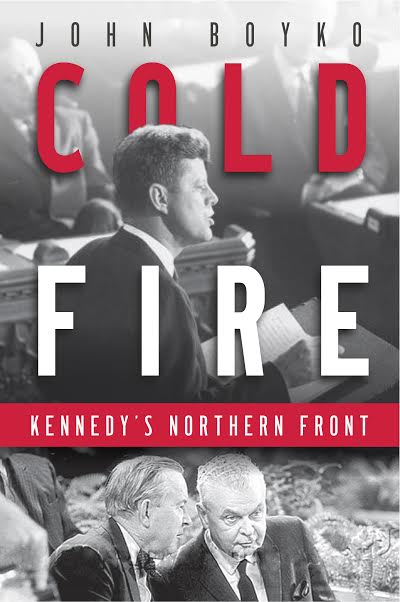
Cold Fire: Kennedy’s Northern Front

jacket

Cold Fire: Kennedy’s Northern Front will be published in Canada and the United States on February 2, 2016.

The United States and Canada had reached a crossroads and three leaders were trying to pull their countries in wildly different directions.

President John F. Kennedy pledged to pay any price to advance America’s homeland defense and strategic goals and he needed Canada to step smartly in line. Canada lay between the United States and the Soviet Union and so was a vital part of America’s security. Kennedy demanded that it house nuclear weapons and change its economic and foreign policies to support his. Frustrating Kennedy at every turn was Conservative Prime Minister John Diefenbaker, an unapologetic nationalist seeking to end the trend toward greater continental integration by bolstering Canadian autonomy and developing an independent identity. Meanwhile, Liberal leader Lester Pearson, the Nobel Prize–winning diplomat, saw value in continuing the slide toward integration.

While battling communism around the world, Kennedy never forgot his northern front. He adroitly exploited his enormous popularity among Canadians to seduce its people and pressure its government to bend to his will. He ruthlessly attacked Diefenbaker and shamelessly supported Pearson.

Newly released documents present shocking revelations about these crucial years. During the Cuban Missile Crisis, Canadian ships and planes guarded America’s Atlantic coast, while Canada suffered a silent coup d’état. Kennedy pushed a nuclear weapons system on Canada while knowing full well that it was merely a decoy to draw Soviet fire. Kennedy carefully influenced and monitored the overthrow of a Canadian government and the election of another. While Canada helped Kennedy tumble into the Vietnam War he did nothing to stop American inspired violence on the Great Lakes border. Perhaps most startlingly, if not for Diefenbaker, Kennedy may have survived the assassin’s bullets in Dallas.

The movie-television rights have already been optioned for this non-fiction book that reads like an adventure novel, brimming with sparkling stories, fascinating characters, and fresh insights into this critical moment. Cold Fire will astonish readers with the intriguing ways in which the struggles of these three resolute leaders determined the course of the next half-century.

The book can be pre-ordered at Chapters: https://www.chapters.indigo.ca/en-ca/books/search/?keywords=john+boyko

or at Amazon: http://www.amazon.ca/Cold-Fire-Kennedys-Northern-Front/dp/0345808932/ref=sr_1_4?s=books&ie=UTF8&qid=1446165612&sr=1-4

Hundred Days and Honeymoons

In the fifth century, a northern European marriage tradition encouraged newlyweds to enjoy a daily dose of mead, a fermented liquid honey. It was believed to be an aphrodisiac. Using the only calendar available, the sipping stopped when the moon returned to the wedding day’s phase – about a month. From this custom came the honeymoon.

The concept has grown. We experience honeymoons at work. The new person is allowed silly questions and rookie mistakes. New business leaders are similarly excused if questions reflect a genuine desire to understand and not veiled threats, and mistakes are forgiven if blame is accepted and apologies are quick. Often, however, honeymoons end when a business leader’s personality flair reveals a character flaw; intelligence becomes arrogance, or the pace and nature of change threatens profits or values.

Such is also the case in political leadership. Political honeymoons are Franklin Delano Roosevelt’s fault. He became president in March 1934, in the depths of the Great Depression. Within 100 days of inauguration he presented, and Congress passed, 15 major bills. He began by closing and stabilizing banks and then quickly touched nearly every sector of America’s sputtering economy. Some New Deal legislation worked and some failed but within those frenetic 100 days confidence and investment were rekindled and lives and capitalism itself were saved. Soon, however, even FDR’s honeymoon ended. Critics appeared from the left and right and the Supreme Court overturned his most ambitious initiatives.

Every leader, whether in business or politics, is warned that a honeymoon is as real as it is transitory and so it must be as productive as possible. Since FDR, every newly elected political leader has also been measured according to his or her First 100 Days.

Few leaders have demonstrated those twin realities as clearly as Barack Obama in 2009 and Pierre Trudeau in 1968. Both were propelled to office by charm, charisma, and positive campaigns. Both undertook ambitious agendas supported by the public and enabled by their party’s legislative majorities. Then, inevitably, both saw popularity plummet as their 100 days involved more talk than achievement and performance that couldn’t match promise. Obama watched Republicans take the House of Representatives. In his next election, Trudeau formed a frail, two-seat minority government.

Justin Trudeau has yet to be sworn in but the clock is already ticking on his honeymoon. Like all honeymoons, it offers novelty and excitement. The United States has seen two father and son presidents – Adams and Bush – but this will be a Canadian first. Never have Canadians welcomed a new leader not through the lens of TV news or at the behest of newspaper endorsements but, rather, primarily through the citizenship levellers and engagement enablers of YouTube videos, tweets, selfies, and blogs. Not since Pierre Trudeau, have Canadians embraced a celebrity politician as they would a movie or rock star.

Hundred Days and Honeymoons

(Photo: beaconnews.ca)

Our prime minister designate followed a masterful campaign with a positive election night speech, a fun meet and greet with surprised Montreal subway commuters, and an articulate, confident press conference. Even those who did not vote Liberal seem invigorated by his promise of change in policy and tone; shown most blatantly in his inviting premiers and opposition leaders to the climate conference in Paris. Much of the country, in fact, much of the world appears giddy with expectation. A Canadian journalist has, only partly in jest, asked the international media to stop ogling our prime minister.

The Liberal parliamentary majority could guarantee a productive 100 Days with actions and bills addressing the environment, murdered and missing indigenous women, tax reform, infrastructure spending, an end to Canadian military action in Syria and Iraq, and more. We should enjoy the ride but remember our history. The 100 Days will end and the honeymoon won’t last. Soon enough, Canadians will stop sipping their honey and Mr. Trudeau may not seem quite so sunny.

If you enjoyed this column please share it with others on Facebook or your social media of choice and consider checking my other columns at http://www.johnboyko.com (This column appeared as an op. ed. in the Ottawa Citizen on October 29, 2015)

The Wolves Within You

A Cherokee legend has a grandfather telling his troubled grandson that there are two wolves fighting within him. One wolf is pride, sorrow, regret, anger, self-pity, and ego. The other is humility, serenity, acceptance, generosity, empathy, and compassion. The boy asks, “Which wolf will win the fight?” The grandfather replies, “The one you feed.”

I know the wolves.

For a long while now, a place I love has been in trouble. It continues to do exceptional work for its clients. But while details and some of the people change from time to time the problem persists. It is existential. The place is trying to remember who and what it is. A number of good people have become the extended period of angst’s victims, others its apologists, while too many are now hiding to avoid becoming either. It’s sad on too many levels. But it is recoverable if those with good hearts and sound wisdom speak to the right people, hear the right things, and then, in turn, are heard.

I still love the place and continue to work hard for its success and redemption. But sometimes, usually deep into long runs, despite conscious efforts, I find myself replaying conversations and situations. It is then I feel the wolves. Their fight is vicious.

The Wolves Within You

(Photo: http://www.whitewolfpack.com)

Two people I love are fighting disease. There is no cure for either. The only weapons available are their knowledge that they are loved and the depths of their characters. They are doing the best they can. They are fighters. The only option for those around them is to offer support, love, and good cheer.

I know all that. But it’s just not fair. Sometimes, and it’s usually when three in the morning shadows wash across my ceiling and haunt a sleepless night that I feel the wolves. I can almost hear them.

The wolf fight rages within me as it does in different ways and to different degrees in us all. The legend is wise. The advice is sound. May I someday garner the sagacity and strength to live its lesson and starve the beast.

If you enjoyed this column, please use Facebook or your social media of choice to share it with others.

A Man of Many Nations at the Intersection of Time

He stood at the intersection of time, a man of many nations, and a man whose leadership lessons resonate through the ages. His name was Thayendanegea but we know him better as Joseph Brant.

Thayendanegea was born the son of a Mohawk chief in present day Ohio in the 1740s when his people where still seen by the French, British, and American colonists as allies and trading partners. However, those days were ending. The Seven Years War, called the French Indian War in the United States, was a world war. It swept across the Atlantic and saw aboriginal nations choose between the French and British. Thayendanegea was in the thick of it all.

His family had moved to what is now upper New York state. Powerful and wealthy British diplomat William Johnson had married his sister Molly. Johnson had taken note of Thayendanegea’s intellect and leadership qualities. After assuming the English name Joseph Brant, he enrolled in a Connecticut school where he perfected English and learned Latin, Mathematics, History, and more.

With growing talk of war, Johnson arranged for Brant to join the British army. At age 15, he fought in the 1758 expedition that ended with the horrific Battle of Carillon. He was promoted to captain after leading men at the 1759 Battle of Fort Niagara. In 1760, he led Mohawk men in the 1760 siege of Montreal that saw the city fall to British and Mohawk forces and, with that defeat, the French empire leave North America.

Brant was one of 181 Native American soldiers honoured with Britain’s Silver Medal. Britain had won but demanded that its American colonists help pay for the war with a series of taxes and that they remain east of a line drawn to protect Native land. As tensions grew, Brant was again that the center of it all.

He had become an influential leader in the six-member Iroquois League, formed to present a united aboriginal front. With growing violence demonstrating that the British and colonists were headed for war, the League convened in August 1775. The League was broken. Four of the six nations decided to back Britain, including the Mohawks, now led by Chief Joseph Brant.

With the revolutionary war causing more intrusions into Mohawk land and Britain asking for more aboriginal help, in 1777 Brant and Johnson’s successor Guy Johnson traveled to London. Brant met with political leaders, members of the artistic and academic community, and twice with King George III. He spoke articulately and in his perfect English of the advantage to Britain of a full alliance with the Mohawk nation. He left with the promise that his efforts in the war would be rewarded with protection and land grants.

Joseph Brant

(Photo: http://www.nativecanadian.ca)

Brant was good to his word. He rallied a substantial force of Mohawk soldiers and for the next two years led them in a number of operations and battles. He and his men fought with the British at Fort Oswego, at the Siege of Fort Stanwix, and the Battle of Oriskany. The war became vicious with both sides destroying livestock, poisoning wells, burning farms, homes and towns, and slaughtering civilians. In November 1778, Brant led 300 Mohawks on a raid along with 150 British Rangers led by Captain Walter Butler that resulted 30 civilian deaths in Cherry Valley. General George Washington reacted by ordering an expedition that resulted in the destruction of over 40 Iroquois villages and the murder of countless women, children, and old people.

Brant gathered his people and soldiers and, after consultation with British generals, moved in April 1781 to Fort Detroit. He was victorious in a number of battles against American troops but conditions grew harsh, British provisions stopped, and on the Atlantic coast, Britain suffered its final defeats.

With the Revolutionary War’s conclusion, Brant and his Mohawk people were left without land, economy, or friends. The 1784 Treaty of Fort Stanwix saw the new American government take control of what had been aboriginal land. Meanwhile, newspapers branded a number of Native leaders who had fought with the British as war criminals. Brant was personally cursed as a monster with actions he and his men had taken exaggerated while similar actions by American armies were swept from official accounts and popular memory.

Brant returned to England where he again met with King George III. He was promised a personal pension with vague pledges of land. With a new American war against aboriginal people spilling more blood and more burning towns, Brant met with Quebec Governor Lord Dorchester and then with President Washington. Despite his efforts he could not negotiate an end to the American – Indian war or secure land for his people. The 1794 Battle of Fallen Timbers led to a number of aboriginal nations signing a treaty that ceded scraps of land for a tenuous peace. Like Shawnee war leader Tecumseh, Brant refused to surrender and sign.

Brant gave up on the Americans. He dealt with the British and, with the assistance of Upper Canada Governor John Graves Simcoe, secured a large land grant along the Grand River that flowed north from Lake Erie in what is now Ontario. Brant moved the remnants of his Six Nations people to the fertile valley and together they developed the area while affording protection against a possible American invasion across the border at Niagara. Roads and towns were built and farms thrived.

Brant bought an additional 3,500 acres from the Mississauga nation at the western tip of Lake Ontario at Burlington Bay. He built a fine house on a cliff that afforded him a stunning vista over the lake. He lived in peace and until his death in November 1807.

Today, memory of Brant has been washed from America but Ontario has the city of Brantford, Burlington’s main street is Brant Street and its hospital is Joseph Brant Memorial. He is remembered as a diplomat, military leader, and a fierce defender of the dignity and rights of his people. The Iroquois confederation he helped form is remembered as an inspiration not only for Tecumseh but also for American and, later, Canadian leaders who admired its democratic nature and federal political structure. Brant and his struggles should be recalled when those living along the Grand River and elsewhere in Canada and the United States are reminded from time to time that their homes may well rest on Native land.

If you enjoyed this column please share it with others through Facebook or your social media of choice and consider checking out my other columns at http://www.johnboyko.com

Why Do We Watch Sports or Why Am I Here?

You have to understand that there are only about twenty five hundred of us in our Village. This time of year, when the city folks go home and we get our Village back, it’s impossible to walk downtown to pick up the mail or drop into a shop without enjoying two or three warm conversations. Even those we don’t know are recognized and acknowledged with a greeting or wave. Consider that when picturing me wedged into a folding chair that was a little too small within a concrete bowl that was altogether too big. Last Saturday I attended a Toronto Blue Jay’s game.

After two or three innings I found myself pondering the existential: “Why am I here?” In fact, why were any of the 47,093 other people there? That crazy number meant that you could shoehorn my entire Village into the little blue seats 20 times and still have room for the rich folks in the plush boxes up top. What could possibly attract so many people?

Why Am I Here

(Photo: jaysjournal.com)

Part of it is the sport itself. Like the others, I assume, I love baseball. I love that unlike every other sport the defense has the ball. I love that there is no standard size park, no standard game time, and no sudden death. I love the metaphor of each pitch where every player determines what will happen next and that nearly everyone is always wrong. I love baseball’s long history and that Jackie Robinson’s number is retired in every park in the league. I love the arcane statistics. I love baseball so much that it is the only sport, other than solitary running, that I still play. I am the worst player on what this season was the worst team in my league but I still love it so.

What I don’t like is watching baseball. I read about the games the next morning and occasionally listen on the radio but last Saturday was the first game I’ve watched all year. I find sports on TV boring beyond belief. The commercials make me mad. The mindless chatter is infuriating. I don’t watch any sports. I don’t watch the Olympics. So, again, last Saturday, in the ugly, sterile old Roger’s Centre, which I still call the Sky Dome thank you very much, I pondered what in hell I was doing there.

A couple of years ago Eric Simons attempted to answer my question with a book entitled The Secret Lives of Sports Fans: The Science of Sports Obsession. Simons goes immediately to what I felt last Saturday: gathering in great numbers at great expense and becoming emotionally charged while watching grown people play a child’s game is irrational. And yet, it’s not.

Simon’s found that when even a nominally conversant spectator watches a game that the motor cortex of his brain – the part that sparks movement – fires with the same rapidity and intensity as a player’s. So when the ball is hit, we actually live the experience of tearing off to first or diving to catch it. He found that watching a sport increases hormone levels. The men fist bumping each other as if they had just hit the home run feel a measurable and significant testosterone and adrenaline rush. People love those feelings. They are more intense, Simons concludes, when at the park and so folks return like drunks to the bottle to feel them again.

Sociologist Stephen Rosslyn takes my question further by arguing that cheering for a particular team allows us to locate a part of our identity. We feel a little better about ourselves because we are a part of a group. It’s what the folks who really sing their anthem or chant USA USA are feeling. It’s why a guy I know tattooed the Detroit Red Wings symbol on his chest or why so many license plates sport team logos.

The need to feel part of a group is related to something called a social prosthetic system. That is, we voluntarily invest ourselves in an outcome over which we have no control and become addicted to the risks and rewards. The investment is fun because unlike in love or at work it has no real costs.

Finally, there is the primal urge, down deep in our brains where reason goes to die, to gather in tribal celebration. Last Saturday I looked around and pictured folks at Rome’s Coliseum watching lions devour Christians. Add ridiculously overpriced beer and the spectacle, emotions, cheers, separation of privileged and cheap seats, and the slow going home to the ordinary concerns of every day lives when it all ended would have been the same.

So there I was last Saturday telling my dumb old brain to stop pondering such thoughts and just shut up and enjoy the game and its attendant craziness. It was great. I loved it. My granddaughter loved it. She ate way too much junk food but that’s OK. She giggled as we watched the sneaky guys on first trying to steal second. She jumped and cheered long fly balls and danced so heartily at a Bautista home run that she was shown on the giant Jumbotron. After the game she waited with her Mom in a Disneyesque long line and ran the bases. She slept all the way home, another warm memory secured deep in her being.

Okay. I know why I was there.

If you enjoyed this column, please share it with others on Facebook or your social media of choice.

Your Circle of Loyalty and Responsibility

We are the enlightenment’s willing slaves. It began when a number of 17th century European philosophers upset mankind’s apple cart. They independently and with variations on a theme argued that progress is not determined by God but by us. Progress, they said, is natural, relentless, and linear. We need to think of life, they contended, in terms of straight lines.

The notion was perfectly fine until the trenches of the First World War, extermination camps of the Second, and then, more recently, climate change’s dreadful reality suggested that perhaps positive progress is not so inevitable after all. Maybe progress does not follow a straight line. Perhaps Aboriginal philosophy, the spiritualism that existed long before religions demanded they were right and Locke, Hobbes, and his cohorts insisted they were wrong, were on to a more fundamental and enduring truth. Maybe it’s all about circles.

Consider the talking circle. It is a traditional way for Native North Americans to solve problems. In a traditional talking circle, men sit at the north and the women south. A conductor, who is nearly always silent, sits to the east. A token of some sort – a feather in Native circles – is passed and, like the old camp game, only those with the token can speak. It removes barriers and allows people to freely express themselves as equals with equally valuable experiences and views.

The talking circle is appearing more regularly in corporate boardrooms and team dressing rooms around the world for the simple reason it works remarkably well. Teachers call it a Harkness Table.

The healing circle is the talking circle’s most powerful iteration. Participants speak of whatever is bothering them with others listening without interruption. As parents and psychologists know, the act of speaking allows the first steps toward healing. The act of listening encourages empathy and support and invites not judgement, punishment, or revenge but justice and redemption. Alcoholics Anonymous employs this ancient technique.

It's All About Circles

(Photo: http://www.dreamstime.com)

The spiritual among us get it. Hermes Trismegistus once said, “God is a circle whose center is everywhere and whose circumference is nowhere.” The poet T. S. Eliot wrote:

We shall not cease from exploration
And the end of all our exploring
Will be to arrive where we started
And know the place for the first time.

Americans and Canadians are now embroiled in political decision-making. The air is smudged with attacks and promises and the media is focused on tiny, distracting issues while portraying the elections as horse races. The options being presented by the various candidates and parties are really asking voters to consider circles of loyalty and responsibility.

Some are saying we should be loyal only to our immediate families and ourselves. Everyone of a different class, race, region, or nationality be damned. Others are arguing that we should feel loyal to and responsible for those of our own country with those outside its borders on their own. We’ve made it into the tree house, they say, and should happily kicked down the ladder. Still others go further. They argue that we are human beings who share the planet and so should feel loyalty to and responsibility for all, including Earth itself.

When boiled to its essence, the American and Canadian elections are proving that the enlightenment philosophers were wrong and that aboriginal spirituality is right because it is really all about circles. It is about the size, the volume if you will, of our personal circles. So where do you draw your circle of loyalty and responsibility?

Consider that question when you hear a candidate speak of building a fence or helping to save Syrian refugees, supporting those who deny gay or women’s rights or those trying to extend them, propose we all pay a little so we can all be healthier or pay for only ourselves. Think of those using dog whistle code words such as “True Americans” or “Old Stock Canadians.” Where is their circle? Where is yours?

If you enjoyed this column, please share it with others and consider checking out my other columns at http://www.johnboyko.com

When Fight nor Flight are Options

It’s not fair. In fact, fair is the last thing it is. A happy, witty, intelligent, empathetic seven-year-old child bursts with life. She is fun and funny. She is gentle and caring. She loves the roughness of hockey and the sweetness of a frilly new dress. She loves catching bullfrogs and reeling in bass and yet trembles at the sight of a spider. She loves corny jokes and bouncing on her trampoline and quietly contemplating books beneath a blanket-fort. She is perfect. But then, she is not. Last year her pancreas died.

No one knows what causes type one diabetes. It is not like type two, which is caused by genetics or a bad diet or lifestyle. Doctors guess that a virus may be the culprit. The virus leads the body’s immune system to attack the pancreas, leaving it unable to produce insulin. Insulin is the hormone that regulates the sugars we eat and allows them to enter our cells and produce energy. But without the pancreas working as it should there is no insulin and so sugar levels in our cells go wild with the transformation not happening.

Until the 1920s, children around the world with type one diabetes were dying by the millions. A Canadian surgeon named Dr. Frederick Banting read German research and came to suspect what we now know. He convinced University of Toronto professor John Macleod, a leading diabetes researcher, to give him money and a laboratory. Working with a medical student named Charles Best, Banting began experiments first with dogs and then with cows. They found that extracting insulin from a healthy pancreas and injecting it into animals that had their pancreas removed controlled the animal’s sugar level. It was an astounding discovery.

Imagine the Pain Stopping

Banting (right) and Best. Photo: U. of T. Archives

Leonard Thompson was a 14-year-old old boy. He was skeletal thin and unable to stand or concentrate. He was near death. Leonard and his parents agreed that he would be Banting and Best’s first human test subject. He was injected with insulin. Within a few minutes he smiled for the first time in days, sat up, and wanted to eat. It was nothing short of a miracle. Other test subjects saw similar results. Child after child was invited back from heaven’s gate.

The 1923 Nobel Committee awarded Banting and Macleod the Nobel Prize in Physiology or Medicine. Banting shared his prize money with Best. Banting was told to patent his discovery. He said no. He did not want to profit from something that he wanted only to help children. Companies rushed in and soon insulin was being injected into young arms and saving lives.

It would be nice if the Banting and Best discovery was a Hollywood happy ending but it is still too early to cue the violins. Insulin injections manage the disease but still do not cure it. The management is tough. Picture yourself having to use a small instrument that jabs a sewing needle into your thumb, then squeezing to bring forth blood. I’ve done it. It hurts. Now picture doing that five to eight times a day. It hurts every time. Now picture your Mom or Dad waking you up in the middle of the night to do it again. Now picture yourself being injected with a needle, akin an epi pen, twice before breakfast, once at lunch, once at dinner, once before bed, and then more times depending upon what all the blood tests suggest. Imagine doing that every day for the rest of your life. How do you do that as a child at school, at summer camp, on camping trips, at sports tournaments, at restaurants, at birthday parties, at slumber parties, and at all the other times and places where you just want to be a regular kid eating kid stuff and doing kid things?

Being a parent is hard enough. Now picture a situation where you do everything perfectly. That is, through steely, relentless diligence your child eats perfectly, carbohydrates are counted, exercise is monitored, blood tests are taken and dutifully recorded, urination is tracked, headaches, dizziness, and fatigue are noted, the insulin levels in all the needles are carefully measured and administered, and yet, despite all that and more, in the middle of the night, your child’s sugar level crashes so low that she falls into diabetic seizure. It looks like epilepsy. If not discovered, discovered while you are asleep yourself remember, and then quickly addressed, it could lead to a coma and – it is too horrifying to contemplate – death.

There are diabetic associations in countries around the world. They help young parents to help their children. In cities and towns throughout Canada the Telus company generously supports the Junior Diabetes Research Foundation Walks for the Cure. Money and awareness is raised along with the hope that someday a cure may be found. Someday.

Meanwhile, my granddaughter carries on because that is her only option. She is fun, witty, clever, kind, creative, fearless, and quite simply the bravest person I know. I am in awe of her. Last Saturday I donned a purple tee shirt emblazoned “Team Kenzie Mac”. She and her family walked at our local Telus Walk for the Cure. We are her team. Everything else can wait. Everybody else can wait. Nothing else matters. We were there for her for the walk in the rain, we are here for her now, and we will be here for her always.

May I live to see that day that the work begun so long ago by Banting and Best is completed so that no child need suffer, that no parent need suffer, and that type one diabetes is cured, once and, I pray, for all.

To learn more about diabetes please check the Canadian Diabetes Association: https://www.diabetes.ca/ or the Junior Diabetes Research Foundation: http://www.jdrf.ca/

If you liked this column, please send it to others using Facebook or your social media platform of choice.

Redemption Earned and Denied

Every novel, play, movie, and TV episode is the same. From Gilgamesh to Game of Thrones they all have three parts. The first act introduces the protagonist and the major conflict he needs to address. The second finds him torn down by difficulties he either creates himself or has visited upon him. The protagonist digs deep into his psyche, revisits what truly matters, recommits to that in which he once believed, and reinvents himself. If the work is done sincerely and well, the third act finds him stronger than ever, at one with his true self, and with redemption earned. The cowboy rides into the sunset, lovers gaze into each other’s eyes, and the mother and child hug as the last page is turned, the curtain falls, or the screen fades to black.

American novelist F. Scott Fitzgerald wrote in The Last Tycoon, “There are no second acts in American lives.” He was suggesting that Americans want to avoid the hard work of existential angst and introspection. Instead, they seek short cuts from the first to third acts. Fitzgerald observed, “The tragedy of these men was that nothing in their lives had really bitten deep at all.” They want rewards without cost, rights without responsibilities, and redemption without reflection.

Sadly, too many examples afford credence to Fitzgerald’s observation. Consider Richard Nixon. He used dirty tricks to win the presidency in 1968 and again 1972. He then illegally spied upon and attacked enemies whom he considered anyone who disagreed with him or his worldview. He treated questions as disloyalty, senior staff as attack dogs, the constitution as an annoyance, and those he was there to serve as saps. Watergate was unique only because he got caught.

After resigning in disgrace, he tried to ignite his third act by writing a number of books but it didn’t work. In interviews and his memoirs, he admitted mistakes and regret for having let Americans down but insisted that Watergate was simply a low rent burglary that should never have destroyed a presidency. He could never admit that it was never really about the break in. Rather, the scandal centred upon the clumsy attempts to cover up and manage mistakes, his reckless disrespect for political culture and proper process, and his flaunting of the spirit as much as the letter of the law.

Americans instinctively recognized that Nixon was attempting to pull a Fitzgerald and skip from acts one to three. They had none of it. They have still not forgiven him. For Richard Nixon, there has been no redemption.

Redemption has no shortcuts. This is a tough truth. We have all done something for which we feel regret and perhaps shame. To move forward there is simply no option save entering the dark and difficult second act and then demonstrating, not just talking about, fundamental change. In January 2011, Dr. Alex Lickerman wrote in Psychology Today, “We must fully recognize that we’ve done wrong; fully accept responsibility for having done it; determine never to do it again; apologize to those we’ve done it to (if appropriate); and resolve to aim at improving ourselves in the general direction of good.”

We can’t say we’re sorry if we don’t really mean it and it won’t matter anyway if we can’t or won’t change. We can’t fool others and, in the end, we can’t fool ourselves. After all, if a faulty steering wheel put us in the ditch, then saying sorry without fixing the wheel will have us off the road again in no time. We become childhood’s refugees, blaming colleagues, bosses, staff, parents, spouses, the stars, an interfering or absent God, and anything and anyone but ourselves. Our families, organizations, or companies, unfortunately and unfairly, pay the highest price for our obstinacy. In such circumstances we deserve to be removed from the driver’s seat through dismissal, divorce, social exile, or, in Nixon’s case, resignation.

For what it’s worth, I think Fitzgerald was wrong. I sincerely believe that most of us are willing and capable of undertaking a second act journey. Right now there are many among us struggling to rescue relationships, marriages, leadership positions, and ultimately themselves. Celebrate them. But watch warily. Those willing to do the work with humility and sincerity, and who are of sufficiently sound moral rectitude, will find old enablers and habits gone but ultimately see second act efforts rewarded with forgiveness earned and redemption deserved.

May we live and work with these people. May we be these people.

If this column resonated with you please share it with others through Facebook or your social media of choice and consider leaving a comment or even checking out my other columns at http://www.johnboyko.com

Learning to Shut Up

I’ve never met the brilliant Canadian comic Ron James but we share a childhood memory. When we were kids, doctors did not diagnose ADHD – attention deficit hyperactivity disorder. James explains that his father instead called it, “What the hell’s wrong with that boy?”

Like Mr. James, I was always flitting from one thing to another and wanting to do more, read more, and know more. While I did all right in elementary school, I recall wanting lessons to be faster and to explore not what the teacher was pointing at but whatever was around the next corner. I was the kid staring out the window or asking so many questions and offering so many comments that I was deemed a disruptive dreamer. Now, I guess, I would be drugged into submissiveness.

Through high school I applied coping mechanisms. I’d doodle and day dream and ask to go to the washroom in order to walk a bit. I’d snatch what I needed from classes and then read the rest on my own. In the fourth class of a university course I asked the professor if she would be basing the rest of her lectures on the reading packages. When told she would, I skipped the next four months, submitted the assignments, wrote the exam, and earned an A. It was my all time favourite course. Basically, I’d been taught and effectively learned to shut up.

The silence is not a solution for your problems.

I got better at it but like many people, even those without so many thoughts competing for attention and itching to volcano, I’m still learning. Here’s what I’ve figured out so far and, with mixed success, am still practicing:

  1. We need to shut up about other people. Surely the joys and challenges of our own lives are plenty without concerning ourselves with the minutia of others. Besides, it’s none of our business. Privacy is good and gossip is the devil’s radio.
  1. We need to shut up about other people’s motives. We never have all the information and there is no such thing as mind reading. Our guesses will never be more than projections of our own values, needs, or reactions.
  1. We need to shut up about things we’re unwilling to do anything about. If that dog down the street is barking again or the boss has just done something infuriating, or myriad other irritants that test our mettle, we need to either directly address the person or issue or stop complaining.
  1. We need to shut up when someone is talking. When we blurt out our guess regarding what someone is about to say we’re often wrong and always annoying.
  1. We need to shut up when someone tells a joke or story. Even if we know a better one, no one likes the one-upper who competes with a funnier anecdote or broader tale. Let the other enjoy the spotlight.
  1. We need to shut up when someone is dealing with a difficult situation and wants only to work it out by talking it out. We can feel all mushy that we’re being trusted with the unburdening but must resist the urge to offer advice or solutions.
  1. We need to shut up in meetings. Meetings are often too long because of airtime hogged to re-word points already made or to impress the boss. Meetings should be held standing up or walking and rewards bestowed for value added rather than word count.
  1. We need to shut up in the presence of dead air. A little silence is okay. Reflection and thought is okay. We should appreciate the tranquil moments, especially in a car.

Consider the value of occasionally shutting up altogether. In 2013, Imke Kirste of Duke University found that when we stop talking and enjoy silence, the hippocampus portion of the brain explodes with new cell growth. It is the seahorse shaped bit at the brain’s centre that is responsible for the categorization and storage of long-term memory.

Kirste quantified what monks have, through their example, been gently arguing for centuries. Based on monastic notions of spiritual sojourning, silent retreats now exist throughout the world. They offer idyllic settings and experiences such as hiking, yoga, or spa treatments, all linked by their sanctuaries of silence. No radio. No TVs, i-things, or music and, most importantly, no talking. People pay big money to shut up. The Esalen Institute in Big Sur California, for instance, charges $5,000 to spend a week with them in silence.

Some folks can’t do it. The toughest part, apparently, is that a week of silence demands hours alone with oneself and some find they don’t like the company. Try it. For just one day, switch everything off and shut up. Let your mind flow. Ponder why it’s so hard or marvel at your personal mystery tour as your brain rewires itself.

There’s work left for me to do. I still slip up and don’t shut up when asked my opinion of an emotionally controversial matter or when happily amid friends. Ron James learned to make a living by harnessing his bucking bronco thoughts. Speaking, writing, and even singing torrents of words have similarly enabled me to ply my trade and pursue my passions. I get the irony of saying this through a blog post shot-gunned into the universe, but I’m getting better at silence.

If you enjoyed this column, please share it with others and consider checking my others at http://www.johnboyko.com or even following my Monday blog posts.(Photo: http://www.texasenterprise.utexas.edu566)

Why I Love Donald Trump and the Rhinoceros

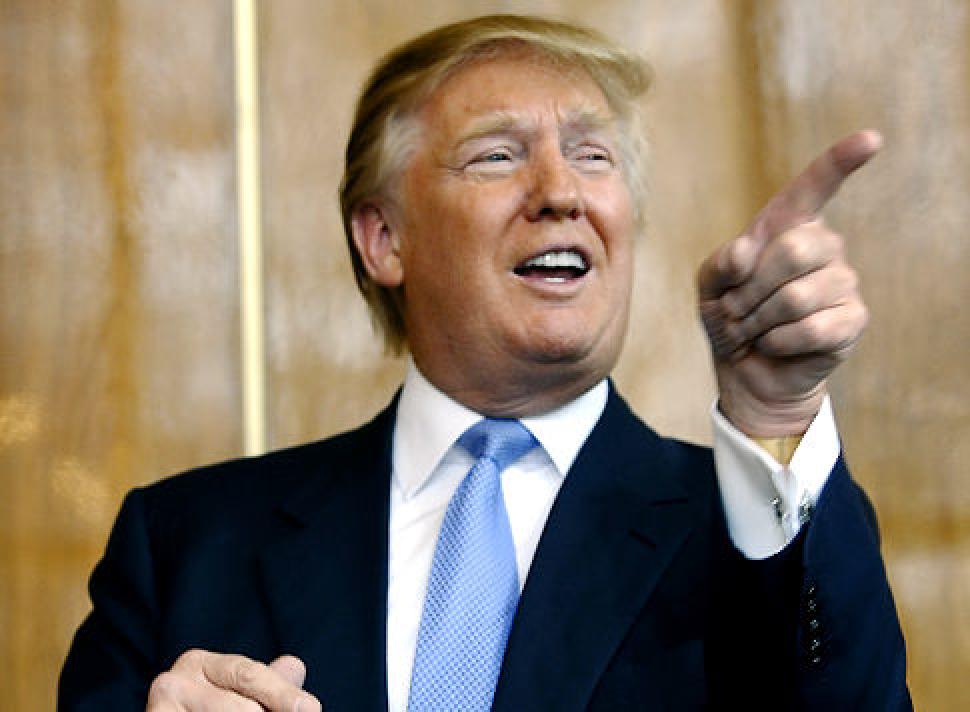
I am Donald Trump’s biggest fan. I follow politics like other folks follow sports and Mr. Trump to me is like NASCAR to my brothers. He’s loud, draws crowds, there’s too much money, and a tumbling wreck is not just inevitable but the main attraction.

Like all comedians, Mr. Trump knows a joke’s three step structure. First he establishes the premise. Mexicans are terrible people, rapists even, and the Mexican government that can’t seem to do much of anything else has its act sufficiently together to gather its worst people and ship them over the border to steal jobs, commit crimes, and take welfare money from Washington. It’s a great premise because everyone knows that Mr. Trump built his wealth upon buying up companies and laying off people and a TV show where he fires people, has been to court several times for skirting the law, and has not just avoided repaying loans by declaring bankruptcy three times but also accepted more money in government tax breaks and hand outs than the Mexican family picking oranges in California’s blistering heat could ever imagine. It’s his absolute blindness to irony that renders the joke’s premise so brilliant.

Then comes the punch line. When he becomes president of the United States, that thought alone turns my giggles to laughter – but wait for it – he will build a giant wall from the Pacific to the Gulf of Mexico. Hilarious! But there’s more. He will leave a door in the middle; perhaps some place in Texas, for the “good Mexicans” to enter. Now I’m laughing out loud.

But then, like in all the best jokes, comes the tag. All great comedians use tags. It’s the line that comes when the laughter begins to subside and everyone thinks the joke is over but then it turns back on itself like a snake eating its tail. Mr. Trump’s tag is that he will have the Mexican government pay for the wall’s construction. All right, now I’m on the floor.

Why I Love Donald Trump and the Rhinoceros

(Photo: www.nydailynews.com)

Canadian elections are too often bereft of such comedy. We are left only to marvel at the shamelessness of the attack ads or wait for some candidate to commit a career-ending gaffe by saying the same insensitive, homophobic, racist, misogynistic, or puerile thing in public that they tell core supporters in private.

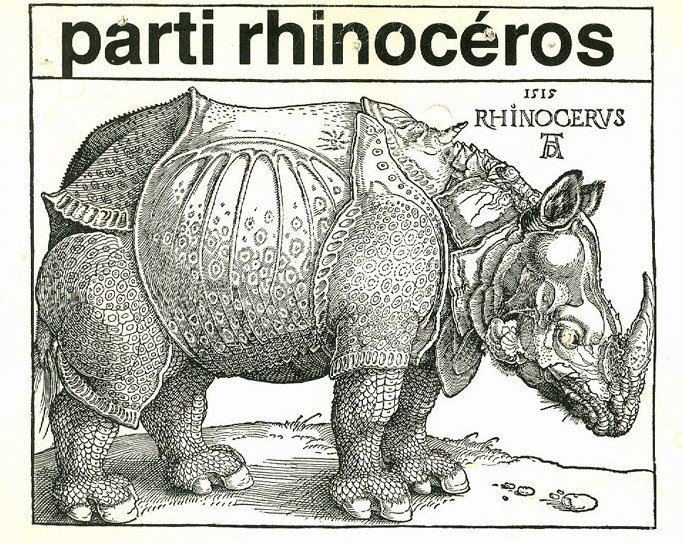
But there is good news. The Rhinoceros Party of Canada is back. Among its campaign promises is that the moment you mark your ballot for a Rhino candidate you will experience an orgasm. If elected, it promises an orgasm a month for every adult in the country. I love it. The promises are as serious as Mr. Trump’s wall and as likely to be fulfilled, but that’s the point.

The Rhinoceros Party was formed in Quebec in 1963. Its name was inspired by Cacareco who was a real Brazilian rhinoceros that in 1958 was run to demonstrate electoral corruption and, surprising those who pulled the stunt, actually won a seat on São Paulo’s city council. The Canadian party elected Cornelius as its leader. He was the rhinoceros who lived, blissfully unaware of his fame, or so I assume, at Quebec’s Granby Zoo.

The party said that Canadian unity was being compromised because the Rocky Mountains blocked our view of each other. They pledged to plow them under. The project would have the added bonus of creating jobs. They promised to pay off the national debt with their VISA card. They would then pay that bill with their Master Card and that one with their American Express, with the assumption they would be out of office before the mess was cleared up. To make Canadians more free they promised to repeal the law of gravity.

The party’s most famous candidate is Guy Pantouffe Laliberte. In 1980, he ran as the Rhino candidate in a Quebec riding and won three percent of the vote. Lalibert went on to found Cirque du Soleil.

Now that the election has been called, I am looking forward to hearing from the Rhinos. past slogan,

All comedy fails when it runs into the bright light of logic and the law. Consider Mr. Trump’s promise to end American citizenship for children born of illegal immigrants. It’s a great applause line at rallies until one considers that the American constitution’s 14th amendment says, “All persons born or naturalized in the United States, and subject to the jurisdiction thereof, are citizens of the United States and of the State wherein they reside.” Trump has never let the law, logic, or the truth for that matter ruin a good gag.

Mr. Trump ceases to be funny when he stirs emotions among those looking for someone to blame for their lot or yearning for a nostalgic past that never really existed. Those acting on Trump’s urgings to be less tolerant and more angry would be akin to those leaving a NASCAR race and driving home at 200 miles an hour. Sorry folks, but the show’s over now and it is time to again act like intelligent, responsible adults.

There is no worry about such tragic repercussions with the Rhino Party. Elections Canada eliminated the party in 1993 due to a number of financial rule changes that made its existence untenable, but it’s back. For the 2015 election they have promised to privatize Canada’s military and nationalize Tim Horton’s. It demands that Lake Ontario’s 1000 Islands be counted as it suspects that the United States has been stealing them. In order to have Canada’s capital city closer to the centre of the country they propose to move the seat of government from Ottawa to Kapuskasing. They will start a lottery where the first 105 winners receive a Senate appointment.

So let’s enjoy the American presidential campaign and the Canadian election. Donald Trump will flare out because, just like Americans saw through the funny but sad spectacle of Sarah Palin they will see through him. Trust American intelligence and appreciate the show while it lasts. And as Canada’s party leaders plod along trying more desperately to avoid mistakes than say anything inspirational, lets giggle along with the Rhinos. After all, their platform says that if they ever actually won they would demand a recount.

If you enjoyed this half as much as I enjoy Mr. Trump and the Rhinos, or even if you think I’m off my rocker for taking serious things as jokes or jokes as serious things, please offer this column up to others to see what they think.

Loyalty Tarnished, Tested, and True

Abraham Lincoln knew there would be a war and wanted America’s best officer to lead his army. He wanted Robert E. Lee. Lee was offered the post but demurred. He packed up his family, left his beloved Arlington, on a Virginia hillside overlooking Washington D.C., and rode south to offer himself to the newly formed Confederate States of America. He had decided that although he despised slavery, the issue that spurred the founding of the Confederacy in the first place, and that he had sworn an oath to the United States, his loyalty lay more with his state than his country. Lee’s decision should give us pause.

Loyalty is perhaps an old fashioned and certainly a tarnished concept. Consider that Liverpool soccer player Mario Balotelli was just awarded a six-figure Loyalty Bonus to remain with his team for the rest of the season. It is interesting because he is being paid £80,000 a week and is in the middle of his contract. Loyalty Bonuses are becoming increasingly common in professional sport.

Customer loyalty is big business. Ten years ago, a ground-breaking study done by Earl Sasser, of the Harvard Business School, determined that acquiring new customers cost a great deal but is worth the effort and expense if followed by strategies to keep them. Sasser concluded that if only 5% of new customers stay customers – remain loyal – then net profits can increase from 25% to an astounding 95%. His conclusions led to waves of ploys to win customer loyalty. They became more intense with the growth of e-commerce. His conclusions were proven valid when company after company reported the value of swallowing early losses for the long-term profits of loyal online customers.

Schools know Sasser. I graduated from McMaster University a long time ago and they have been sending me magazines, letters, push-page newsletters, and emails ever since. In a moment of generosity, or soft surrender, I once sent them a $100 cheque to help with a library renovation project – a piddling amount, but no matter. They upped their game and sent me mountains of appeals and even phone calls from earnest young folks who always start by encouraging me to reminisce and end with a request for money. They’ve spent way more than I gave them!

All colleges, universities, and private schools are part of the Sasser game. They all have Sasser loyalty departments flimsily disguised as alumni affairs, constituent relations, parent councils, trustee boards, or whatever other euphemisms they contrive. Good on them.

Loyalty

(Photo: http://www.linkedin.com)

My grandfather was loyal to the steel plant in which he worked for 42 years and it was loyal to him. Those days of reciprocal loyalty appear to be over. In just about any workplace, be it an office, factory, or school, Robert E. Lee’s conundrum of divided loyalty is played out every day. What happens when a decision tests a CEO’s loyalty to the Board to which she reports, those she employs, customers she serves, and shareholder’s dividends? Can she muster the ethical fortitude to take a stand on where her loyalty should rest? What happens to middle managers when a CEO’s decisions violate established policies or threaten an organization’s values, culture, and customer loyalty? Will their loyalty rest with the leader or company? Will they summon the courage to fight for right or demonstrate character and walk away?

According to the Journal of Psychology, loyalty among today’s workers no longer depends on the old motivators of money, office, or title. Workers will walk, wilt, or revolt if loyalty is not shown through the trust of genuine autonomy, professional development they design or find, and an environment in which their voices are actually heard and sincerely respected without fear of reprisal or pandering.

An organization that fails to understand and live loyalty will flounder. Loyalty dies because one-way loyalty cannot live. People will only be loyal to someone whose loyalty to them is always demonstrated and never questioned. If loyalty is sacrificed for a quick buck, quick fix, or even the best of intentions it becomes a burned bridge that is tough to rebuild, especially by those found holding the matches.

Perhaps loyalty is old fashioned. It is certainly tarnished and it is tested every day. Maybe things have become so bad that loyalty is now a commodity that can be bought, wheedled, or ignored. I hope not. Maybe we would be well served to pause and consider where our loyalties truly lay. The exercise might reveal that loyalty is not so hard or old fashioned after all.

My loyalty rests with leaders who earn it, ideas that stand scrutiny, friends who offer compassion, companies that provide value, and institutions that live their stated values. The loyalty I feel most deeply is to loved ones who gently but constantly remind me that, in the end, they are all that truly matters.

If you enjoyed this column, please send it to others and consider subscribing to my blog where I post a new musing every Monday morning.

Ten Rules for a Campaign Worthy of Canadians

In TV’s political drama West Wing, C. J. once bemoaned a trivial incident being reported as news and said, “Everybody’s stupid in an election year.” Charlie replied, “No, everybody gets treated stupid in an election year.” With the first debate in Canada’s long electoral slog heading toward the October vote now over and the campaign gathering steam, sadly, it appears that C. J. was correct. But there remains time to change. Canadians can enjoy the campaign they deserve if party leaders obeyed the following rules:

10 Rules for a Campaign Worthy of Canadians

(Photo: kelownalakecountry.liberal.ca)

  1. Don’t call us voters or taxpayers. We are citizens. Citizenship is a profound concept that informs our collective identity, individual rights, and responsibilities to others. Don’t cheapen citizenship’s nobility by confusing it with voting and paying taxes. They are merely two of its duties.
  1. Don’t tell us we’re choosing a prime minister. We’re not Americans picking a president or Human Resource directors involved in a hiring. Rather, we’re architects designing a House. The 338-member House we create will decide which party enjoys its confidence and that party’s leader will become ours.
  1. Don’t deride coalitions. Canada fought the First World War with Borden’s coalition government. In 2010, Britain’s Conservative and Liberal Democrat party leaders negotiated a coalition that successfully and responsibly governed Britain for five years. Coalitions are a legitimate option in any parliamentary democracy.
  1. Don’t offer false choices. The most obvious example is the old chestnut of picking either a thriving economy or sustainable development. Respected scientists and economists have argued for years that we can have both or neither.
  1. Don’t employ terms without definitions. Promising tax changes for the rich and middle class without defining either invites cynicism. Promises to help families are similarly shallow when the concept of family is so broad.
  1. Don’t try to scare us. We know that foreign policy discussions must involve Canada’s support for aid, international justice, environmental stewardship, and fair trade. We know we must sometimes go to war. Please don’t pretend that foreign policy is about nothing more than tempering liberty to battle terrorism that, after all, is not an enemy but a tactic.
  1. Don’t bribe us with our money. Monthly cheques for this program or that are just dribbles of our cash that you held for awhile. Come tax time, you’ll get part of it back again anyway. We are not children and our money is not your candy.
  1. Don’t devalue social media. If you shade the truth or outright lie, change your message in various regions, or contradict a previously stated principle, we’ll know instantly. We’ll know before you can react or spin. Your TV ads won’t save you because fewer of us watch them than follow Twitter and Facebook.
  1. Don’t underestimate us. Kim Campbell once said that campaigns are not a time to discuss complicated issues. The unusual length of this campaign offers a unique opportunity to prove her wrong. Trust our intelligence and attention spans by engaging us with complex ideas and grand visions. We just may surprise you.
  1. Don’t forget character. Impress us by your ability to rise above empty slogans, staged events, sophomoric behaviour, and bully tactics. Speak not at us but with us. Speak with journalists who inform us. We all suffer slips of the tongue so if you commit a verbal gaffe, apologize and move on. Relax. A leader’s most important attribute is not a bursting war chest, lists of promises, strict adherence to a script, or even, forgive me, nice hair. Leadership is about character. In fact, that’s all it’s about. Show it. We’ll recognize it. We’ll reward it.

West Wing’s Leo McGarry once said, “We’re going to raise the level of public debate in this country and let that be our legacy.” We respect all those working to earn a seat in our House. Just imagine if party leaders, in turn, respected us by obeying the ten rules and adopting McGarry’s goal as their guide. We could then engage in a campaign worthy of Canadians.

If you liked this, please send it to others through Facebook or your social media of choice. This column appeared as an op. ed. in the Montreal Gazette, Ottawa Citizen, and Maclean’s online.

Leadership Lessons from the Moon

The Globe and Mail’s July 21, 1969 front page was intoxicating. Bold, green, three inch high print announced MAN ON MOON. It reported 35,000 people breathlessly glued to a big TV screen in Toronto’s Nathan Phillips Square who cheered at 10:56 pm when Neil Armstrong stepped from the lunar module. Mayor Dennison delivered a brief speech calling it, “the greatest day in human history.” He may have been right. What he couldn’t know, and the Globe missed, were the important lessons contained on that front page.

Leadership Lessons from the Moon

(Photo: thedailydigi.com)

The moon adventure was the culmination of an effort begun by President John F. Kennedy on May 25, 1961. He had just returned from meetings with Soviet premier Nikita Khrushchev. While Kennedy negotiated, Khrushchev had hectored. Kennedy became convinced that the Cold War was about to turn hot.

Upon his return he called for a special meeting of Congress and asked for a whopping $1.6 billion increase for military aid for allies and $60 million to restructure his military. He called for a tripling of civil defence spending to help Americans build bomb shelters for a nuclear holocaust that, he warned, was a real possibility. The president also said: “I believe that this nation should commit itself to achieving the goal, before this decade is out, of landing a man on the moon and returning him safely to the earth.” His popularity surged.

It was daring and presumptuous. The Soviets were far ahead of the United States in space exploration. But that day and later Kennedy couched the courageous new effort in soaring rhetoric that appealed to America’s inspiring exceptionality and Cold War fears. When cheers arose from public squares and living rooms only seven years later and everyone instinctively looked up, it was the culmination of Kennedy’s dream for the world and challenge to America.

Kennedy had not micromanaged his NASA team. He set the vision and got out of the way. He did not badger them regarding tactics or berate them over temporary failures. He gave them the money they needed then trusted them to act as the professionals they were. His vision and leadership spurred the team and survived his death.

Leadership Lessons from the Moon.

(Photo: karmadecay.com)

The Globe and Mail’s July 21 front page declaring his vision’s realization did not mention President Kennedy. However, a smaller headline at the bottom noted, “Woman dies in crash, police seek to charge Kennedy.” The story explained that Senator Edward Kennedy, the president’s brother, would be prosecuted for leaving the scene of an accident.

On July 18, with the Apollo astronauts approaching the moon and their rendezvous with infamy, Kennedy had attended a party on Chappaquiddick Island for six women and two men who had worked on his brother Bobby’s doomed 1968 presidential campaign. While driving 28-year-old Mary Jo Kopechne back to her hotel, he took a wrong turn, then missed a slight curve on an unlit road and drove over a bridge and into eight feet of water.

Kennedy managed to escape the submerged car and later spoke of diving “seven or eight times” but failing to free Kopechne. He walked back to the party and was driven home. That night he consulted with advisors and then, eight hours after the accident, called police. A coroner reported that an air pocket probably allowed Kopenchne to survive for three or four hours before drowning. A quicker call for help, he concluded, would have saved her life.

Leadership Lessons from the Moon..

Car being pulled from river. Photo: www. www.latimes.com

In the 1990s, Edward Kennedy would become the “Lion of the Senate,” guardian of the Democratic Party’s progressive wing, and model for bi-partisanship. However, when he ran for his party’s nomination for president against the incumbent Jimmy Carter in 1980, many saw not a lion but liar and not a politician but playboy. Chappaquiddick appeared to reflect a belief that ethics, morality, and the law applied only to others. Voters punished his conceit by withholding support.

It was all there on the Globe and Mail’s front page, 46 years ago: the legacy of intrepid leadership by one brother and the price of hubris by another. They are leadership lessons of the moon. On this anniversary we are left to ponder questions inadvertently posed by the Globe that day regarding the difference between bold audacity and stupid risk, daring vision and manipulative reaction, planning and plotting, and between big decisions that positively affect millions and big decisions disguised as little ones that are always pregnant with unintended consequences. The front page’s historical coincidence urges us to wonder if, in their wisdom, people still reward leaders of selfless vision or selfish arrogance.

President Kennedy’s leadership lessons from the moon offer even more profound lessons for those willing to learn.

If you enjoyed this column, please send it to others on Facebook or your social media of choice.

The River’s Spirit for Those Who Can Hear It

It’s moving. It will be moving all day, all night, and for a billion tomorrows. The Otonabee River is a block from my home and on quiet nights we hear it relentlessly cascading over the dam. We smile at a loon’s mournful echo, nature’s saddest and most magnificent cry. The blue heron has his favourite spot near the Lakefield bridge and sometimes the osprey leaves his giant nest by the power station to perch in the tree above him. Both stare with infinite patience, waiting for the right moment to pounce into the gurgling water.

I walk home from work along the river and run the trail that hugs its banks. In the summer, when the city folks invade, canoes glide by and rented houseboats boom their music as they tack haphazardly along amid the mammoth floating mansions, always, it seems, with flapping American flags. The river splits our little Village in two and yet its bounty makes us whole and, in fact, possible.

The River's Spirit for Those Who Can Hear It..

Deeply respected Canadian novelist Margaret Laurence lived in Lakefield. Her most stunning book, The Diviners, begins by observing that the river runs both ways. It does you know, it really does – all rivers do. They run as natural facts but also as spirits and metaphors through our history, literature, music, and souls.

Science meets religion at the intersection of the Tigris and Euphrates. Between the two powerful rivers is the fertile valley where archaeologists insist human civilization first developed. Those ascribing to a literal translation of the Christian Bible agree, in a sideways sort of fashion, by claiming the junction housed the Garden of Eden.

Homer gave us one of our first stories. He told of the filthy waters of the Xanthus. Polluted by bodies killed in the Trojan War, the river rose up and nearly swallowed the hero Achilles. The river became a metaphor for war, a scourge so horrible that even the unworldly strength and courage of the greatest among us can neither defeat nor tame it.

War has too often soiled rivers with its evil. Battles have been won by fording armies, a bridge’s destruction, or an enemy trapped against a riverbank. During the American Civil War, the South named its armies after states but the North after rivers, hence the Army of Virginia fought the Army of the Potomac. Early battles had two names because the South considered the nearest town and the North the nearest river, so we have Sharpsburg or Antietam and Manassas or Bull Run.

Many civilizations developed along rivers from the Yangtze in China, the Amazon in Brazil, and the Nile in Africa. A predominant historian dubbed Canada the “Empire of the St. Lawrence,” arguing that without the natural highway to the interior, the country could not have developed when or how it did. Consider also the cities built upon rivers: Montreal, Calgary, Ottawa, New York, Washington, St. Louis, London, Paris, Moscow, Berlin, and…well…you can think of many more. Rivers are the veins through which so many cities’ lifeblood flows.

The Tennessee is the Singing River. To hear it you have to believe it. For thousands of years the Whana-le people heard the creator sing through the river’s sparkling waves. In the 1830s, the Whana-le were uprooted and banished to the barren Oklahoma Indian Territory. They starved beside tiny and silent rivers. One winter, an old woman named Te-lah-nay had enough. To save her family and people, she sought the wisdom of the river’s song and so walked from Oklahoma to her ancestral home, now called Alabama, on the banks of the Tennessee. Today, in northwest Alabama stands a long, winding, outrageously magnificent stonewall that her great-great-grandson Tom Hendrix created to commemorate the walk, his people, and the river that still sings for those with the spiritual faith to hear.

On the banks of the Tennessee is a town called Muscle Shoals. In the late 1950s, Rick Hall built the FAME recording studio and it soon produced hit records that reintroduced gospel, R & B, and soul to the pop charts. Percy Sledge, Aretha Franklin, Etta James, and Wilson Pickett recorded there. When Hall’s studio band, the Swampers, formed their own studio, the Muscle Shoals sound was heard in records by the Rolling Stones, Paul Simon, John Prine, Jerry Reed, Lynyrd Skynyrd, Alicia Keys, and on and on.

The Muscle Shoals feel was black but the studio musicians were white so the music was as colour blind as it was glorious. The singing Tennessee must have approved and maybe, just maybe, played a role in inspiring the magical sounds. Maybe it was the same enchantment that flowed from the mighty, muddy Mississippi that gave birth to rock ‘n’ roll in Memphis when, within blocks of the roiling river, Roy Orbison, Johnny Cash, B.B. King, Jerry Lee Lewis, Carl Perkins, and Elvis Presley all did their best work in the same little Union Avenue Sun studio. Maybe the same spirit sang from Liverpool’s Mersey River that created what the world came to know as the Mersey Beat of the Beatles and British invasion.

In his terrific novel that was turned into a fine movie, A River Runs Through It, author Norman Maclean wrote: “Eventually, all things merge into one, and a river runs through it. The river was cut by the world’s great flood and runs over rocks from the basement of time. On some of the rocks are timeless raindrops. Under the rocks are the words, and some of the words are theirs. I am haunted by waters.”

In Siddharta, Hermann Hess observed, “Have you also learned that secret from the river; that there is no such thing as time? That the river is everywhere at the same time, at the source and at the mouth, at the waterfall, at the ferry, at the current, in the ocean and in the mountains, everywhere and that the present only exists for it, not the shadow of the past nor the shadow of the future.”

The River's Spirit For Those Who Can Hear It.

I am both haunted and comforted by those thoughts as I prepare for my run along the banks of my river, the Otonabee River. The heron may be at the bridge and perhaps the osprey, and down near the Sawyer Creek lock the turtles will be sunning themselves. The bald eagle may be about, soaring without a care above it all and swooping with breathtaking majesty to steal his lunch from the river that he, like me, knows will always be here: powerful, relentless, with soul but without judgement. And through it all I am happy that in my Village, and my life, a river runs through it.

If you enjoyed this column please share it with others through Facebook or your social media of choice and consider returning for my regular Monday morning postings. Thank you.
Love Letter to Canada on her Birthday

Dear Canada,

Birthdays are great. The friends, family, and food are marvelous as another marker is placed on the road to wisdom and understanding; the destination we seek and hope to recognize upon arrival. Of course, the fewer candles on the cake increase the chances of bouncy castles and donkey-pinning and the normally banned junk-food.

Your birthday is always special. What’s not to love about fireworks, music, and a day off in the middle of summer? For some reason we attach special significance to anniversaries ending in fives and zeroes so your biggest birthday bash was in 1967. The Centennial parks, fountains, buildings, and bridges from coast to coast are testament to your 100th birthday having been celebrated everywhere. The biggest bash was in Montreal. Expo ’67 invited the world and the world came. Magnificent national pavilions wove facts and myths in what other countries chose to display of themselves and how we cheered ourselves.

Dear Canada on her Birthday

(Photo: nmmc-co.com)

Your most powerful myth is your birthday itself. You became an independent state on July 1, 1867. But your independence was an act of the British parliament. Britain still controlled your constitution. A British committee could over rule your Supreme Court. A British company controlled what is now northern Ontario, Quebec, Manitoba, and the North West Territories. Britain still negotiated and co-signed treaties and trade deals. So you were independent but only like a teenager who moves out but only as far as Mom’s basement.

For a long while, we pouted and slammed doors from time to time but didn’t do much about it. After all, we still considered ourselves British. Our census form had nowhere to proclaim we were Canadian. We carried British passports. We voted for Sir John A. and his slogan: “A British subject I was born and a British subject I will die.”

It all changed when a European family spat led cousins with big navies and bigger egos and more pride than brains to trip the world into war. We called it the Great War because not until the next phase in what became a decades long European civil war would we begin to number them. Britain was in and all we could yell up the stairs was “Ready Aye Ready”. Boys who had never traveled more than fifty miles from home were stirred by a pull of patriotism, a yearning for adventure, and the hope that girls really do love a man in uniform. They were soon on trains to Val Cartier, Quebec, and then aboard crowded ships to Britain and then, the front.

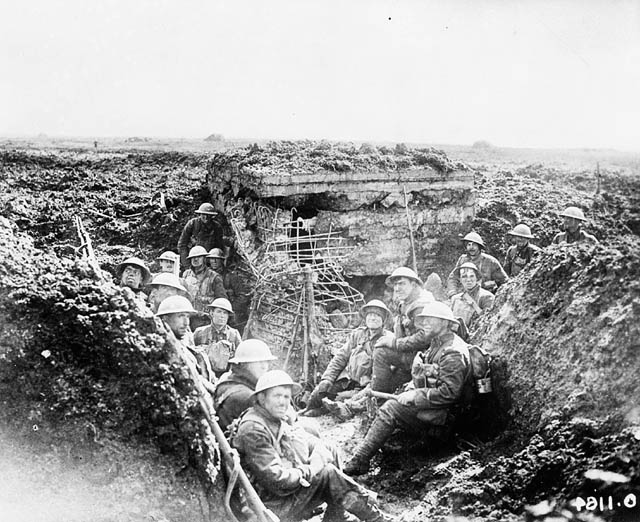
They had no idea what they were in for. Picture digging a hole in your yard and living there for a year. Eat there, sleep there, and relieve yourself there, day after day and season after season. Watch for rats the size of spaniels, killing coughs, lice, maggot-infested food, and after standing for days in the open sewer, toes fall away when sodden boots were finally removed. It was a war against conditions and, too often, stupid officers more than the enemy.

Dear Canada on her Birthday.

(Photo: http://www.collectionscanada.gc.ca)

After years of using Canadians as shock-troop cannon fodder, our four divisions were joined and told to capture a ridge that the French and British had found impossible to take. We dug and planned. We ignored the British way and told every man his job. And men the boys had indeed become. Many still bore pimples but too much boredom punctuated by terror and too many trips on leave for bad booze and horizontal recreation made them older than their ages; older than anyone deserved to be. On Easter Sunday, a barrage that shook the earth and shattered the sky announced the attack and the Canadians soon had Vimy Ridge..

Back home, for the first time, we had not an allied, not even a British, but a Canadian victory. For the first time, Canadians considered themselves Canadians. When the war finally ended, Britain said it would take care of the peace. With a pat on the head we were to go back downstairs and wait quietly. No. Too many of our children, sent to kill their children, had died. Too many were home but broken. We had earned a place at the grown-up’s table. It took a while but we increasingly considered ourselves Canadian and one but one by one the vestiges of colonialism fell away, forgotten like other childish things.

So while a person’s birthday is easy to peg, a country’s is more a decision than fact. Perhaps, Canada, your birthday is really April 12, 1917; the day we made it to the top of that damned hill. But is it better to plant our patriotism at a Charlottetown conference table, in the British House of Commons, or on a blood-spattered Belgian ridge? Or is according too much significance to the tragic blunder of a crazy war affording too much recognition to the boneheads who started it, the profiteers who exploited it, and mankind’s predilection to slaughter rather than build?

Perhaps it’s better to stick with July 1, 1867. I guess, like Jimmy Stewart was told in The Man Who Shot Liberty Valance, when facts get in the way of the legend, print the legend. So this July, let’s enjoy the day off and with the sun’s surrender, let’s ooh and ahh at the fireworks. But this year, with these thoughts in mind, let’s offer ourselves a dare. Let’s see if any of us now can watch the colourful explosions over the park or lake and not think of the sky over Vimy.

Sincerely,

A Friend.

This is a few days late to stick with my Monday posting schedule but hopefully still invites consideration. If you enjoyed it, please send it along to others through Facebook or your social media of choice.