Sir John the Saviour

Part of the joy of being an author is the privilege of travelling the country and meeting people who share a passion for books and ideas. Interviews are fascinating too because questions reveal the issues that are stirring interest. The questions are sometimes surprising.

Last January I was speaking with an American journalist from Louisiana about my book dealing with Canada and the American Civil War. She said, “I read your book and admit I had never heard of John Macdonald. It seems like he was quite was a big deal.” “Yes,” I offered politely, “He was and is quite a big deal.”  She continued, “So how would you explain Macdonald to our American readers in one sentence?” “Well,” I said, drawing a breath, “Macdonald is like America’s James Madison in that he led the writing of our constitution, and he is like your Thomas Jefferson in that he provided the ideological basis and political justification for the creation of our country, and he is like your George Washington in that he was our first chief executive that put flesh on the country’s skeleton while his every decision provided a precedent that resonates to this day; so our Macdonald was your Madison, Jefferson and Washington rolled into one man.”

I could have said much more. We can’t escape Macdonald. Every time we discuss the Senate, or the power of the prime minister, or the role of an MP, or government’s power we are revisiting his vision. We know that he created and built Canada. Less well known, however, is how he saved Canada.
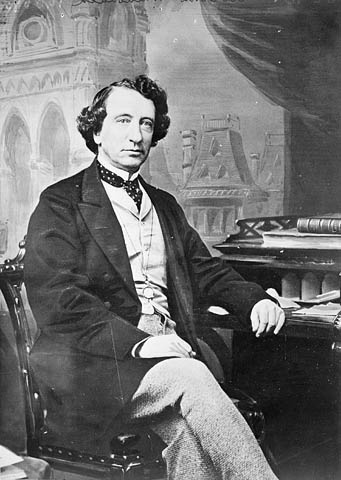
Image Sir John A. Macdonald

In 1871, Canada was four years old. The American Civil War that had affected how and when the country had been created had been over for six years; but it was not really over. When the war began, Britain had declared itself neutral. That made Canada neutral too but still about 40,000 Canadians and Maritimers broke the law to don the blue and gray and fight. Canadians sold weapons to both sides and housed a Confederate spy ring that organized raids from Toronto and Montreal. John Wilkes Booth visited Montreal to organize Lincoln’s assassination. All of this and more led a great many Americans to call for revenge; generals, newspapers and politicians called for invasion and annexation.

Throughout the war, Britain had ignored its neutrality law and allowed ships to be bought or built then sold to dummy companies that turned them over to the Confederate navy. One such ship was called the Enrica. The Americans knew about it even while she was under construction at the Laird Yards in Liverpool in the fall of 1861. The British government allowed it to be built and then snuck down the Mersey to the Azores where it was refitted for war and rechristened the CSS Alabama.

The Alabama roamed the seas and eventually sank 64 American commercial vessels and a warship. Lincoln ordered it destroyed and the global hunt was on. In July, 1864, the Alabama was sunk outside a French port.
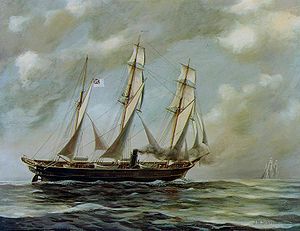
Image CSS Alabama

At the war’s conclusion, the United States continued its Manifest Destiny driven desire to have Canada. Annexationist Secretary of State William Henry Seward purchased Alaska in 1867. He explained that the purchase was merely a step in driving Britain out of British Columbia and eventually all of North America. But Macdonald stopped him by persuading those in Vancouver and Victoria to join Canada. Seward negotiated with Britain to purchase Rupert’s Land from the Hudson’s Bay Company – nearly all of what is now northern Ontario and the prairies. But Macdonald stopped him again by negotiating around the United States and buying it for Canada.

Seward had one card left to play. He argued that by allowing ships such as the Alabama to be built and bought that Britain had prolonged the Civil War and cost America money and lives. He added up everything from lost ships to increased maritime insurance rates and presented Britain with a bill totalling an astronomical 125 million dollars.

Britain would not, and in fact simply could not pay. Its economy would be crushed. Plus it needed what money it had to build its defence in light of growing troubles in Europe. It reacted to what became known as the Alabama claims by playing the diplomatic game of deny and delay.

By 1871, Ulysses S. Grant had become president. Like Seward, Grant hated the roles Canada and Britain had played in the war. He told his cabinet, “If not for our debt, I wish Congress would declare war on Great Britain, then we could take Canada and wipe out her Commerce as she has done ours, then we would start fair.” Grant’s Secretary of State Hamilton Fish spoke with the British minister to Washington Edward Thornton. He said that Grant would waive the entire Alabama reparation payment if Britain would simply hand over Canada. Thornton said the Canadians would probably not like it but that he would inform his government. Shortly afterwards, a conference was convened to settle the matter. Grant was pleased and said that if Canada was annexed then the Alabama claims could be settled in five minutes.
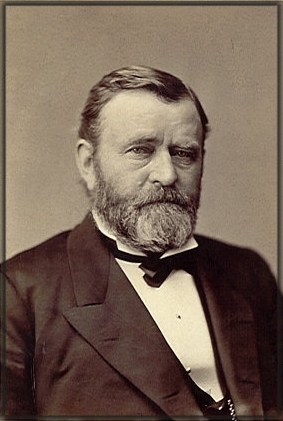
Image President Grant

In February, 1871 five Americans, including Secretary of State Fish, welcomed five Brits to Washington. As a courtesy, the British allowed Sir John to be a part of their delegation. Macdonald knew that the future of his infant country was at stake. He took the proceedings so seriously that he even abstained from drink for the entire conference!

Macdonald maneuvered the agenda so that they began negotiating the American abuse of rules regarding inland fishing rights. It was an enormously important issue for Canada and he refused to budge an inch. But focussing on fishing was also a brilliant strategy for no matter how many other matters were raised Macdonald kept coming back to fishing. Every time anyone brought up the main question at hand – the Alabama claims – Macdonald talked to Fish about fish.

The Americans badgered him during the day. The British delegates badgered him every night. The Brits threatened him with a withdrawal of British military support. He was unmoved. They tried to bribe him with an appointment to Her Majesty’s Privy Council. He laughed them off. When cornered, Macdonald delayed by saying he needed to write home for advice. It was later discovered that his cables to the cabinet and governor general were being boomeranged back to Washington by Governor General Lisgar who had more loyalty to Britain than Canada. The backstabbing double-cross meant that British delegates knew exactly what Macdonald was doing and all of his fall back positions; but they could still not best him.

The conference ended after 9 weeks and 37 meetings. Macdonald won everything he had wanted. Fishing rights were settled in Canada’s favour. Because the Americans refused, Britain would pay Canada 4 million pounds in compensation for losses incurred in the Fenian Raids; Macdonald would use the money for railway construction. Free access to the American market for a number of Canadian products was guaranteed while Canadian tariffs could remain. Two concessions were more important than these and others. First, the Alabama claims would be settled by an international tribunal and it was agreed that the reparations for Canada swap was off the table. Second, it had been established that the ratification of the Washington Treaty would need approval by the American Congress, British parliament and by the Canadian parliament.

The Washington Treaty was the final battle of the American Civil War. It was the final episode of the American Manifest Destiny dream of Canadian annexation. Macdonald ensured that Canada could thrive because it would survive.

When he arrived back in Ottawa Macdonald delivered a four hour speech in the House. He did not strut. He did not gloat. Rather, he acted as a responsible statesman who respected Canadians sufficiently to explain what had been at stake and what had happened in all of its complex detail. He then went home and for the first time in over two months enjoyed a drink; perhaps more than one. He deserved it, he had saved his country, and that was quite a big deal.
Civil War Hero or Villian

Civil War Hero or Villain

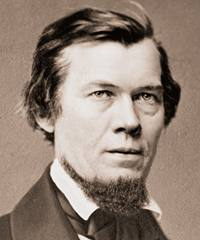
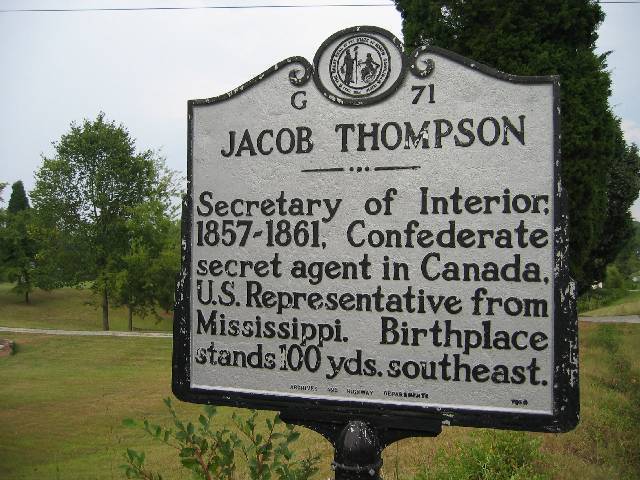
You may not know Jacob Thompson but he knew us. One hundred and fifty years ago this week Thompson brought the American Civil War to Canada as it hadn’t been before and helped spur Confederation. His role in our birth reminds us of the ideas that seem to be motivating us still.

The winter of 1863-64 was tough on the Confederate States of America. Its armies were losing men and battles, its cities saw food riots and its dollar was plummeting. President Jefferson Davis needed to turn things around and so he turned to Jacob Thompson.

Image

Thompson was a Mississippi lawyer, politician and former federal cabinet secretary. Davis asked him to save the South by going north. He was given one million dollars, an astronomical sum at the time, and ordered to harass and distract Lincoln’s Union from Canada.

Thompson arrived in the first week of May, 1864 and established offices in Montreal and in Toronto’s swankiest hotel, the Queen’s, located where the Royal York is today. He mobilized Confederate deserters and escaped prisoners and Canadians sympathizers.

One of his first acts was to invite America’s most influential newspaper publisher and Lincoln’s personal secretary to Niagara Falls under the pretence of negotiating a peace agreement. When Lincoln set terms the South could never meet, Thompson’s contacts pilloried him in the press for being a warmonger with no interest in peace. Lincoln’s already shaky support in the war-weary North suffered.

Union ships on Lake Erie were hijacked. Attempts were made to free Confederates from Northern prisons. Arms and ammunition were manufactured in Guelph and Toronto and shipped to the South. Thompson worked with the Copperhead movement to stop Lincoln’s re-election and split the North by creating a new, independent country. The Copperhead leader ran operations from his hotel in Windsor. Thompson and the Copperheads disrupted Lincoln’s Republican Party convention.

Thompson’s underground actions led to more Union troops being moved to the border. American ships ignored a War of 1812 agreement and rearmed. In response, more British soldiers were deployed to Canada along with more complaints from London that the colony was too expensive and should be left to its own devices. Canadian militia units were mobilized with the realization that the broke, politically dysfunctional colony could not effectively defend itself in the face of growing American threats.

John A. Macdonald knew that Thompson’s actions had enraged a United States that was already upset with Canadian war-time actions and attitudes. The likelihood of a post-war invasion seemed real and terrifying. For years, Confederation had been an interesting idea but it had become a necessity. To save itself Canada needed to create itself. It is no coincidence that five months after Thompson arrived in Toronto the Fathers of Confederation arrived in Charlottetown.

While Macdonald debated Thompson terrorized. His men simultaneously engulfed a number of Manhattan’s hotels and theatres in flames and then fled back to Toronto. Among the New Yorkers caught in the chaos on Broadway was the famous actor John Wilkes Booth. As part of his plot that killed Lincoln, he spent a week with Thompson’s men in Montreal.

Several of Thompson’s terrorists raided St. Alban’s, Vermont. They robbed its banks, killed a man and then fled with guns blazing and a posse in pursuit. They were caught by Canadian authorities but a judge freed them. American newspapers insisted that Lincoln immediately invade Canada in retribution. The American Senate reacted by ending the Canadian-American free trade agreement and taking other actions that promised to economically punish Canada. Canadians were further convinced of the threat to all they valued and yearned to preserve.

With his country dying, Jacob Thompson inadvertently aided in the birth of ours; he was our Uncle of Confederation. Considering his role in motivating change allows us to consider the degree to which our political decisions are still based upon equal parts courage, hope and fear. And, as in politics so often and war always, we are left to ponder whether Thompson was a hero or a villain.

Image

Read more about Jacob Thompson and about Canada’s role in the war in the bestselling Blood and Daring: How Canada Fought the American Civil War and Forged a Nation.

http://www.amazon.ca/John-Boyko-Books/s?ie=UTF8&page=1&rh=n%3A916520%2Cp_27%3AJohn%20Boyko

http://www.chapters.indigo.ca/home/search/?keywords=john%20boyko

It’s Time to Put R. B. Bennett on the Hill

It’s Time to Put Bennett on the Hill                                                       

History matters. It is the stories we tell ourselves and others about whom we are and who we aspire to be. Among the important ways we tell those stories are through the monuments we erect on Parliament Hill; the lawn outside our House. Sir John is there. So are Diefenbaker and Laurier, the Queen, the Famous Five, and more. But Parliament Hill’s story is incomplete for it is without a statue of Prime Minister R. B. Bennett. He deserves to be there. We need him there for visitors to ponder his life and contributions as reflections of the values we cherish as Canadians.

Bennett was a remarkable man. Born to a poor New Brunswick family, he was a school principal by age 19. Wanting more, he attended law school. Senator James Lougheed was so impressed with the young student that he offered a full partnership so that Lougheed-Bennett was born in the Wild West boomtown of Calgary. Bennett was soon president of several companies and on the boards of more. Through hard work, connections and good luck he became a multi-millionaire. But he was never inspired or impressed by wealth. He owned neither a car nor, until retirement, a house. He gave nearly all of his money to individuals, charities, schools and universities.

Bennett was an engaged citizen. He believed in the nobility of public service. He was a city counsellor, territorial representative, and then a member of Alberta’s provincial parliament. He was the first leader of the Alberta Conservative Party. He won a federal seat and served in cabinet. In 1927 he became leader of the federal Tories and then, in 1930, Canada’s prime minister – the first, but not the last from Calgary.

After suffering defeat in 1935, Bennett was an effective opposition leader for two years but then fulfilled a life-long dream and retired to England. The Second World War drew him back to public service. He led the preparation of the Royal Air Force by coordinating the building of planes and air strips. Churchill rewarded him with an appointment to the House of Lords where he worked hard to prepare for the post-war years.

Bennett was a transformational leader. He became prime minister just as the Great Depression was entering its darkest days. The Red Tory principles that he had espoused throughout his life led to policies that respected the positive power of capitalism and a constructive role for government.

Bennett’s government provided immediate relief for those in need and then restructured the economy to mitigate the impacts of future economic calamities. He modernized unemployment insurance, established a minimum wage and limits on work hours, extended federally-backed farm credit, enacted anti-monopoly legislation, and saved thousands of farms with a revamped Wheat Board. He wrestled control of monetary policy from chartered banks with the establishment of the indispensable Bank of Canada. To protect and promote Canadian culture and national unity, Bennett formed the Canadian Radio Broadcasting Commission that became the CBC.

His legacy also includes increased trade with a host of countries and a trade deal with America that was enacted weeks after he left office. He negotiated a treaty that later served as the framework for the construction of the St. Lawrence Seaway. Bennett’s bold actions led to a reinterpretation of the constitution that allowed the creation of many of the social policies which Canadians now proclaim as their birthright.

Bennett was not a perfect prime minister. There is no such thing. He was not a perfect human being – none of us are. But he was a remarkable man, a generous philanthropist, an engaged citizen and a transformational leader. His contributions, principles, and the questions his life forces us to ponder helps us understand ourselves and our country. R. B. Bennett’s story deserves to be a larger part of our collective story. We should begin our consideration of its place and lessons by placing a commemorative statue of R. B. Bennett on Parliament Hill.

(For more on R. B. Bennett see Bennett: The Rebel Who Challenged and Changed a Nation (Goose Lane Editions) available at: amazon.ca and chapters.indigo.ca

(This was published as an op. ed. column in Ottawa’s Hill Times on April 28, 2014)


What If It Had Rained in Dallas or Diefenbaker Forgot About the Tree?

What If It Had Rained in Dallas or Diefenbaker Forgot About the Tree?

Anniversary journalism is lazy but inevitable. We were bombarded with the fiftieth anniversary of President Kennedy’s assassination stories and more than once I turned away from the horrible film clip of a man being murdered. I thought it fascinating that through the mourning porn, few stopped to consider Kennedy’s impact on Canada – and it was enormous. More fun, I thought, would be to play the “what if” counter-factual game of historical inquiry and ponder the effects on Canada not of his life but if he had lived.

After all, Kennedy’s living past November 1963 could have happened if one of two things had changed. First, if it had rained in Dallas that day then his limousine would have had its roof in place and Lee Harvey Oswald (or whoever) may not have found his target. Second, on a 1961 visit to Ottawa Prime Minister John Diefenbaker had insisted on Kennedy planting a ceremonial tree at the Governor General’s residence.  While shovelling dirt he had seriously reinjured his already weak back and so was fitted for a stiff brace. He was wearing it that day in Dallas and after the first shot it had kept him erect and a sitting duck for the second and deadly shot.

So what if it had rained in Dallas or Diefenbaker had forgotten about the tree?

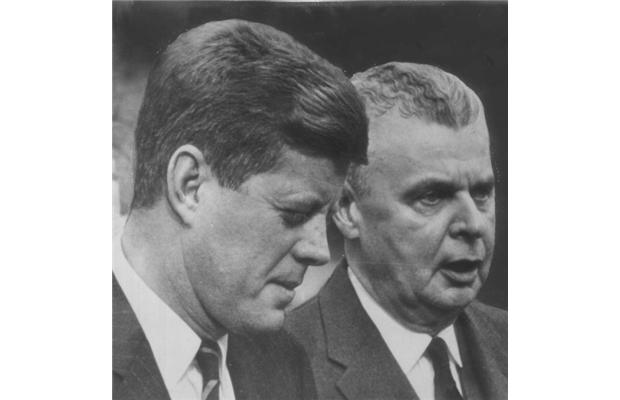
JFK and Dief

                 President Kennedy and Prime Minister Diefenbaker in Ottawa

JFK was a careless philanderer. He consorted with prostitutes, movie stars, and even a mobster’s girlfriend. He was once asked what he wanted for his birthday and he pointed to a young Hollywood starlet in a magazine. Guess who was with him a few days later?

In August, 1963, the F.B.I. told Attorney General Robert Kennedy that his brother was having an affair with East German communist spy Ellen Rometsch. This was different. This was serious. She was quickly deported on an Air Force plane. Days before Kennedy left for Dallas, the Senate Rules Committee was preparing to subpoena Rometsch in its investigation of Bobby Baker who was suspected of having shady financial dealings with Senators and of arranging many of the president’s dalliances.

The sex-spy scandal could have shattered Kennedy’s presidency. There would have been significant ramifications for the increasingly left-leaning Canada if the uproar and possible impeachment had led to the election of the Republican’s 1964 presidential candidate, the extreme right-wing Barry Goldwater.

But what if Kennedy was re-elected? He and Diefenbaker hated each other. The president knew and liked Liberal leader Lester Pearson and so his government helped defeat Diefenbaker in the April, 1963 election. Kennedy then ordered a resumption of positive Canadian-American interaction. The vastly improved personal relations between leaders could have earned major dividends for Canada.

Pearson had campaigned on a promise to surrender to Kennedy’s pressure and house American nuclear missiles in Canada. In the subsequent months, though, Kennedy worked to end nuclear proliferation and signed the Nuclear Test Ban Treaty. He was sending signals to the Soviet Union with hopes to create what would later be called détente. It is likely that Pearson would have reacted to the changing Cold War policies and tenor and revisited his long-held views on disarmament and used his relationship with Kennedy to get the weapons of mass destruction back out of Canada.

Kennedy invited Pearson to his home and asked for advice on Vietnam. When told he should get out, Kennedy laughed and said that any fool knew that but the question was how. After the 1964 election, Kennedy would probably have withdrawn the American military ‘advisors’ he had dispatched and there would have been no Americanized Vietnam war.

Without the Vietnam War, tensions caused by Canada’s opposition to it would not have existed. Eighty Canadians who went to the U.S. to serve would not have died. Tens of thousands of American draft dodgers would not have crossed the border. Without Vietnam, African Americans and Canadian women and youth fighting for change would not have had the link that helped unite and strengthen their movements. The young, for instance, would probably have initiated their cultural rebellion but without much of its anti-war inspired, revolutionary anger. Vancouver’s Gastown, Toronto’s Yorkville and conversations at dinner tables across the country would have been different.

After eight years of Kennedy’s growing liberal consensus, and without the war tearing America’s social fabric, the ‘silent majority’ that helped elect Richard Nixon may not have evolved. No Nixon would have meant no anti-American wave caused by Nixon’s 10% tax on Canadian trade and by his Vietnam policies. No anti-American wave could have tempered the uptick in Canadian patriotism – our negative nationalism.  No Nixon would have meant no Watergate so we might not still be suffering its sad legacy of wrathful, prying journalism and popular political cynicism.

John F. Kennedy was America’s first celebrity president. He taught all future leaders – Trudeau, Clinton, Obama and Trudeau again – the efficacy of image and television. He was a flawed man but a transformational leader with a positive vision and the courage and intellect to pursue it. Had he lived and dodged scandal, Canada would have been different then and different now.

The Day I Was Tear Gassed

THE DAY I WAS TEAR GASSED

Canadians are nice. We seem to revel in our international reputation as being so nice that when bumped we say sorry or when queue-jumped we say nothing. A problem, of course, is that a slight scratch beneath of the surface of ourselves and our history reveals that we are really not that nice at all.

I glimpsed beneath those surfaces in April, 2001. After reading about the 1999 troubles in Seattle and with Horton Hears a Who in our minds – I swear – my dear wife and I left our little Ontario village and headed to Quebec City. We were ready to add our little yop to voices being raised in concern over cascading corporate power on display at the third Summit of the Americas conference. As I am a historian and my wife’s degree is in political science, we were curious about being witness to the making of history and a political point.

We arrived in time to join a wondrously joyful parade. Colourful banners and flags were hoisted above thousands of people singing, strumming guitars and some even dancing on stilts. There were old people and children. There were families and groups who had obviously journeyed here together and other that had spontaneously come together. Most of the signs were serious and many were good natured. Many expressed self-interest and reminded me a little of the old Buffalo Springfield song as they seemed to shout “Hooray for Our Side”. We walked slowly beneath a wonderfully cloudless blue sky enjoying the positive, party atmosphere and folks who were taking their messages but not themselves too very seriously.

The world leaders discussing the possibility of creating a Free Trade Area of the Americas, of course, didn’t see the parade. They were ensconced far away and up the hill in the National Assembly building behind 4 km of fence and cordons of police. At the parade’s end most people milled about and there were hugs and goodbyes. But I couldn’t leave. I could not go home without venturing up to see the so-called red zone, the area closest to the fence, where the streets were blocked and businesses shuttered.

As I walked up the hill it was if I could hear the theme to some Clint Eastwood spaghetti western in my head. I walked slowly and then slower still. As I reached the outer limits of the red zone I was stunned. It was like an eclipse had suddenly blotted the sun and the world had morphed into black and white. It was eerily quiet. The parade had been a party but this was a war. The air smelled of gasoline. The streets were dirty. People were dressed in varieties of battle fatigues and many had bandanas and goggles dangling on their chests. No one smiled.

Down a narrow street I saw a group of about twenty young people sitting in a circle and singing John Lennon’s Imagine. Strung behind them from building to building was the silver, gleaming 3 meter high chain-link fence. Behind the fence was a row of police officers. They were in black riot gear with face guards down and hand-held shields up. They looked every bit like a row of Darth Vaders. Each officer held a club and each smacked it onto their left palms to the song’s beat – ones and threes. They could not have been more intimidating. I guess that was the point.

I moved on to find a spot where I could be alone to swallow the metallic taste of adrenaline and catch my breath for I suddenly realized that I was breathing as if in a race. Around the corner I found another stretch of fence blocking the road before me with another row of police officers behind it; but I was alone. I did what I always do when I see a police officer; I smiled and waved. None waved back. In a minute or so a man about my age joined me and we stood chatting quietly. We were about ten feet from the fence, looking at each other and not the officers off to our right. No one else was near. We discovered that curiosity had drawn us both from Ontario to the parade and then up the hill and that we were both shocked by the incredibly tense atmosphere. We traded ideas about a restaurant for dinner. We were just two middle-aged guys dressed in shorts and golf shirts, very much tourists and not terrorists.

We were suddenly startled when a silver canister crashed behind us and white-gray tear gas spewed forth. We instinctively spun away and blindly careened right into the fence. The line of cops charged forward and smashed it with their clubs. We turned and stumbled through the noxious cloud with eyes and lungs on fire. A masked and khaki angel pulled me to a curb, sponged my eyes from a galvanized pail, secured a red kerchief over my nose and mouth, told me to run when I could, and then was gone. I have no idea what happened to my companion. I staggered dazed and bewildered as people ran past in both directions shouting that crazy Canadian jumble of French, English and profanity that transcended them both.

Image

Woozy and blinded, I wobbled down the road and happened upon a group of young people shouting through the fence at yet another line of storm troopers. I turned and joined them, yelling every ugly epithet my years of school yards and hockey dressing rooms had taught me. But then, in mid-tirade, it was like I suddenly awoke. Perhaps the gas had worn off. Perhaps my righteous temper had peaked. I was suddenly embarrassed that every ounce of anger I had imprisoned since childhood had been so quickly and completely un-caged. I was shocked at my rage and the sound of my own voice and what I heard that voice shouting.

I stumbled back to the sidewalk across the street and stood watching the two groups of people – protesters and police – probably much the same age, who probably grew up in similar neighbourhoods, separated only by twists of fate and a fence that I was suddenly glad was there. My youngest brother is a police officer and I knew that he was one of the helmeted cops assembled that day. He may have been among those standing in silence before me now; perhaps he was the target of my crazy abuse. I needed to get out of there.

I walked back down the hill to meet my wife and breathlessly told her what had happened. We ventured cautiously up the hill just a little so she could glimpse the place but we then turned back and were soon in our car and heading for home.

I found out later that while my companion and I were very innocently chatting, the security system on the other side of the red zone, far from where we were, had faltered. Protesters or anarchists or whatever they were had torn down part of the fence at Boulevard René Lévesque and police had reacted around the whole perimeter with gas, water cannons and rubber bullets. In their attempt to re-establish order, police were attacking those on the fences and those singing songs. They attacked those with rocks and those with guitars. They attacked those administering first aid. And they attacked my companion and me, over a kilometer from the real trouble, who had done nothing.

On the streets of Quebec City I left a certainty about myself along with my naive conviction that Canadians are nice. I am no different than anyone else. As individuals, nearly all rational Canadians are guided by ethical and moral codes that afford us the opportunity to forge happy lives, secure in our nearly always rational society. But sometimes we find ourselves in crowds. In crowds we occasionally do things that we would never remotely consider doing on our own – like swearing at police officers, tearing down security fences, smashing store windows or overturning cars. Sometimes it’s for a political or social cause and other times it’s simply because our team lost the big game.

Riots are not nice. Neither are all the people who perpetrate them nor all the police who stop and sometimes start them. And yet, riots are as much a part of Canada’s civil society as voting and kids’ hockey and soccer leagues. We are a nation of riots. Consider the 1848 Quebec City Parliament Buildings riot, the 1907 Vancouver Race Riot, the 1929 Winnipeg General Strike riot, Regina’s 1935 On To Ottawa Trek riot, the 1955 Rocket Richard riot and many, many more. Some led to good things happening and others to nothing more than the revealing of ugliness and an undercurrent of furious indignation that we thought only existed elsewhere.  Perhaps we need to think about the riots as I thought of my reaction to being caught up in one. That’s what history for – to teach, to expose, to challenge.

The day I was tear gassed changed me. It made me a little more reflective and a whole lot more wary. It did not rob me of my optimism for Canada, pride in being Canadian or my respect for those who legally and reasonably protest or those who reasonably and legally keep law and order in our society. I still believe that Canadians are inherently nice but my being tear gassed made me put aside old comforting thoughts and ponder the degree to which our niceness is a thin and vulnerable veneer.